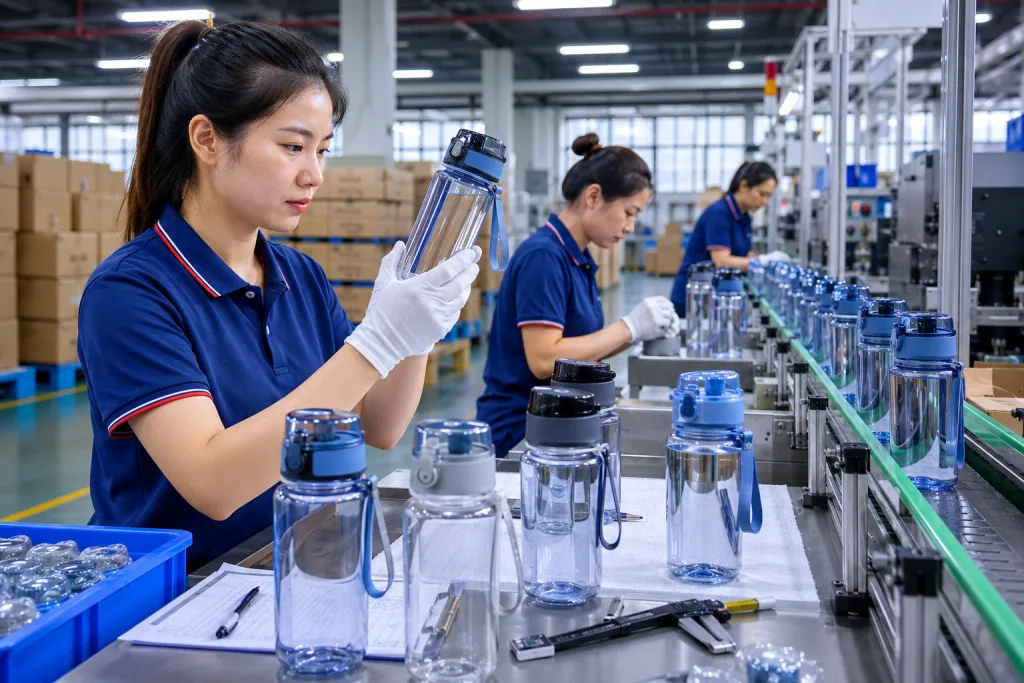
Key Takeaways
- A practical pp tritan bottle wholesale MOQ is usually 3,000 units per color for stock molds and 10,000 units for custom colors
- Tritan bodies and PP lids need separate food-contact checks for FDA, LFGB, EU 10/2011, and REACH where applicable
- Typical FOB Ningbo pricing runs about USD 1.20-2.80 for 500-1,000 ml stock-mold bottles before custom packaging
- Allow 7-10 days for samples and 30-45 days for mass production after artwork and deposit approval
If you are buying pp tritan bottle wholesale for a retail launch, corporate program, or distributor catalog, finding a supplier is the easy part. The real work is locking a spec that survives 1.2 m drop tests, sea freight, price cuts, and the second PO. Samples lie. QC pulled one 650 ml bottle last month with a 1.15 mm side wall, clean photos, and a cap that leaked after 40 tilt cycles; the buyer had only asked for “same as sample,” which is the wrong question to ask.
From our factory in Hangzhou, Zhejiang, we quote about 35 drinkware buyers a month comparing Tritan sports bottles with PP lids, bulk canteen programs, drinkware wholesale lines, and sometimes beer growler wholesale bulk projects in the same sourcing week. China can run all of these, but the math changes by mold set, resin grade, FDA or LFGB test plan, carton drop layout, and MOQ. For a 20 oz Tritan bottle, we run different cap torque checks than a growler project; the line uses a torque meter, not guesswork, and one PO typo like “PP body” instead of “PP lid” can send the whole quote sideways.
Start With The Bottle Use Case
Before asking for a pp tritan bottle wholesale quote, pin down what the bottle has to survive in the buyer’s hand. Tritan is a copolyester we run when the order needs glass-like clarity, impact resistance, and a BPA-free claim without glass breakage. PP is the workhorse for lids, straws, push buttons, flip caps, handles, and inner seals because it molds cleanly and keeps the BOM under control. On our line, a PP flip-cap mold with 0.8 mm gate size will show stress whitening fast if the resin choice is wrong.
For a gym bottle, the hard points are one-hand opening, leak resistance after 3,000 open-close cycles, and a 650 ml or 750 ml capacity. For kids’ retail, we look at 350-500 ml sizes, ASTM or CPSIA thinking for North America, plus colorants that pass heavy metal limits. For outdoor canteen wholesale, the buyer usually asks for a wider carry handle and 1,000 ml capacity; matte finish sounds simple, but QC pulled one sample last month with uneven frosting around the shoulder. Promo orders are different. Price and print area drive most decisions, and a 45 x 80 mm logo window can matter more than a fancy lid.
Do not put every product into one RFQ. A wholesale canteen, a bulk growler, a beer tumbler in bulk, and an alcohol flask wholesale item are separate projects, even if they sit in the same drinkware aisle. Tritan is the wrong material for hot beer tumblers or vacuum growlers. Stainless steel fits beer growler wholesale, beer tumbler wholesale bulk, and alcohol flask wholesale bulk because those products need heat retention, pressure tolerance, or alcohol compatibility. Tritan fits clear, lightweight cold-water bottles. We have seen this go sideways when a PO says “Tritan growler” in one line and “keep beer cold 12 hours” in the next.
A good China supplier should push back on the use case. If you ask for a 1.5 L Tritan bottle with a thin wall, a low price, and a long shoulder strap, the math does not work. We normally recommend 1.6-2.2 mm body wall thickness for common Tritan sports bottles, depending on shape and capacity. Below that, drop-test failure and deformation during packing become more likely. In carton testing, a 0.9 mm sample looked fine on the table, then dented after a 12 kg stack load for 24 hours.
Materials And Compliance Details
Tritan and PP get sold as “safe plastic,” but that wording is too soft for a purchase file. Ask for the resin grade, the exact food-contact test scope, and the destination market before you approve the sample. For North America, we see buyers ask for FDA food-contact compliance plus BPA-free documentation on almost every PO. For Europe, the file usually needs LFGB, EU 10/2011 migration testing, REACH, and retailer screening for heavy metals or phthalates when the bottle goes into supermarkets. Last month QC pulled a 650 ml Tritan sample because the test report named only the raw pellet supplier, not the finished bottle item code.
Ask the factory to name every food-contact component. The body may be Tritan, while the lid can be PP with a silicone gasket, a TPE bite valve, POM spring parts, stainless pins, or printed ink touching the rim. If the test only covers the clear body, your compliance file has a hole. We have seen this go sideways when an Amazon buyer flagged a missing gasket report 4 months after delivery, with 12 cartons still sitting in FBA review. Retail chains and online marketplaces do not care that “the main material passed.” They check the assembled bottle.
Color is where buyers underestimate the work. Transparent Tritan and opaque PP behave differently on the line, especially when the color masterbatch affects clarity, odor, migration results, or MOQ. A stock transparent body with a custom PP lid color is easier than a custom translucent body color because we can run the lid on a 1.5 kg color trial before committing resin. At our Zhejiang facility, stock mold projects usually start from 3,000 units per color. Custom resin colors normally make sense at 10,000 units or more because 18–25 kg of resin and masterbatch loss is real scrap, not a negotiation trick.
Be careful with recycled content claims. Brand owners ask for sustainable bulk drinkware more often now, but food-contact recycled plastic approval is not automatic. If your launch depends on recycled Tritan or recycled PP, write the claim into the RFQ and ask for documentation before sampling. The wrong question is “can you make it eco-friendly?” Ask which certificate supports the exact recycled resin percentage on the label. We once caught a packaging draft that said “50% recycled PP” while the PO only listed standard PP, and the math did not work for retail compliance.
Practical rule: test the final assembled bottle, not just the raw material. The lid, gasket, logo ink, and straw are where we find most compliance surprises during pre-shipment checks.
MOQ, Pricing, And Tooling Reality
For pp tritan bottle wholesale, MOQ depends on mold status, color, decoration, packaging, and how much the order slows the line. Stock molds move fastest. For a 500-1,000 ml Tritan bottle with PP cap, we run a practical MOQ of 3,000 units per color with one-color silkscreen or simple pad print; QC usually checks logo position with a 0.5 mm tolerance gauge before bulk printing. If you ask for custom Pantone body color, private mold lid, retail box, and barcode labels, the workable MOQ moves closer to 10,000-20,000 units.
FOB Ningbo pricing for a stock-mold Tritan bottle usually sits around USD 1.20-2.80 per unit, based on capacity, cap structure, silicone parts, print process, and packaging. A simple 600 ml bottle with one-color logo and polybag may land near the low end. A 1,000 ml bottle with lockable flip cap, time markings, silicone sleeve, custom color box, and carton drop-test requirement will not. The math changes fast when the buyer adds a 5-layer export carton and asks us to pass a 76 cm drop test on all six faces.
Tooling is where 8 out of 10 new buyers underestimate cost. A small logo insert or minor lid texture change may be cheap, but a new body mold can cost USD 6,000-18,000 depending on cavities and complexity. A private cap mold can add USD 3,000-10,000. If your forecast is only 5,000 units, this is the wrong question to ask; use a stock mold and spend the budget on color, logo, and packaging control. We have seen this go sideways when a buyer approved a 2-cavity mold, then pushed for a 12-day delivery window after sample approval.
Buyers sometimes send one RFQ with terms like canteen bulk, canteen wholesale, drinkware bulk, growler bulk, wholesale growler, and best wholesale drink bottle. That tells the factory you are still sorting the assortment. Split the RFQ into product families: Tritan water bottles with ml capacity, stainless canteens with wall thickness, beer growler bulk with lid type, beer tumbler bulk with finish, and alcohol flask in bulk with packaging style. Cleaner quotes come back. Last month the buyer flagged a PO typo where “Tritan 750 ml” became “PP 750 ml,” and that one line would have changed resin cost, mold choice, and FDA file checking.
Our Hangzhou, Zhejiang production line can handle about 450,000 plastic drinkware units per month across injection, assembly, printing, and packing. That does not mean every order can ship tomorrow. Capacity depends on mold availability, print workload, and whether your packaging supplier delivers on time. We ship faster when the 128 g preform bin, PP cap components, and color-box cartons arrive before the injection schedule is locked; if the box supplier slips by 6 days, a promised 12-day shipment becomes 18 days.
Logo, Packaging, And Retail Readiness
Decoration choice affects cost and scrap rate. For Tritan bottles, we run silkscreen for bold one- or two-color logos, usually after a 3M tape pull on the first 20 printed samples. Heat transfer is better for a 180 mm wrap graphic, but the line still needs curve testing and a 500-cycle rub check. Laser engraving belongs on stainless steel, not clear Tritan bodies. UV printing can look clean, but QC pulled samples after dishwashing simulation last month and found edge lift on 3 of 32 bottles.
For a pp tritan bottle wholesale order, we ask for AI or PDF vector artwork, Pantone references, print size in millimeters, and logo position on a flat or low-curve area. Simple files save days. If the logo crosses a deep curve or grip texture, the buyer will see distortion, not “premium branding.” A 50 mm wide logo may look fine on the drawing and bad on the actual bottle if the body narrows near the waist; we have seen a PO typo list 50 cm, and that stopped artwork approval for 2 days.
Packaging should match the sales channel. Distributor bulk cartons may only need an OPP bag, divider, and export master carton. Retail drinkware wholesale programs need color boxes, hang tags, UPC or EAN labels, warning text, and sometimes multilingual instructions with the font no smaller than 6 pt. For online fulfillment, we ship individual drop-test packaging, suffocation warnings, FNSKU labels, carton weight under 15 kg, and outer carton barcodes. The buyer flagged this twice in 2024 because the FNSKU was on the color box bottom instead of the scannable side panel.
Carton design is not decoration. It is risk control. A typical 750 ml Tritan bottle may pack 24 or 48 units per master carton depending on box size. We usually target five-layer export cartons with 175-200 lb burst strength or equivalent edge crush performance for heavier loads, and our packing team checks carton length, width, and height with a tape measure before sealing the pre-production carton. For Amazon-style shipments, test one packed carton before mass production. Arguing after 18 cartons arrive crushed is the wrong way to save 12 days.
If your assortment includes beer tumbler wholesale, beer growler in bulk, or alcohol flask bulk alongside Tritan bottles, do not force one packaging rule across all items. The math doesn't work. Stainless items are heavier, often need scratch protection, and may require different carton weight limits, so we add PE bags or paper sleeves before the divider test. Plastic bottles need more attention to deformation, cap rub marks, and dust control; QC once rejected 7 cartons because black specks showed under the clear Tritan shoulder after final packing.
Quality Control Before Shipment
Write the QC clause for pp tritan bottle wholesale before the deposit leaves your account. Once 50,000 bottles are packed, the math doesn't work in your favor: rework takes 12 days, air freight quotes arrive in 18 hours, and everyone starts pushing for “ship first, solve later.” We run the golden sample with a digital caliper, Pantone card, 500 ml fill line gauge, and torque tester on the cap before mass production starts. At minimum, lock the approved sample, PP/Tritan material grade, capacity tolerance, color tolerance, logo position in mm, leak test method, drop test condition, carton test, plus AQL inspection level.
For general drinkware wholesale orders, 7 out of 10 import buyers we work with use ANSI/ASQ Z1.4 with General Inspection Level II. A common AQL setting is 0.0 for critical defects, 2.5 for major defects, and 4.0 for minor defects. Critical defects mean unsafe sharp edges, foreign material inside the bottle, failed food-contact claims, or severe leakage; QC pulled one sample last March with a 6 mm plastic shaving stuck under the straw valve. Major defects mean wrong logo, cracked cap, poor assembly, severe color mismatch, or bottle deformation. Minor defects are small scuffs, slight print dots, or packaging wrinkles inside the signed limit.
Leak testing has to copy real use. A bottle that passes upright water filling can still leak upside down in a school bag, and buyers flag that fast. We test filled bottles inverted for 30 minutes, shake them 20 times, then check cap threads, straw holes, air vents, and silicone gaskets with dry tissue. For flip caps, we cycle the spring and lock 200 times on the line. A cheap PP hinge can pass once, then split at the pin after 200 cycles.
Drop testing needs fixed conditions: filled or empty, height, angle, surface, and temperature. Our normal internal check is a 1.0 m drop on base, side, and cap at room temperature, using a concrete floor beside the packing line. For retail packaging, carton drop testing can follow ISTA-style thinking, even if you do not run a formal certified ISTA test. If the order ships to cold regions in Europe or North America, ask for a low-temperature check at -10°C; we have seen Tritan bodies survive while PP lids turn brittle.
Pre-shipment inspection should happen when at least 80% of goods are packed and 100% are produced. For a first China order with a supplier, use a third-party inspector or require video inspection with random carton opening, not the 6 “best-looking” cartons near the office door. QC should record carton numbers, pull bottles from the top and bottom layers, and compare the PO; one buyer once typed “matte black lid” on the PO while the artwork showed a clear lid. Video is not a replacement for AQL, but it beats final photos taken under factory showroom lights.
Lead Time And Shipping Planning
A normal pp tritan bottle wholesale timeline is simple on paper, but the line still needs tight control. For stock molds, we run 3-5 days for quotation and artwork confirmation, 7-10 days for pre-production samples, and 30-45 days for mass production after deposit and sample approval. Add 3-7 days if custom color matching is needed; our color room checks the chip under a D65 light box before we cut the sample. Add another 5-12 days if your retail box has legal copy, warning labels, or a brand team that keeps changing the barcode position by 2 mm.
For sea freight, FOB Ningbo or FOB Shanghai are common terms from Zhejiang and nearby China manufacturing zones. From Hangzhou, Ningbo usually makes better sense because the truck can reach the warehouse in about 3.5 hours, while Shanghai can lose half a day at the gate during peak weeks. For urgent launches, air freight works for sample sets or 20-50 cartons of replenishment stock. Full cartons of low-price drinkware bulk are another story. The math doesn't work once chargeable weight hits 300 kg and the buyer still expects retail margin.
Plan around Chinese holidays. Chinese New Year can disrupt production for 3-5 weeks including worker return time; after the break, QC pulled the sample more than once because the first returned shift set the injection temperature 8°C off the approved setting. Golden Week in October also creates pressure. If you need goods on shelf in April, do not approve samples in late January and expect a clean shipment. We have seen this go sideways. Serious procurement managers place spring orders before the holiday or accept a later delivery window.
Payment terms also affect timing. A common first-order structure is 30% deposit and 70% balance before shipment after inspection. Established buyers may negotiate better terms after 3-4 successful orders, but most factories will not finance a new buyer’s private label launch without history. Last month, a buyer flagged this as “too strict,” then sent a PO with the factory name misspelled and no consignee address. If a supplier offers unusually loose terms, check whether the cost is hidden in unit price or material shortcuts.
For mixed container projects, split the production schedule by category. Tritan bottles and wholesale canteen SKUs may run in one workshop, while beer growler wholesale items and alcohol flask wholesale products often come from stainless steel lines or partner factories. Consolidation saves freight, but it can hold the whole shipment if one SKU is late. Use a packing list with SKU, carton size, gross weight, net weight, and barcode requirements before booking the vessel; our shipping clerk checks carton marks against the final PI because one wrong EAN code can stop 800 cartons at the buyer’s DC.
Send Your Bottle Spec For A Factory Quote
Share capacity, lid style, logo method, target market, MOQ, and delivery date. We will reply with practical China factory options.
Frequently asked questions
What MOQ should I expect for pp tritan bottle wholesale?
For stock molds, 3,000 units per color is a realistic MOQ for many pp tritan bottle wholesale programs. If you need a custom Pantone body color, private lid color, retail box, or special silicone sleeve, expect 10,000 units or more. Full private molds usually make sense only when your forecast reaches 20,000-50,000 units across the first year. Smaller orders are possible sometimes, but the unit price rises because resin setup, printing setup, carton purchasing, and QC time do not shrink in proportion.
Is Tritan better than PP for wholesale drinkware?
Tritan and PP solve different problems. Tritan is better for clear bottle bodies because it has higher clarity, better impact resistance, and a more premium shelf look than standard PP. PP is better for caps, hinges, handles, straws, and internal parts because it is flexible, cost-effective, and reliable in injection molding. A common structure is Tritan body plus PP lid plus silicone gasket. If your product is a low-cost promotional bottle, full PP may work. If you want retail-grade wholesale drinkware, Tritan usually presents better.
What tests do I need for Europe and North America?
For North America, ask for FDA food-contact support and BPA-free documentation. For Europe, ask about LFGB, EU 10/2011 migration, REACH, and relevant heavy metal checks. If the bottle is for children, add CPSIA or ASTM-related review depending on age grading and market. Test the finished bottle assembly, not only the Tritan resin. The PP cap, silicone gasket, printing ink, straw, and any metal pin may also contact the user or liquid. Budget 7-14 working days for third-party lab testing after samples are ready.
Can I combine Tritan bottles with canteen or growler orders?
Yes, but treat them as separate SKUs with separate specifications. A Tritan sports bottle, wholesale canteen, bulk growler, beer growler wholesale, and alcohol flask wholesale order may involve different materials, molds, factories, and tests. Consolidating under one shipment can reduce freight cost, especially for distributors building a broad bulk drinkware catalog. The risk is timing. If the stainless growler bulk item is delayed by polishing or vacuum testing, your Tritan bottle shipment may wait unless you split bookings.
How long does a private label order take?
For a stock-mold private label pp tritan bottle wholesale order, plan on 7-10 days for samples and 30-45 days for mass production after approval. Custom color matching can add 3-7 days. New tooling may add 25-45 days before production starts, depending on mold complexity and trial revisions. Sea freight to Europe or North America usually adds 25-45 days port to port, plus customs and inland delivery. For a seasonal launch, build a 2-3 week buffer instead of relying on the best-case schedule.