Key Takeaways
- Typical MOQ is 3,000 pieces per color for stock molds and 10,000 pieces for new private molds
- Tritan bodies cost more than PP but give better clarity, impact resistance, and retail shelf appeal
- Plan 25-35 days for production after sample approval, plus 7-10 days for pre-production sampling
- Ask for LFGB, FDA, REACH, and AQL inspection terms before paying the 30% deposit
If you are sourcing a pp tritan bottle custom project, bottle shape is the easy part. The hard work starts after your sales team has shown the sample to a retail buyer: resin proof, cap torque, leak rate, logo rub test, color ΔE, and the ship date all get locked in fast. We had QC pull 32 pcs from a 3,000 pc pre-production run last month because one flip lid leaked at 45 kPa on the pressure tester.
From our Hangzhou, Zhejiang factory, we see 8 out of 10 new B2B buyers ask for unit price before they define the bottle. That is the wrong question to ask. PP body vs Tritan body, lid resin, straw material, carton spec, test standard, and Incoterm can move the price by 15-35%, and the math gets worse when the buyer later adds LFGB or a 1.2 m drop test. If you want customized drinkware shipping cleanly into Europe or North America, send a tighter brief before asking any canteen supplier in China for a quote; the line cannot fix a vague PO after cartons are already marked 24 pcs/ctn.
Define the bottle before pricing
A pp tritan bottle custom inquiry should start with a spec sheet, not a trade-show photo shot under blue booth lights. PP and Tritan are often put in the same sentence, but they are not doing the same work. Tritan usually goes on the clear body: glass-like clarity, good drop strength, no BPA. PP is the workhorse for lids, handles, inner caps, push buttons, and opaque bodies when the buyer says, “Nice bottle, but the math doesn’t work.” On our line, QC checks Tritan clarity against a 2 mm sample card before we approve the first injection run.
For a quotation we can stand behind, define capacity, wall thickness, lid style, mouth diameter, gasket material, logo process, carton requirement, and target market. Better yet, send a simple table. A 650 ml bottle with a 2.2 mm Tritan wall, PP flip lid, silicone seal, and one-color screen print is not the same job as a 750 ml bottle with a carry loop, straw, gradient spray, and retail gift box. Last month the buyer flagged a 3 mm mouth-diameter mismatch after sampling; that small miss changed the straw mold insert and cost us 4 days.
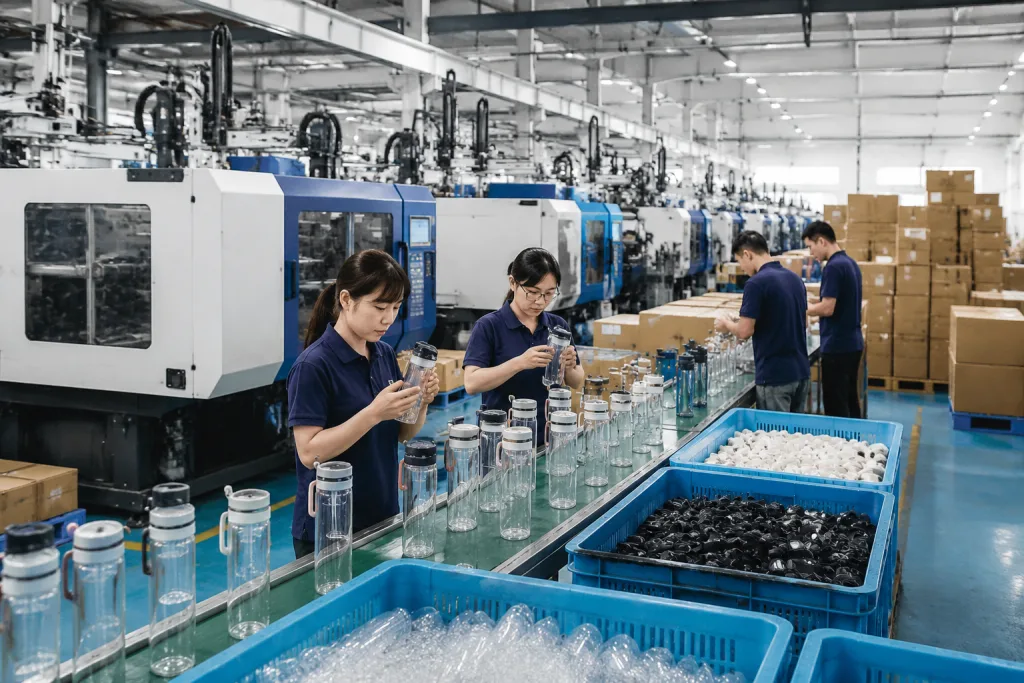
Most stock-mold projects from our Zhejiang line start at 3,000 pieces per color. New cap tooling or a private body mold usually needs 10,000-20,000 pieces to make sense because mold cost, testing, and color trials take real machine time. We run color chips on the injection machine before mass production, then QC pulled the sample for lid torque and leak testing at 30 minutes inverted. Our current monthly output for plastic drinkware and mixed custom drinkware programs is about 420,000 units, but capacity does not fix a vague brief.
If you are a canteen distributor or distributor drinkware buyer, send your price target with the specification. This is the wrong question to ask: “What is your best price?” A serious canteen manufacturer can adjust resin grade, mold choice, packaging, or decoration once we know the ceiling, without pretending every request fits a USD 1.20 FOB price. We have seen this go sideways when a PO says “Trian” instead of Tritan and the buyer expects clear material at PP pricing.
PP versus Tritan in practice
Buyers ask us every week whether PP or Tritan is “better.” Wrong question. Ask where the material sits in the canteen design. We run Tritan for clear sports bottles and school bottles where the buyer wants to see the water line through a 2.2-2.8 mm wall; it looks cleaner on shelf than cloudy plastic. PP earns its place in flip hinges, lid shells, and colored parts because it takes pigment well and keeps the hinge from cracking after drop testing.
For a 600-750 ml bottle, the structure we quote most for North American and European promo orders is a Tritan body with a PP lid. Simple and safe. A full PP bottle may reduce FOB cost by roughly USD 0.18-0.45 per unit depending on weight, but the math doesn't work if the buyer expects a premium retail look. Last month a buyer flagged a PP sample as “too milky” under a 6500K light box. If your channel is gym retail with barcode packaging or branded employee kits packed 24 pcs per carton, Tritan sells better. For low-cost canteen giveaways at 5,000 pcs MOQ, PP is often enough.
Temperature claims need discipline. Tritan bottles are sold for cold or warm drinks, not boiling water. We had 3 buyers this quarter ask to print 100°C on the carton because it looks strong; we pushed back. Do not print that unless the full assembly, including lid, straw, gasket, and decoration, has passed the correct test. QC pulled one sample after a PP lid lip curled 0.6 mm in hot-fill checking, while the Tritan body still looked fine.
For Europe, ask your canteen factory for LFGB food-contact testing. For the United States, ask for FDA food-contact compliance and, when relevant, California Proposition 65 screening. For kids bottles, discuss ASTM F963 and small-part risk before the mold drawing is signed; once the PP push button is 18 mm wide, changing it later costs time. China factories can arrange these tests, but budget 5-10 working days and several hundred USD per material color if a fresh report is required. We have seen this go sideways when the PO says “blue lid” and the approved sample is actually Pantone 2925C.
Logo and color choices that survive use
Customizable drinkware usually gets rejected for decoration, not the bottle mold. We’ve had buyers approve a clean counter sample, then six weeks later QC pulled the arrival sample and found the logo scuffed after carton rub and dishwasher testing. For pp tritan bottle custom orders, choose the print method around the body curve, surface gloss, wall thickness, color, and the way the bottle will be used.
Silkscreen printing is our standard choice for simple logos on smooth bottle bodies. It is cost-effective at 3,000 pieces and works best for 1–2 solid colors; once a buyer asks for 3 colors plus a tight registration mark, the math gets weaker. Heat transfer gives a larger image area and cleaner gradients, but it costs more and needs a flat application zone, usually at least 45 mm wide on the line fixture. UV printing handles detailed artwork and shorter runs, but we run adhesion tests on the exact resin and coating before quoting bulk. Laser engraving belongs on stainless steel, not clear Tritan bodies. Don’t force it.
For color, use Pantone references and agree on tolerance before the PO is issued. Plastic resin, wall thickness, and surface texture shift the final shade; a 2.5 mm wall can look deeper than a 1.8 mm wall even with the same masterbatch. We normally ask for Delta E tolerance or an approved physical color chip for serious retail orders, because “match our website blue” is the wrong instruction for a molding shop. If you are building a canteen customized program with seasonal colors, keep the lid and body color system simple. Every extra custom color adds resin cleaning time, 8–15 kg of purge waste, and possible delay.
Packaging also affects decoration quality. Bulk cartons are cheaper, but bottles can rub for 28–35 days during ocean freight, and that is where glossy prints get exposed. For retail or distributor growler-style premium lines, we ship polybags, paper sleeves, or separated inner cartons; the buyer flagged sleeve cost once, then accepted it after seeing black rub marks on 12 of 80 samples. A USD 0.04 packing upgrade can prevent a USD 0.40 complaint later.
MOQ, tooling, and sample timing
MOQ is not a punishment from a canteen vendor. It is production math. We run the injection line through mold setup, 80-90°C Tritan resin drying, color-change purging, pad-printing jig adjustment, and carton packing setup before one sellable bottle comes off the belt. Ask 5 canteen vendors for 500 pieces in 6 colors with a custom cap, and the quote gets ugly because the fixed cost is sitting on too few units. The math doesn't work.
For stock molds, a realistic MOQ is 3,000 pieces per color, or sometimes 5,000 pieces when the bottle uses special color matching, spray coating, or multi-part lids. For a private mold, start the discussion at 10,000 pieces and expect tooling cost from roughly USD 2,500 to USD 8,000 for a body and lid set, depending on cavity count and complexity. A wide-mouth bottle with flip straw, locking button, and handle needs more mold work than a simple screw lid; our tool room will check the 2D drawing for undercuts, parting line position, and lid gasket groove depth before quoting.
Sampling has two phases. A logo sample from a stock bottle may take 7-10 days after artwork confirmation. A new mold sample can take 25-35 days before you see the first T1 sample, then another 7-15 days for corrections. QC pulled one T1 Tritan sample last month with a 0.4 mm mismatch at the cap thread, so we cut the steel again before sending photos to the buyer. Production after signed sample approval normally takes 25-35 days for 3,000-20,000 pieces, assuming no third-party test failure and no late carton artwork change.
For FOB Ningbo or FOB Shanghai shipments from Zhejiang, allow time for export carton production and container booking. We ship from Hangzhou to Ningbo in about 1 day by truck, but carton printing can add 3-5 days if the PO has a typo in the barcode or color name. China logistics is efficient, but peak season still matters. If your retail launch date is fixed, reverse-plan from warehouse arrival, not factory finish date.
Quality control buyers should specify
A professional canteen supplier should raise AQL before the first deposit, not after 3 cartons come back with complaints. Put the inspection terms on the PO, right next to artwork version and carton mark; we once had a buyer send “AQL 25” by typo, and QC pulled the sample before production because the math made no sense. For most custom drinkware programs, we suggest AQL 2.5 for major defects and AQL 4.0 for minor defects, with critical defects at zero tolerance. Critical defects include sharp edges, leakage, broken caps, contamination, wrong resin, or unsafe small parts.
Leak testing gets underestimated. A bottle can pass a 30-second upright fill test and still wet a laptop sleeve after 18 minutes sideways in a gym bag. For flip lids and straw lids, we run negative pressure checks at -20 kPa, upside-down standing checks for 4 hours, plus random carton drop checks from 76 cm. If your product is sold as leakproof, define the test condition: water volume, time, angle, and temperature. Without that, “leakproof” is a label claim, not an inspection standard.
For canteen manufacturers in China, traceability should include resin batch, production date, injection machine record, assembly shift, and inspection report. Ask for photos of incoming resin labels and retained production samples; our line keeps 2 sealed samples per color for 12 months in the QC room. This is not excessive. It is basic protection if a distributor canteen order later has a field issue and the buyer flags odor, cracking, or a wrong resin concern.
Retail customers also care about odor. New plastic can smell after molding and packing, especially when cartons are sealed within 2 hours of assembly. We recommend 24 hours of ventilation before final packing for sensitive orders; for PP lids with silicone straws, QC checks odor after the bottle sits closed overnight. For baby, kids, or wellness channels, add a sensory check and dishwasher-cycle test if you plan to make that claim on packaging. We have seen this go sideways when marketing prints “dishwasher safe” before the test report is back.
How distributors should compare suppliers
Too many canteen distributors put 6 quotes into Excel and pick the lowest FOB line. For a plain stock bottle, fine. For a canteen customizable program with 4–8 SKUs, the math doesn't work. Compare the cost of the whole order: sample lead time, artwork revision count, test report age, defect rate, carton burst strength, spare lid policy, and how fast the merchandiser answers a marked-up PDF. We had one buyer save USD 0.06 per unit, then lose 12 days because the logo film was made from a 72 dpi JPG.
A real canteen factory knows its mold list, machine tonnage, cavity count, and daily output without checking for 30 minutes. Ask directly. Is the body blown, injected, or injection-stretch blown? If the supplier cannot answer, slow down. On a pp tritan bottle custom program, that route decides whether the wall holds 1.2 mm evenly, whether the bottle stays clear after polishing, and whether tooling is a USD 900 insert job or a full private mold. On our line, QC pulled the sample once because the shoulder was 0.35 mm thinner than the approved drawing.
Check the audit position before you talk price too hard. BSCI, ISO 9001, and Sedex-style social audit readiness are not magic stamps; they show whether the factory has dealt with Western retail files, worker-hour records, and CAP follow-up. For Europe, REACH and LFGB experience matters. For North America, FDA, Prop 65, CPSIA, and ASTM wording depends on the bottle category. We once had a PO typo list “LFGB lid only,” and the buyer flagged it during document review because the straw also touched water.
Ask who owns the mold. Put it in the contract if you pay for private tooling: exclusivity, storage location, maintenance cost, and what happens after 24 months of no orders. A solid canteen manufacturer writes this down, with the mold number etched on the base plate and photos before shipment of the first batch. A weak vendor says, do not worry. Worry. We've seen this go sideways when a distributor found its “exclusive” cap on a competitor's Amazon listing 7 months later.
Build a cleaner RFQ package
The fastest pricing comes from a clean RFQ package. Send capacity in ml, target height and diameter in mm, material choice, lid drawing or reference photo, logo file, Pantone code, packing method, test requirement, quantity split by color, delivery date, and shipping term. Our costing clerk will ask for these anyway; missing one item can add 12 hours to the quote. If you want a custom growler, customizable growler, or customized growler in plastic rather than stainless steel, state the use clearly: cold water refill, beer-style promo with no pressure claim, or outdoor refill program with carabiner packaging. Different claim, different risk. We saw one PO write “Tritan PP bottle” on line 3, and QC pulled the sample because the body and lid materials were mixed in the spec.
For a first order, keep the range tight. Three body colors, one lid color, and one logo process are manageable on the line; eight colors with three decorations is where the math doesn't work for a 5,000-piece trial. Color changeover on our injection machine takes about 45 minutes, and pad-print ink matching can eat another half day if the Pantone chip is only sent as a screen photo. Prove sell-through first, then add SKUs. This matters for distributor drinkware buyers holding inventory across 4 or 6 countries, where one slow color can sit in the warehouse for 90 days.
Payment is usually 30% deposit and 70% before shipment after inspection for standard export orders from China. For long-term canteen suppliers, staged payments are possible, but open account on the first PO is the wrong question to ask. If you need Amazon FBA prep, FNSKU labels, carton weight under 15 kg, or drop-test cartons, put it in the RFQ before quoting. We ship different cartons for FBA than for palletized distributor orders, and a 32 ECT carton that passed local trucking once failed a 76 cm corner drop in inspection. Packing labor changes too.
At BottleForge Industrial in Hangzhou, Zhejiang, we prefer buyers who are direct about budget and risk. If your target is USD 1.60 FOB for 5,000 pieces, say it. We can price around a stock mold, PP lid, one-color print, and bulk carton without pretending it is a premium retail bottle. If your target is premium retail, we will push for a heavier Tritan wall, stronger cap hinge, individual box, and third-party LFGB or FDA testing before mass production. We've seen this go sideways when a buyer approved a 2.1 mm wall sample, then asked for a 1.7 mm wall after tooling to save freight.
Send your bottle brief for a practical factory quote
Share quantity, logo, material, market, and deadline. We will return a realistic FOB China quote with MOQ, sample timing, and testing notes.
Frequently asked questions
What is the normal MOQ for a pp tritan bottle custom order?
For stock molds, plan on 3,000 pieces per color. If you need a special Pantone body, custom lid color, or heat-transfer artwork, 5,000 pieces is more realistic. For a new private mold, most canteen manufacturers will ask for 10,000-20,000 pieces because tooling, resin trials, and machine setup take time. BottleForge usually quotes logo samples within 7-10 days for stock molds, then 25-35 days for mass production after sample approval. Smaller orders are possible only when the design uses existing resin colors and a standard logo process.
Is Tritan always better than PP for custom drinkware?
No. Tritan is better when you need clarity, premium appearance, and strong impact resistance for a transparent bottle body. PP is better for lids, hinges, handles, and lower-cost opaque bodies. A common construction is a Tritan body with PP lid and silicone gasket. Compared with a full PP bottle, this may add roughly USD 0.18-0.45 per unit, depending on weight and design. For retail shelves, gyms, schools, and branded employee kits, Tritan often justifies the cost. For basic canteen promotional giveaways, PP can be the smarter choice.
Which tests should I request for Europe and North America?
For Europe, ask for LFGB food-contact testing and REACH screening where applicable. For the United States, ask for FDA food-contact compliance and Prop 65 assessment if selling into California. Kids bottles may require CPSIA and ASTM F963 review, especially if there are straws, bite valves, small parts, or character accessories. Do not rely on one old generic report for every color and part. A fresh third-party test normally takes 5-10 working days. Put the exact standard, sample quantity, and pass requirement into the PO before the 30% deposit.
How should a distributor compare canteen suppliers beyond price?
Compare the full supply risk, not only FOB cost. Ask each canteen supplier for MOQ, production lead time, mold ownership terms, AQL level, test report validity, carton specification, and defect handling policy. A quote that is USD 0.08 cheaper can become expensive if cartons collapse, logos scratch, or caps leak. Good canteen vendors can explain resin grade, lid structure, machine process, and inspection method without guessing. For distributor drinkware programs, also check whether the factory can support barcode labels, mixed cartons, FNSKU labels, and repeat color consistency over several POs.
Can I use the same factory for custom canteen and custom growler projects?
Sometimes, but check the material and production process. A factory strong in plastic pp tritan bottle custom work may not be strong in stainless steel vacuum growlers, and the reverse is also true. If your custom growler is plastic for cold beverage promotions, the same canteen factory may handle it. If it is vacuum insulated stainless steel, you need welding, vacuum testing, copper coating, and powder coating capability. For a mixed customized drinkware program, ask for separate QC plans, because plastic bottle leakage tests and stainless growler insulation tests are completely different.