Key Takeaways
- A realistic MOQ for customized thermos flasks is 1,000 units per SKU, not 100 units with full custom tooling
- 304 stainless steel plus food-grade PP and silicone is the normal baseline for EU and North American buyers
- Lead time is usually 25-35 days after artwork approval for repeat orders, 40-55 days for new custom thermos projects
- AQL 2.5/4.0 inspection should cover vacuum performance, lid leakage, coating adhesion, logo position, and carton drop results
If you are searching for a pp thermos flask supplier, you are probably not asking for a plastic bottle. In sourcing calls, 8 out of 10 buyers mean a stainless vacuum flask with food-grade PP parts: lid, stopper, handle, tea filter frame, or cup liner. That detail decides the order. The steel body usually passes; the trouble starts at the PP thread, gasket compression, stopper fit, and odor after the 60°C hot-water soak test. QC pulled one sample last month where the lid looked fine, but the caliper showed a 0.35 mm thread mismatch, and the buyer flagged leakage after 12 hours in the carton.
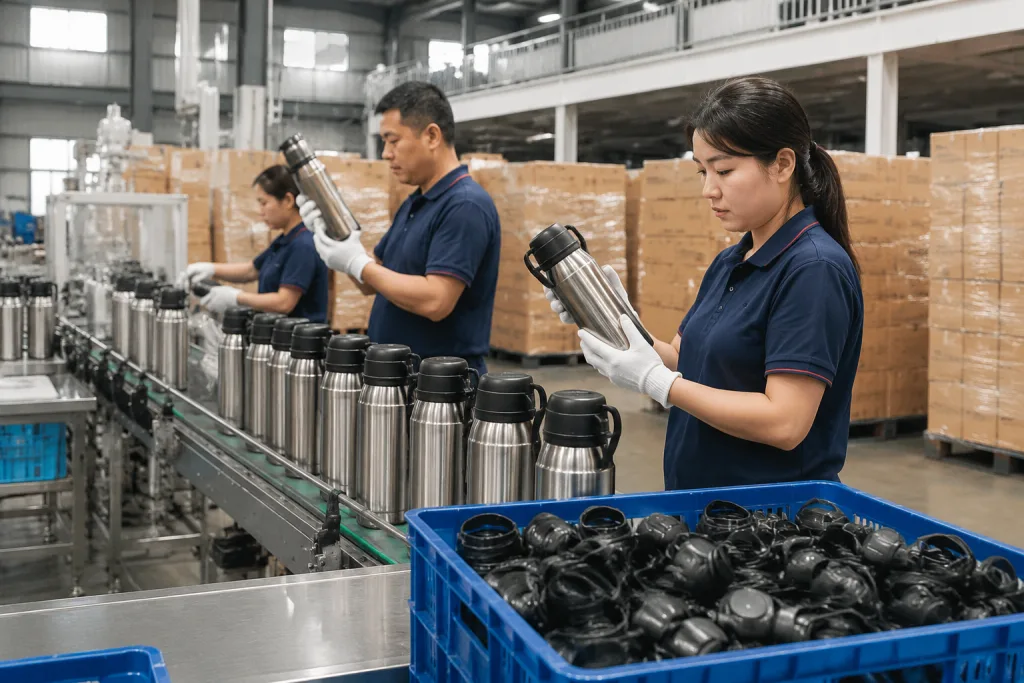
BottleForge Industrial is based in Hangzhou, Zhejiang, China, and we run custom stainless thermos programs for outdoor retailers and promotional brands. Our view is simple: asking for a nice mockup first is the wrong question to ask. A solid supplier thermos project starts with material specs, test methods, carton planning, and decoration limits, then artwork. On the line, we check 304 stainless body thickness, PP lid fit, silicone gasket seating, and carton drop direction before mass packing. Our factory thermos capacity is 450,000 units/month, with typical MOQ from 1,000 units per SKU.
What PP means in thermos sourcing
If a buyer writes pp thermos flask supplier on the RFQ, we ask this first: which component is PP? In thermos sourcing, PP usually means the lid set, not the vacuum body. We run PP on push-button stoppers, carry handles, inner cup shells, straw adapters, and tea infuser frames; last month QC pulled 18 lid samples and 11 were PP-heavy designs. The bottle body should still be 304 stainless steel for most outdoor and promotional thermos programs. For higher chloride exposure or marine use, 316 stainless can be quoted, but the math rarely works for a 3,000 pcs retail run.
PP gets chosen because it is light, easy to mold, stable enough with hot water, and cheaper than Tritan or stainless lid structures. Still, PP grade matters. We have seen low-grade PP smell after a 95°C hot-fill test, warp 0.8 mm around a steam vent, and turn white around a 2.5 mm hinge pin after drop testing. If your bulk thermos will be sold in Europe or North America, ask the thermos supplier for food-contact declarations, migration test history, and the actual resin grade on the material sheet. “Food grade” alone is the wrong answer to accept.
For a practical stainless thermos custom order, we specify 0.4-0.5 mm inner 304 stainless, 0.5 mm outer 304 stainless, food-grade PP lid parts, and LFGB/FDA-compliant silicone gaskets. Wall thickness can vary by capacity and body shape, but going too thin creates dents during shipping and weaker vacuum yield; we have rejected cartons after finding 6 dented bottles in a 50 pcs drop-test lot. For outdoor retailers, we check one-hand opening force with a 3 kg pull gauge and test glove use on the line. Promotional brands should put more attention on logo area flatness, color repeatability, and whether the master carton survives 12 days of mixed truck and sea handling.
A cheap lid can make an expensive stainless flask look bad in the customer’s hand. Do not approve a sample until QC has filled the PP parts with boiling water for 30 minutes, checked odor, tested leakage upside down, and felt the thread after 20 open-close cycles.
Core specs before requesting price
A factory can quote almost anything when the brief is loose. The number is useless. Asking price first is the wrong question to ask. Before you ask a thermos team for FOB pricing, freeze the product architecture on one sheet. A 500 ml slim flask, a 750 ml outdoor bottle, and a 1,000 ml cup-cap travel thermos do not share the same cost base, even with the same logo. Capacity, mouth diameter, lid type, coating, carton format, and target compliance market all move the quote; we once had QC pull a sample because the PO said 500 ml but the drawing showed a 62 mm wide mouth for ice loading.
For outdoor retail, we run 500 ml as the crossover size, 750 ml as the hiking shelf size, and 1,000 ml when buyers want a cup cap and carry handle. Mouth diameter is often 45-55 mm for drinking lids and 58-70 mm for wide-mouth ice loading. For promotional thermos orders, 350 ml and 500 ml are common because freight cost per gift set stays manageable in a 12 kg master carton. A powder-coated 500 ml thermos with laser logo may quote around USD 3.20-4.60 FOB Ningbo or Shanghai at 3,000 units, depending on lid complexity and steel price. A 1,000 ml outdoor model with cup cap, handle, and thicker coating may sit closer to USD 5.80-8.50 FOB. We check this against the daily 304 stainless board before sales sends the PI.
Send a specification sheet with these points:
- Body: 304 inner and outer stainless, vacuum insulated, copper plating optional.
- Plastic: PP lid and stopper, no recycled PP unless declared and approved.
- Seal: removable silicone gasket, odor test after 95°C water exposure.
- Coating: powder coating, spray painting, or raw brushed steel.
- Decoration: laser engraving, silk screen, heat transfer, water transfer, or full-wrap print.
- Packaging: white box, kraft box, retail color box, or gift set.
If you are comparing thermos suppliers in China, make every vendor quote from the same sheet. We ship better when the buyer gives lid drawings, carton size, logo artwork, and test market on day one. The lowest number usually hides thinner steel, weak coating, 250 g carton board instead of 350 g, or no compliance testing. We have seen this go sideways: one buyer flagged rust spots after salt-spray review because another supplier swapped the outer shell grade without writing it on the quotation.
Decoration choices that survive use
A custom thermos gets judged twice: first on the shelf, then after 90 days in a backpack, delivery van, or office dishwasher. Decoration decides whether the brand still looks like a brand after that abuse. Promo buyers often ask for the cheapest logo, and this is the wrong question to ask if the bottle will be reused. Outdoor retailers push us harder: the mark has to look clean after the bottle is clipped to a carabiner, dropped on gravel, or handled with sunscreen on the user’s hands. We have seen QC pull samples with perfect cartons but scuffed logos after a 3 kg rub test on the coating line.
Laser engraving is our safest choice for stainless and powder-coated bottles. No ink layer. Less to peel. It usually beats silk screen in abrasion because the mark sits in the surface, not on top of it. The tradeoff is color: laser usually exposes steel or leaves a tonal mark, so don’t expect Pantone red from a fiber laser head. MOQ can be as low as 1,000 units for laser on stocked colors, and setup cost is modest, often USD 30-80 per artwork position. Silk screen gives solid brand colors and runs well on cylindrical bodies, but tight registration on curved surfaces is not magic. Keep single-color logos under about 80 x 120 mm unless you have approved a curved jig sample; last month a buyer flagged a 1.8 mm drift on the second pass, and they were right.
Heat transfer and full-wrap graphics work for a thermos promotional campaign with lifestyle artwork, especially when the design needs photos, gradients, or a 360-degree retail feel. The math doesn't work for every distributor thermos order, because the film, clear coat, and extra handling add cost. Scratch resistance depends on film quality plus clear coat, and we run tape pull plus edge-rub checks before packing. For a customizable thermos range where distributors thermos buyers need different logos, we usually suggest shared bottle colors with laser or single-color print. It keeps MOQ under control while giving each distributor thermos account its own branding; the line can switch artwork faster when the bottle body stays the same.
Color matching needs a plain conversation before deposit. Powder coating can normally hit within Delta E 1.5-2.5 against an approved physical sample, but Pantone paper references are not the same as coating on metal. If your retail line depends on exact color blocking, approve a pre-production color panel from Zhejiang, not only a digital mockup. We label the master panel with batch number, gloss reading, and coating supplier, then QC checks it under a D65 light box. China factories can repeat color well, but only when the master sample, coating batch, and inspection tolerance are written down.
Compliance and inspection basics
For Europe and North America, price the compliance work into the thermos from the first quotation. Do not leave it for shipment week. We have seen a clean-looking bottle fail because the spray coating showed lead over the lab limit, the silicone gasket smelled after a 70°C soak, or the PP stopper had no migration report under the same material grade shown on the PO. Ask for LFGB or EU food contact test reports, FDA-related food-contact confirmation for the US, REACH/SVHC screening for surface coatings, and BPA-free declarations for plastic parts. QC should match the report to the actual BOM: 304 stainless body, PP stopper grade, silicone ring color, coating code, and supplier lot number.
Outdoor retailers sometimes ask for ASTM-related performance wording, but for stainless vacuum flasks the real control is the factory test bench plus third-party food-contact testing where the market requires it. We run vacuum checks with 95°C water, room temperature at 20°C ± 5°C, and temperature readings at 6 hours and 12 hours. The operator logs each sample with a probe thermometer and a 500 ml fill line mark. A decent 500 ml stainless thermos should keep water above roughly 65°C after 6 hours under controlled conditions, though lid design and capacity move the number. Cold retention is tested with 4°C water over 12-24 hours. Fancy claims do not fix weak vacuum.
Inspection should use AQL, not the phrase “factory checked.” For most bulk thermos orders, we recommend AQL 2.5 for major defects and 4.0 for minor defects. Critical defects should be zero. Major defects include leakage during the upside-down shake test, failed vacuum, sharp burrs at the mouth, wrong logo, wrong material, loose lid, or carton damage that exposes product. Minor defects include small coating dust points, slight color variation within tolerance, or print position deviation under 1.5 mm if the approved artwork allows it. Last month QC pulled the sample after finding 3 loose lids in one carton; that is exactly why the sampling table matters.
If your order is going to Amazon FBA, club retail, or regional distributors, carton labeling matters as much as the bottle. Confirm FNSKU labels, suffocation warnings for polybags, master carton barcodes, and pallet height limits before mass packing starts. We check barcode scan rate with a handheld Zebra scanner at the packing table, not after the truck arrives. Reworking 5,000 cartons in Zhejiang because labels were approved late is a costly way to learn packaging discipline. The math does not work: 6 workers, 2 label guns, and 5,000 cartons can turn a one-day loading plan into 2.5 days of overtime.
MOQ, tooling, and lead time
MOQ is where 7 out of 10 first-time buyers push back on the quote. A true customized thermos with new lid tooling, unique body shape, private mold handle, and retail packaging is not a 300-unit project; the math doesn't work once we open a PP injection mold and book coating line time. For our Hangzhou, Zhejiang operation, the practical MOQ is 1,000 units per SKU for logo customization on existing molds, 3,000 units for custom color coating, and 5,000-10,000 units when new PP lid tooling is involved. Tooling cost for a simple PP lid insert may start around USD 1,200-2,500. A full multi-part drinking lid can be USD 5,000-12,000 depending on mold cavities and mechanism. On the factory floor, QC pulled one 62 mm lid sample last month because the flip button sat 0.4 mm proud after cooling; that is exactly why small “easy” lid changes still need proper tooling budget.
Lead time depends on how much is actually custom. For stocked bottle shapes with laser logo, sample time is 5-7 days and mass production is often 25-30 days after deposit and artwork approval. For custom color powder coating, add 7-10 days for color panels and production scheduling; we run color panels under a D65 light box before the line gets the go-ahead. For new molds, plan 25-35 days for tooling, 7-10 days for T1 sampling and adjustment, then 30-40 days for mass production. If a supplier thermos quote promises a new mold, custom color, retail box, and full inspection in 20 days, be skeptical. We’ve seen this go sideways when the buyer approved artwork on day 3 but the PO had one typo in Pantone 7421 C, and the coating shop refused to start without written correction.
Payment terms in China are commonly 30% deposit and 70% before shipment for new buyers. Established distributors thermos accounts may negotiate different terms after several clean orders, usually after 3-5 shipments with no overdue balance or chargeback. FOB Ningbo and FOB Shanghai are the common export terms from Zhejiang because both ports are practical for drinkware shipments; a 40HQ from our Hangzhou warehouse to Ningbo normally needs one 17.5 m trailer and about 4-5 hours on the road. EXW can look cheaper, but it shifts inland handling, export declaration, and loading responsibility to you. This is the wrong place to save USD 0.03 per flask if your forwarder has never handled stainless drinkware cartons.
For planning, remember that production is only one part of the calendar. Sea freight to the US West Coast may take 18-28 days port-to-port in normal conditions; to Europe, 30-40 days is common. Add customs clearance, inland delivery, and retailer receiving windows. A safe custom thermos launch calendar is usually 90-120 days from approved sample to warehouse arrival. We ship enough seasonal orders to say this plainly: if your retailer needs goods in the DC by October 10, the approved PP lid sample should not still be sitting on our torque tester in late July.
How to compare suppliers fairly
Comparing thermos manufacturers by FOB price alone is the wrong question to ask. The cheapest quote helps in negotiation, but it is a weak base for a retail or promotional program. Put the quotes on one sheet: 304 stainless inner wall, outer shell weight in grams, PP lid structure, silicone gasket spec, powder coating or spray paint, 5-layer carton burst strength, FDA or LFGB scope, and AQL 2.5 inspection terms. We have seen a USD 0.35 saving vanish when QC found 8% lid leakage on a 3,000 pcs pilot run, with water marks showing up around the thread after a 30-minute upside-down test.
Ask every thermos vendor for actual unit weight, not catalogue weight. A 500 ml vacuum flask that is 35 g lighter than the rest of the quotes usually has thinner walls, a lighter PP lid, or both. That is not automatically bad. It needs an explanation. Ask for a cut sample, or at least wall thickness confirmation in mm from a vernier caliper reading. Ask whether the vacuum layer is copper plated. Copper plating helps heat retention, but the math does not work if the welding is loose or the vacuum yield drops; our line checks this with a 95°C hot-water test before packing.
Factory audits matter too. BSCI, ISO 9001, or Sedex documentation does not guarantee every shipment is clean, but it shows the manufacturer thermos operation has a basic management system. For promotional brands selling to banks, airlines, or corporate gift channels, social compliance is often required before the PO is released. We have seen this go sideways: one buyer flagged BSCI after PP lid injection had already started, and the shipment moved from 12 days to 18 days because the audit file was not ready. If your customer needs REACH, LFGB, and BSCI, put those words on the first RFQ, not after production starts.
Use samples correctly. One golden sample from a trade show is not enough. Request a pre-production sample made with the actual PP resin, actual gasket, matched coating color under the light box, confirmed logo process, and final retail box board thickness. Then approve it in writing, with the SKU and Pantone code checked against the PO. For larger thermos bulk orders above 10,000 units, we recommend a during-production inspection when 20-30% of goods are finished, plus a final random inspection before shipment. This is not paperwork for its own sake. QC pulled the sample once and found the lid needed 0.4 mm more thread engagement; catching that on the line costs less than explaining leaks after the container arrives.
Best fit for outdoor and promo
Outdoor retailers and promo brands should not buy the same thermos. Outdoor retail needs a stronger product face: a grip that works with wet hands, dent resistance after a 1.0 m drop, and insulation claims the QC team can repeat in the lab. We run 750 ml and 1,000 ml stainless models most often for this channel, usually with powder coating, carry handle, cup cap, and wide mouth. The buyer should check lid feel, coating adhesion after the cross-hatch tape test, replacement gasket supply, and whether the carton survives a 18 kg stack test. If the product sits in a premium outdoor range, skip the busy print. A clean laser logo looks tougher than a full-wrap graphic after 6 months in a hiking shop display.
Promo thermos programs are built around budget, logo speed, carton count, and event dates. Simple wins. A 500 ml bottle from an existing mold, black or white powder coating, laser engraving, and individual kraft box is the workhorse we ship for banks, trade shows, and staff gifts. For thermos customized orders going to multiple corporate end users, keep the base bottle the same and change only the logo. Last March, a buyer asked for 9 body colors across 1,200 pcs; the math did not work once we added line wash time and 9 separate color approvals. One base bottle lets a thermos factory combine batches and cut setup waste.
For distributor thermos and thermos distributors serving regional markets, stock planning decides the profit. Hold 2-3 neutral colors in 500 ml and 750 ml, then decorate in smaller batches when the order lands. We have seen this model keep 60-70% of SKUs moving without forcing the buyer to sit on dead stock. QC pulled the sample cartons last season and found the slow movers were not the bottle shape; they were odd colors like peach pink and metallic green. This is how supplier thermos programs avoid dead inventory while still offering a customizable thermos catalog. Need seasonal colors? Forecast early. Coating lines in China get crowded before spring outdoor launches and Q4 gift season.
Our slightly opinionated advice: do not chase the strangest lid unless your brand can support replacement parts and customer service. A simple PP screw lid with a reliable silicone gasket will beat a clever but fragile mechanism in plenty of real programs. We have seen this go sideways when a PO says “flip lid,” the artwork file shows a straw lid, and the buyer flags it only after the pre-production sample. For a pp thermos flask supplier relationship, the best factory partner is not the one that says yes to every idea. It is the one that tells you which idea will fail before you spend money on tooling.
Send your thermos brief for a factory quote
Share capacity, lid style, logo method, target market, and quantity. We will reply with MOQ, FOB pricing, lead time, and test options.
Frequently asked questions
What is the normal MOQ for a custom stainless thermos with PP lid?
For existing stainless thermos molds, a realistic MOQ is 1,000 units per SKU for laser engraving or simple silk screen logo. If you need custom powder coating, plan around 3,000 units per color because coating lines need batch efficiency. If the PP lid is custom too, the MOQ usually moves to 5,000-10,000 units because tooling cost and injection molding setup must be justified. A simple PP insert mold can cost USD 1,200-2,500, while a multi-part drinking lid may be USD 5,000-12,000. Very small trial orders are possible on stocked items, but they are not a good benchmark for bulk thermos pricing.
Can you make a customized thermos that passes EU and US requirements?
Yes, but compliance must be specified before sampling. For Europe, buyers normally ask for LFGB or EU food-contact testing, REACH/SVHC screening for coatings, and BPA-free declarations for PP and silicone parts. For the US, FDA food-contact expectations apply to plastic, silicone, and coating components that may contact drinks or the mouth. We can quote testing through recognized third-party labs, but the cost depends on material count and market scope. A basic stainless thermos test package may take 7-12 working days after sample submission. Do not rely on old generic reports if you change resin, coating, gasket, or lid construction.
Which logo method is best for promotional thermos orders?
For most promotional thermos orders, laser engraving is the safest method because it is durable, fast, and clean on powder-coated or stainless bodies. It works well from 1,000 units and does not require ink color matching. Silk screen is better when you need a solid brand color, but it has more limits on curved surfaces and abrasion resistance. Heat transfer or full-wrap printing is useful for high-impact campaign graphics, usually at 3,000 units or more. If your deadline is tight, choose stocked body colors plus laser logo. That can cut sample approval to 5-7 days and production to about 25-30 days.
How should we inspect a thermos bulk shipment before release?
Use a written AQL inspection plan. For thermos bulk shipments, AQL 2.5 for major defects and 4.0 for minor defects is common, with zero tolerance for critical defects. Check leakage by filling, closing, shaking, and inverting samples. Check vacuum performance with hot water testing, usually 95°C fill water and readings after 6 or 12 hours. Inspect logo position, coating scratches, sharp edges, lid thread fit, gasket installation, carton strength, barcode labels, and packing quantity. For orders above 10,000 units, a during-production inspection at 20-30% completion is smart because it catches lid or coating issues before the full batch is packed.
What lead time should outdoor retailers plan for a new thermos program?
For a new outdoor retail thermos program using existing molds, plan 5-10 days for samples, 7-10 days for color and packaging approval, and 30-40 days for mass production after deposit. If new PP lid tooling or new body tooling is required, add 25-35 days for mold making and adjustment. Sea freight then adds about 18-28 days to the US West Coast or 30-40 days to many European ports, before inland delivery. A safe launch schedule is 90-120 days from approved sample to warehouse arrival. Rush projects are possible, but they usually reduce testing time, which is a poor trade for outdoor products.