Key Takeaways
- A realistic MOQ for custom stainless thermos production is 1,000–3,000 pcs per model, depending on color, lid tooling, and packaging
- Most PP thermos flask RFQs actually require 304 stainless steel bodies with food-grade PP lids and silicone gaskets
- For outdoor and promotional channels, specify AQL 2.5/4.0, REACH/LFGB or FDA contact testing, and 6–12 hour heat-retention targets
- FOB Ningbo or Shanghai pricing is usually more stable than chasing a low EXW quote with unclear packaging and inspection terms
If you searched for a pp thermos flask manufacturer, you probably do not mean a plastic bottle. In 8 out of 10 B2B RFQs we see, “PP thermos” means a 304 stainless vacuum flask with polypropylene lid, stopper, handle, cup, or inner cap parts. Small wording. Big quote impact. Our sales desk still gets POs with “PP body” typed by mistake, then the buyer flags FDA food-contact wording after QC pulls the lid sample with a 0.3 mm flash on the thread.
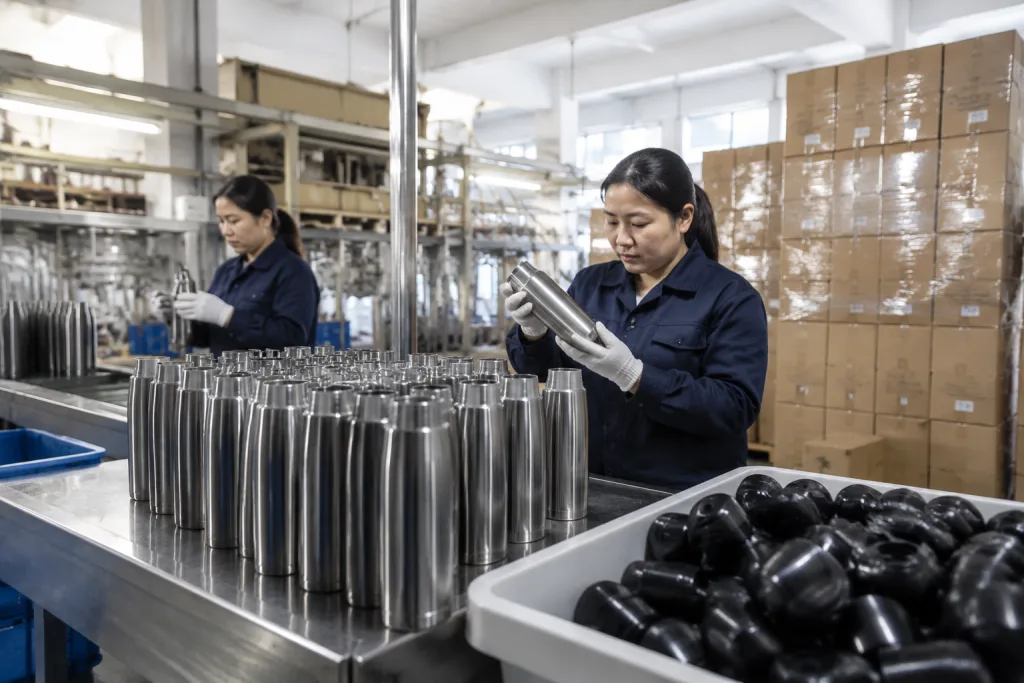
Outdoor retailers and promo brands need a custom thermos that looks sharp on shelf and survives carton-drop testing before the selling season. BottleForge Industrial manufactures in Zhejiang, China, with monthly capacity around 420,000 stainless drinkware units, standard MOQ from 1,000 pcs per model, and typical production lead time of 30–45 days after sample approval. We run laser logo, powder coating, and assembly on the line; if artwork approval slips 6 days, the math does not work for a May campaign.
What PP thermos really means
When a buyer writes “pp thermos flask manufacturer,” we stop the quote sheet first and confirm the build. PP means polypropylene. On our line, it shows up in injection-molded lids, push buttons, cup caps, handles, filter frames, and inner stoppers; one 500 ml lid set often has 3 PP parts plus 1 silicone ring. PP does not keep the drink hot. The insulation comes from the double-wall stainless steel body, vacuum pumping, and a sealed mouth area checked with a 0.05 mm feeler gauge.
For a standard 500 ml to 1,000 ml stainless thermos, we usually run 304 stainless steel for the inner wall, 201 or 304 stainless steel for the outer wall, food-grade PP for lid parts, and silicone for sealing rings. Outdoor retailers often push for 304 outer steel too, especially on a premium customized thermos line. We ship promotional thermos projects with 201 outside when the buyer’s target is tight, but 201 for the liquid-contact inner wall is the wrong place to save money. QC pulled 12 random inner shells last month and checked material certificates before polishing; that step catches bad substitutions early.
The wall thickness needs a real check, not a nice sentence in a catalog. A common construction is 0.4 mm inner wall and 0.5 mm outer wall before forming, though shape and capacity change the draw ratio. If the quote looks too cheap, ask whether the supplier thermos body uses thinner gauge steel, lower vacuum yield assumptions, or a simplified lid with fewer sealing ribs. We have seen this go sideways: a buyer flagged 7 dented bottles in a 300-piece carton test after the outer wall was cut to 0.38 mm. These are not small details. They change dent resistance, heat retention, and complaint rates.
A good thermos manufacturer in China should split the quotation by body, lid, surface finish, logo, packaging, and testing. That is how you compare one factory thermos quote against another without guessing. On our proforma invoice, we usually show the logo charge, color MOQ, carton spec, and AQL 2.5 inspection cost as separate lines, because buyers ask about them during PO review. If you only ask for “best price for thermos bulk,” you will usually get the easiest specification, not the one your retail customer expects.
Set the right specification first
Your RFQ should read like a production sheet, not a mood board. Put the hard specs first: 750 ml capacity, body height in mm, base diameter in mm, mouth opening, target weight, 304 stainless or other steel grade, lid drawing, leakproof standard, coating, logo process, inner carton size, master carton size, and destination compliance. We run the first quote through a spec table, and if one buyer writes “same as photo” next to a 78 mm lid, the line has to stop and ask again. A manufacturer thermos quote for 750 ml with powder coating and laser engraving is not comparable to a 500 ml painted bottle with one-color silk screen logo.
For outdoor retail, the common capacities are 500 ml, 750 ml, 1,000 ml, and 1,200 ml. A 750 ml bottle often gives the cleanest balance: strong shelf presence without pushing the master carton over 15 kg. For promotional thermos campaigns, 350 ml and 500 ml sell better because carton weight, courier cost, and unit price get checked before the color is even approved. Small bottle, tight budget. If the bottle will be used in cold weather, ask for a cup lid or easy-grip PP cap. If it goes into a hiking pack, set a leak test such as 30 minutes upside down after 3 drops from 1 meter, and skip complex flip mechanisms unless your budget includes proper pre-shipment testing. We have seen this go sideways when QC pulled the sample and found coffee inside the cap hinge after only 12 cycles.
Heat retention claims need test conditions, not sales language. Write it like this: fill with 95°C water at 20°C ambient temperature, test after 6 hours and 12 hours. A practical target for a good 500 ml stainless vacuum flask is above 60°C after 6 hours, depending on mouth diameter and cap structure. Wide-mouth bottles lose heat faster than narrow-mouth bottles. That is physics, not a factory excuse. On our bench, a 54 mm mouth usually beats a 70 mm mouth by 4°C to 7°C at the 6-hour reading, and the thermometer probe depth matters too.
For compliance, tell your thermos supplier whether the goods are for the EU, UK, USA, or Canada before we open the sample order. EU buyers usually ask for LFGB, REACH, and sometimes BSCI factory audit status. North American buyers may ask for FDA food contact, ASTM packaging considerations for children’s items, Prop 65 review, and CPSIA only when the product is clearly intended for children. Zhejiang factories can arrange these tests, but the cost and timeline need to sit in the quote before the purchase order is signed. The math does not work if a PO says “ship in 25 days” and LFGB migration testing takes 7 to 10 working days after the final material sample is ready.
MOQ and pricing you can trust
MOQ is where first-time buyers burn 7–10 days before a PO even gets typed. For an existing stainless thermos mold, BottleForge normally starts at 1,000 pcs per model for one standard color and one logo position. If the buyer asks for two colors, a matched PP lid color, retail gift box, or a special coating, the workable MOQ usually moves to 2,000–3,000 pcs because the line has to change powder, fit inserts, and reset the pad-printing jig. Custom mold development for a new lid or body can push the starting point to 5,000 pcs or more because tooling, trial scrap, and 80–120 pcs of pre-production loss need to be covered.
FOB China pricing for a standard 500 ml custom thermos has a wide spread, and chasing the lowest line on a spreadsheet is the wrong question to ask. As a working range, a basic stainless finish promotional thermos may sit around USD 3.20–4.20 FOB Ningbo at 3,000 pcs. A powder-coated 750 ml customized thermos with an upgraded lid lock, individual kraft box, and laser logo may land closer to USD 5.50–7.80 after QC pulls the sample and checks coating thickness with a film gauge. A heavy 1,000 ml outdoor bottle with cup lid and 304/304 steel can go higher. These are budget guardrails, not promises.
Be careful with a quote that is 15–25% below the market. We have seen this go sideways: the supplier excluded inner carton, used lower steel grade, skipped vacuum inspection, quoted EXW instead of FOB, or assumed loose bulk packing in a sack carton. For distributor thermos orders, packaging is often 8–15% of the total unit cost once color box, master carton, barcode label, and pallet rules are counted; last month one buyer flagged a 2 mm barcode shift on the color box proof before we released plates.
Payment terms also affect the quote. A common China export term is 30% deposit and 70% balance before shipment, after inspection. For repeat distributors thermos programs, some factories discuss staged shipments or credit insurance, but not on the first order; the math doesn't work when the factory is buying 304 stainless coil and PP resin before production starts. The cleanest first project is still a clear PO, approved sample, deposit, production inspection, and balance before loading. Check the PO twice. We once held a line for 2 days because “matte black” was typed as “mate black” and the buyer had to reissue the artwork file.
Customization choices that hold up
A custom thermos is not durable just because the logo looks clean on the first sample. This is the wrong question to ask. Start with the bottle surface and sales channel. Laser engraving holds well on 304 stainless and most powder-coated bottles, and we run it when the buyer wants a permanent logo that still looks sharp after 500 rub cycles on the RCA tester. It does not suit a 90 mm full-color camping graphic. Silk screen printing keeps cost down for 1-color or 2-color logos, but expect a setup charge, artwork film cost, and one Pantone check under a D65 light box. Heat transfer and water transfer carry richer artwork; QC pulled the sample last month after the edge lifted 1.5 mm on the tape test, so abrasion and dishwasher claims need proof before you print them on the box.
For outdoor brands, powder coating beats simple spray paint in most thermos projects. Better grip. Better scratch resistance. The result still depends on pretreatment, oven curing temperature, and coating thickness, not just the coating brand on the quotation. Ask your thermos factory for cross-hatch adhesion testing, tape test results, and rub testing if your retail warranty is strict. A typical powder coating layer may be around 60–80 microns, but we have seen 70 microns fail when the line skipped proper degreasing before spraying.
For promotional thermos programs, logo accuracy, price, and ship date usually matter more than building a new look from zero. Choose an existing mold, one standard color, and a simple logo method. The math doesn't work if you ask for custom PP color on only 1,000 pcs. PP color matching means resin changeover, 2 to 3 trial shots, and color tolerance approval against a master chip; on the injection line, that can burn 4 hours before the first approved lid comes out. It is possible, but it is not free.
Packaging is customization too, and it is where buyers lose time fast. Retailers may need a printed gift box, hang tag, care instruction, GTIN barcode, and carton marks. Online sellers often ask for FNSKU labeling, 1.2 m drop test packaging, and carton weight under 15 kg because the warehouse flags anything heavier. Tell the thermos vendor these rules at RFQ stage. We have seen this go sideways from one typo on a PO, “FNSK” instead of “FNSKU,” and changing packaging after production starts is one of the easiest ways to lose 7–10 days.
Quality checks before shipment
A vacuum bottle looks simple on the shelf. The line tells a different story. In our QC room, the same 8 complaints keep coming back: heat drops too fast, lids seep at the thread, bodies arrive with 1–2 mm dents, powder coating gets scratched, logos sit 3 mm off target, PP parts smell after hot-water rinse, cartons crush at the corner, or the inner plug feels loose. A serious thermos manufacturer catches these before the container leaves China, not after the buyer opens 312 cartons in their warehouse.
For production inspection, we recommend AQL 2.5 for major defects and AQL 4.0 for minor defects unless your customer requires tighter levels. Critical defects should be zero. The checklist needs real measurements, not just a tick box: capacity by measuring cup, unit weight on a 0.1 g scale, finish under a 600 lux lamp, logo size and position against the artwork file, barcode scan, carton drop condition, lid assembly, torque or fit feel, leak test, and heat-retention sampling. For leak testing, we fill the bottle, cap it, invert it, then shake it 20 times or place it sideways for 30 minutes. For heat retention, we run hot-water sampling on the line, but if you print a claim like “keeps hot 12 hours” on packaging, use third-party lab testing. We have seen that claim go sideways.
Material control matters too. Ask for stainless steel material declarations, food-contact reports for PP and silicone, and coating safety documents where required. For Europe, REACH and LFGB are often requested. For the United States, FDA food-contact documentation is common. If the same custom thermos will ship to both markets, plan testing early because sample preparation and lab queues can add 7–15 days. QC pulled one sample last year where the PO said “304 stainless,” but the lid gasket drawing named a different silicone grade; that one typo delayed approval by 9 days.
At BottleForge in Hangzhou, Zhejiang, our normal QC flow includes incoming material check, welding and forming inspection, vacuum performance screening, surface inspection, logo inspection, assembly check, and final random inspection before packing release. China has more than 600 thermos suppliers on the export side, but machinery is the wrong question to ask first. The better question is whether the factory stops boring problems early: a weak spot weld found by pressure test, a 0.5 mm rim burr after trimming, or a carton that fails before packing release. We ship only after those small things are closed.
Lead time and logistics planning
For an existing model with standard colors, the timeline is simple enough to quote. Pre-production sample takes about 7–10 days after artwork confirmation; our sample room prints the logo film and checks the Pantone chip under a D65 light box before we cut the sample. Mass production takes 30–45 days after sample approval and deposit. Sea freight to Europe or North America can add 25–45 days depending on port, season, and routing. If your outdoor retail season starts in September, placing the PO in late July is already tight. We’ve seen this go sideways when a buyer approved artwork on July 28, then asked for a lid color change after QC pulled the sample.
Air freight works for urgent promotional thermos orders, but the math can break fast. A 500 ml stainless flask with packaging may weigh 350–500 g. Air shipping 3,000 pcs is not a small courier bill; on one 3,000 pcs rush order, the freight quote was higher than the bottle cost. If the campaign date is fixed, split shipment is usually the cleaner move: air ship 300–500 pcs for the launch, then sea ship the balance. Simple plan. Your thermos distributor margin will survive.
Most buyers choose FOB Ningbo or FOB Shanghai from Zhejiang because customs flow is predictable and both ports have steady sailings. EXW can look cheaper on the PI, but you then own the inland truck, export declaration, port charges, and handoff timing; we had one PO with “EXW Shanghai” typed by mistake, and the buyer flagged it only after the forwarder asked for warehouse loading photos. For new importers, FOB is the safer quote. If you already have a forwarder in China, we work with them directly and send carton size, gross weight, and loading address before pickup.
Carton planning changes freight cost. A typical master carton for stainless thermos bulk orders may hold 24 pcs for 500 ml bottles or 12 pcs for 1,000 ml bottles. We try to keep carton gross weight under 15–18 kg when possible, because warehouse teams complain fast when a carton hits 21 kg and the handles tear during loading. If you sell through online channels, ask for drop-test packaging and label placement before production; QC should check the FBA label position with a ruler, not guess by eye. For distributor thermos replenishment, consistent carton dimensions help pallet planning and warehouse slotting.
Choosing a factory partner
You do not need the biggest manufacturers thermos operation in China. You need a steady factory partner that understands your channel and says “stop” when the idea will fail on the line. A proper supplier thermos discussion should cover wall thickness, 304 stainless grade, PP contact parts, MOQ such as 3,000 pcs per color, sample timing at 7 days vs mass production at 35 days, testing ownership, and packaging limits by carton drop test. Simple rule. If every answer is “yes, no problem,” you are not getting engineering advice; you are listening to a sales script.
For outdoor retailers, ask about vacuum yield, coating adhesion after 100-grid tape test, spare gasket options, lid replacement, and 5-layer carton strength. QC pulled a sample last month where the powder coating looked fine, but the lid thread felt tight after 12 open-close cycles. For promotional brands, ask about logo tolerance in mm, Pantone matching under a D65 light box, lead time discipline, and repeat artwork control when the buyer sends “final_logo_v3.ai” after approving “final_logo_v2.ai.” For thermos distributors, ask whether the factory can keep molds available and repeat colors across 3 production runs without drifting shade.
Audit status matters, but it does not replace a clean project file. BSCI, ISO 9001-style process control, and third-party inspection support reduce risk. The math does not work if the PO only says “500ml thermos, black, logo as before.” Your PO should state the exact model, steel grade, PP grade requirement, silicone requirement, capacity tolerance, logo file version, packaging version, inspection level, and shipment terms. That document protects both sides when AQL 2.5 inspection finds 18 scratched lids in a 1,200 pcs checked lot.
BottleForge Industrial is based in Hangzhou, Zhejiang, close to stainless drinkware supply chains and Ningbo/Shanghai port routes. We do not chase an order with a vague low quote and argue later over lid fit, carton size, or who pays for rework. We have seen this go sideways. If you need a thermos custom program for retail shelves, a thermos promotional campaign, or a repeatable manufacturer thermos supply plan, send the real use case first: target price, channel, annual volume, logo method, and required ship date. The factory work gets easier when the commercial target is clear and the line knows what it is building.
Send your thermos specification before you chase quotes
Share capacity, lid style, logo, market, MOQ, and target price. We will return a practical factory quote and sampling plan.
Frequently asked questions
Is a PP thermos flask the same as a plastic thermos?
Usually, no. In B2B sourcing, a PP thermos flask normally means a stainless steel vacuum flask with PP plastic parts, such as the lid, stopper, handle, or cup cap. The body should still be double-wall stainless steel, commonly 304 inner and 201 or 304 outer. PP is used because it is lightweight, moldable, and suitable for food-contact parts when the correct grade is selected. If you want a fully plastic insulated bottle, say that clearly in the RFQ because the tooling, insulation performance, price, and compliance route are different. For stainless custom thermos projects, we recommend stating 304 stainless inner wall, food-grade PP lid, silicone gasket, and the target market testing standard.
What MOQ should I expect for a custom stainless thermos?
For existing molds, a realistic MOQ is 1,000 pcs per model for one standard color and one logo position. If you need two body colors, custom PP lid color, printed retail box, or more complex decoration, the practical MOQ often becomes 2,000–3,000 pcs. New lid tooling or a unique body shape can require 5,000 pcs or more, plus tooling cost and 20–35 days for mold development. Promotional brands sometimes ask for 500 pcs, but the unit price becomes high and factory scheduling is harder. If you are testing a new channel, choose an existing thermos factory mold first, then invest in custom tooling after repeat sales are proven.
How long does production take after I approve the sample?
For an existing stainless thermos model, sample production usually takes 7–10 days after artwork and specification confirmation. Mass production normally takes 30–45 days after sample approval and deposit. Add 7–15 days if you need third-party food-contact testing, special packaging validation, or custom PP color matching. Sea freight to Europe or North America often adds another 25–45 days depending on port and season. A safe planning window from RFQ to warehouse delivery is 75–110 days for first orders. Repeat orders are faster because artwork, carton layout, color standard, and inspection checklist already exist.
Which logo method is best for outdoor retail bottles?
For outdoor retail, laser engraving on powder coating or stainless steel is usually the most durable and clean-looking option. It handles abrasion better than many printed logos and avoids ink color variation. For larger graphics, silk screen printing works if the artwork is simple and the surface is suitable. Heat transfer can create full-color designs, but you should test adhesion, rub resistance, and dishwasher-related claims carefully. A practical tolerance for logo placement is often within ±1.5–2.0 mm, depending on bottle shape and fixture. If the bottle has a tapered body, confirm the printable area before approving artwork because flat artwork can distort on curved surfaces.
What tests should I require before shipping bulk thermos orders?
At minimum, require final random inspection using AQL 2.5 for major defects and AQL 4.0 for minor defects, with critical defects at zero. The checklist should include visual finish, coating scratches, dents, logo position, capacity, weight, lid fit, leak test, odor check, carton marks, barcode scan, and packaging condition. For performance, sample heat retention should be tested with defined conditions, such as 95°C water at 20°C ambient temperature, checked after 6 or 12 hours. For Europe, request REACH and LFGB where applicable. For the USA, ask for FDA food-contact documentation. If claims are printed on retail packaging, use a third-party lab report, not only factory internal data.