Key Takeaways
- A realistic MOQ for customized thermos orders is 1,000 pieces per color, with 30-40 days mass production after sample approval
- 304 stainless steel with 0.45-0.55 mm outer wall thickness is a practical baseline for outdoor retail thermos bulk programs
- PP lids and cups should be food-grade, BPA-free, odor-tested, and checked against LFGB, REACH, or FDA requirements
- FOB China pricing for a 500 ml custom thermos commonly ranges from USD 3.20-6.80 depending on lid structure and decoration
If you search for pp thermos bottle wholesale, you are usually not asking for a fully plastic bottle. In 9 out of 10 RFQs we see, the buyer means a stainless vacuum thermos with a PP lid, PP handle, PP cup, or PP inner stopper. That detail changes the quote. The stainless body controls heat retention and dent resistance; the PP parts control drinking feel, leak risk, color matching, and compliance paperwork. Last month QC pulled a 500ml sample on the line because the PP stopper lip was 0.35mm oversize, and the cap needed two hands to open.
From our factory in Hangzhou, Zhejiang, we’ve watched buyers lose 12 days vs 3 days because the PO only said “custom thermos” and attached 4 photos. Photos are not specs. China has 3,000+ drinkware suppliers, but the math doesn’t work unless the quote locks steel grade, capacity tolerance, lid material, logo method, carton packing, AQL level, and FOB terms. We run into this often: the buyer flagged a lower price, then found the carton was 20kg gross with no drop-test note and the logo was printed, not laser engraved.
What PP Means In Thermos Sourcing
In pp thermos bottle wholesale, PP usually means polypropylene parts, not a plastic vacuum body. We use PP because it is light, easy to injection mold, and safe for food contact when the resin and color masterbatch are sourced cleanly. On the line, QC checks lid fit with a 0.05 mm feeler gauge after the first 200 shots. You will find PP in screw caps, push-button lids, carry handles, drinking cups, tea filters, straw sets, and inner stoppers.
The vacuum body should still be stainless steel if you want a proper outdoor or promotional thermos. For most distributor thermos programs, we run 304 stainless steel inside, 201 or 304 stainless steel outside, copper-plated vacuum insulation, and injection-molded PP lid parts. Some premium programs specify 316 stainless inner wall for high-salt drinks or coastal retail positioning, but it raises cost by about USD 0.35-0.80 per 500 ml unit. Last month a buyer asked for 316 inside and 201 outside on a 10,000 pcs PO; the math worked only after we removed the gift box insert.
Watch vague terms like “food grade plastic.” Ask your thermos supplier to state the PP grade, color masterbatch type, and a written ban on recycled PP. For Europe, we normally prepare LFGB or EU 10/2011 food-contact documentation where required. For North America, FDA food-contact expectations and Prop 65 screening may be requested. If your promotional thermos will be sold to schools or outdoor youth programs, check ASTM-related packaging and small-part concerns too. We have seen this go sideways when a PO typo changed “new PP” to “PP,” and QC pulled the sample after smelling regrind during lid drilling.
A good manufacturer thermos quotation should separate the stainless body from the PP lid details. If a supplier thermos quote only says “SS + plastic,” you do not know what you are buying. That is the wrong quote to approve. Two similar photos can hide a USD 1.20 price gap, a loose 58 mm lid thread, and a return rate your sales team will remember.
Build A Specification Before Pricing
Price shopping without a specification burns time and gives you bad comparisons. This is the wrong question to ask first. Before asking factories in China for pp thermos bottle wholesale pricing, define the bottle like we do on the line: body size, steel grade, lid structure, carton pack, test target. Last month one buyer sent only “500 ml black thermos with logo,” and QC pulled the sample later because the lid gasket sat 0.8 mm proud after tightening. Outdoor retailers usually push us on dent resistance and heat retention. Promotional brands push harder on repeatable Pantone color, clean logo edges, and ship date. Similar bottle. Different risk.
For a standard custom thermos, lock these items before you ask for price:
- Capacity: 350 ml, 500 ml, 750 ml, 1,000 ml, or 1,200 ml. State the tolerance, usually ±5%, and tell us if the brim-fill or usable volume matters.
- Steel: 304 inner wall as baseline; 201 or 304 outer wall depending on budget. We check incoming coil with an XRF tester before it reaches the forming press.
- Wall thickness: 0.40 mm is low-cost; 0.45-0.55 mm is more suitable for outdoor retail. The math does not work if you ask for a rugged camping flask at the thinnest gauge.
- Insulation target: 6 hours above 65°C for 500 ml, or 12 hours above 55°C for larger flask formats. We run the heat test with boiled water filled to the neck, not half volume.
- PP parts: lid type, cup type, gasket material, handle structure, and color reference. A 1 mm change on the PP hinge can decide whether the cap clicks cleanly or feels loose.
- Decoration: silkscreen, laser engraving, heat transfer, powder coating, or full-color UV print. Send vector artwork, because a 0.25 mm line in a logo can disappear after powder coating.
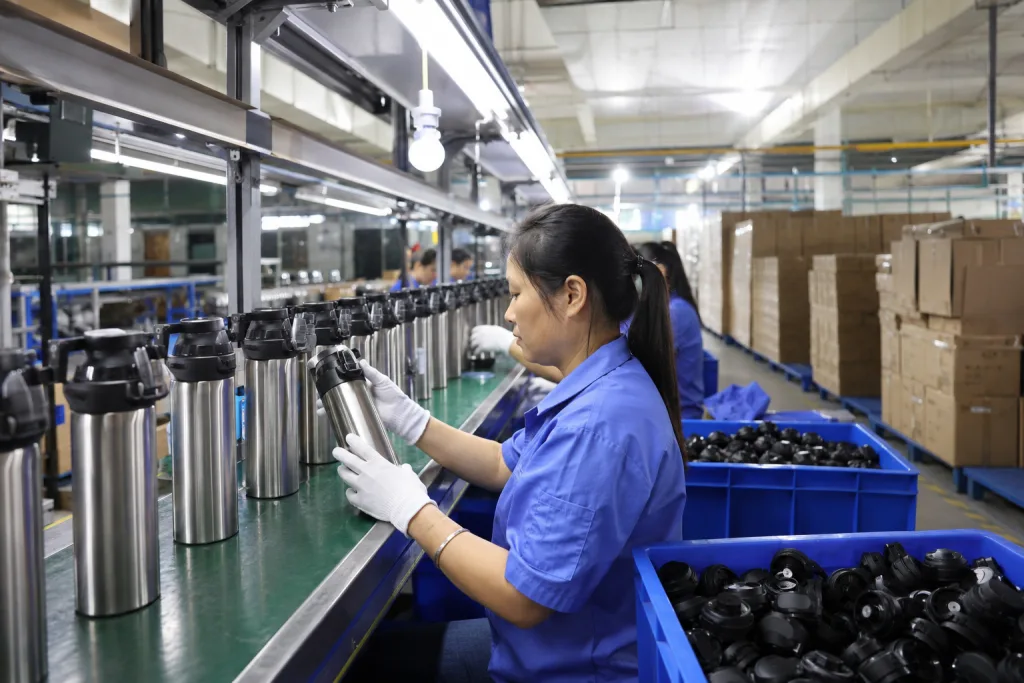
At BottleForge Industrial in Zhejiang, our monthly stainless thermos capacity is about 420,000 units, but capacity will not rescue a loose brief. We quote faster when you send target capacity, sales market, logo artwork, packaging style, and expected order volume. For a customized thermos with a private color and logo, 1,000 pieces per color is a normal MOQ. New PP injection molds usually make sense only above 5,000-10,000 pieces because tooling can run USD 1,200-4,500 depending on lid complexity. We have seen this go sideways when a PO says “blue” and the approved sample was Pantone 2945 C; the buyer flagged it at pre-shipment, not at sample stage.
If you are building a distributor thermos line, keep one body and change lids or colors. Faster reorders. Lower tooling risk. We ship repeat bodies about 12 days sooner than new-body projects because the vacuum line, leak tester, and carton drop test setup are already confirmed.
Materials And Compliance That Matter
Stainless thermos buying is not just a heat-retention question. The cup touches food, passes customs, sits 30-60 days in a retailer warehouse, and carries your logo if something smells wrong. On our line in Hangzhou, QC pulled 12 random lids last month because the PO said “PP lid” but the approved sample used PP body with a silicone seal. Small mismatch. Big headache.
For stainless steel, 304 inner wall is the safest commercial baseline. It holds up better than 201 when buyers fill the bottle with black tea overnight, coffee with milk, or sports tablets that leave acidic residue. We still see 201 outer wall in about 40% of price-driven thermos quotes because it saves money, and that can work for a giveaway order if the powder coating passes a 3M tape test and the market is not sold as premium. For outdoor retail or Amazon listings over USD 12.99, specify 304 outside as well and put “304 inner / 304 outer” on the purchase order.
For PP parts, ask for food-grade virgin PP unless you already have a tested recycled-content program. Recycled PP sounds good in a buyer meeting, but the food-contact paperwork gets messy fast. Gaskets are usually silicone, not PP, and this is where the math doesn't work if you chase the cheapest lid set. A low-grade gasket can create 2-3% leak complaints even when the stainless body is fine, so we run inverted water leakage checks for 30 minutes, lid torque checks at 8-12 kgf.cm, and 95°C hot-water odor checks before packing.
For Europe, buyers usually ask for LFGB plus REACH, and RoHS only comes in when the promotional set has an electronic accessory like a temperature-display cap. Packaging waste documents also matter because some retailers check carton markings against the shipping file. For North America, FDA food-contact expectations apply, CPSIA comes up for child-targeted items, and Prop 65 screening should be discussed before artwork is locked. Larger retailers may ask for BSCI or Sedex audits; ISO 9001 helps the factory profile, but it does not replace product testing. We have seen buyers flag this during pre-shipment inspection when the report named a black coating but the production cup was pearl white.
Do not accept a test report that covers a different lid material, different coating, or a different factory thermos model. Customs and retail QA teams can reject that shortcut, and re-testing after goods are packed can add 7-10 days.
China sourcing works well when the documents match the actual SKU. Zhejiang factories run export testing every week, but you still need to ask before production, not after 120 cartons are sealed with your barcode labels. We ship cleaner when the PO spells out material grade, lid resin, gasket material, coating, target market, and test standard from day one.
Logo Options For Promotional Orders
A promotional thermos has to look sharp after cartons are dropped, sleeves rub in transit, and the buyer’s sales team uses it for 30 days. Chasing the cheapest logo is the wrong question to ask; we have seen USD 0.06 printing turn into a 4% complaint rate after a cross-hatch tape test. The right method depends on powder coat type, printable area in mm, PO quantity, and whether the bottle sits in a gym bag or on a retail shelf.
Silkscreen printing fits simple one- or two-color logos. We run it often for thermos bulk orders on powder-coated bodies, especially when the logo stays under 80 mm wide and uses solid Pantone colors. Expect a setup cost of about USD 35-60 per color and a unit cost from USD 0.05-0.18 depending on logo size. For a clean corporate gift, silkscreen still makes sense. QC usually pulls the first 20 pcs from the line and checks edge blur with a 3M tape test.
Laser engraving cuts through the coating and shows the stainless steel underneath. No ink. No adhesion argument. It suits outdoor retailers that ask for a rugged logo and do not need full-color artwork. The limit is color, so do not send us a four-color crest and expect laser to match the PDF. Unit cost is often USD 0.12-0.35. For 500 ml and 750 ml custom thermos programs, we recommend laser when the logo is small, usually under 60 mm, and the bottle has a matte powder coat.
Heat transfer and UV printing are better for gradients, wide graphics, or retail artwork with fine details. They cost more and need tighter file control; one buyer once sent a PO with “UV priting” and a 72 dpi logo, and the proof looked soft at 1:1 size. A full-wrap heat transfer can add USD 0.45-1.20 per unit and may require 2,000-3,000 pieces to be sensible. If your thermos customizable project uses seasonal graphics, confirm film MOQ before approving the design.
For color, give Pantone references, then check the real sample. Powder coating on stainless and PP injection color will not match perfectly because metal, plastic, and clear PP lids reflect light in different ways. A professional thermos manufacturer should provide a pre-production sample under the same coating and PP color batch; we usually mark the batch card with the powder lot and injection machine number. Approving a render is not enough.
MOQ, Lead Time, And Price Reality
Most serious pp thermos bottle wholesale orders do not start at 100 pieces. We can run 100-300 pcs only when the body, lid, carton, and color are already in stock. Real thermos custom production needs enough volume to cover line setup, powder booth cleaning, logo screen setup, AQL 2.5 inspection, and export packing. At BottleForge Industrial, a normal MOQ is 1,000 pieces per color for logo customization and 3,000 pieces for a private powder-coat color. For new PP lid tooling, plan 5,000 pieces or more. The buyer often asks, “Can you do 500 pcs in Pantone Black 6C?” The math does not work once the coating line has to wash the gun and purge 8-12 kg of powder.
Sampling usually takes 7-12 days for an existing body with logo. If you need a new PP part or custom mold, prototype timing can run 18-30 days. Mass production is typically 30-40 days after sample approval and deposit, assuming no special compliance test delay. We count from approved artwork, not from the first WhatsApp photo. Small detail, big delay. Last month QC pulled the sample because the logo file was 42 mm wide on the PO, while the approved AI drawing showed 48 mm. Peak season for China drinkware exports is usually March to July for back-to-school, fall outdoor, and holiday promotional programs. If you place a customized thermos order in late June and need retail delivery in September, air freight may eat your margin.
FOB Ningbo or FOB Shanghai is common for Zhejiang drinkware factories. As a rough guide, a 500 ml stainless vacuum thermos with PP lid, powder coating, and one-position logo may run USD 3.20-6.80 FOB China. A 1,000 ml outdoor flask with cup lid and handle can run USD 5.80-10.50. That price gap is not magic. It comes from 304 stainless thickness, lid thread fit, gasket material, spray thickness in microns, carton burst strength, and whether the buyer asks us to run AQL 2.5 or a lighter check. We ship more claims from bad lids than from bad cups, so shaving USD 0.08 on the PP lid is usually the wrong question to ask.
Do not pressure a thermos vendor into unrealistic pricing without changing the specification. Something will move: 0.4 mm steel becomes 0.35 mm, the coating fails a 3M tape pull, the silicone gasket smells, delivery slips 12 days vs 18 days, or inspection gets loose. We have seen this go sideways. A professional manufacturers thermos quote should show exactly where the price is saved, line by line, before the deposit hits our account.
Inspection Before Shipping
Inspection is where a clean-looking order proves whether it can sit on a shelf. For outdoor retailers and promotional brands, we ask for written AQL terms on the PO, not buried in a WeChat chat. A common standard is AQL 2.5 for major defects and AQL 4.0 for minor defects, with critical defects at 0. Critical defects include leakage, sharp edges, unsafe odor, contamination, wrong material, or an incorrect logo that cannot be sold. Last month QC pulled 200 pcs from a 6,000 pcs run and found 3 cups with burrs around the inner thread, measured by feeler gauge and hand check. Small finding. Big headache if it reaches retail.
Key checks for thermos suppliers include vacuum performance, leakage, coating adhesion, logo position, lid torque, PP part fit, capacity, carton drop resistance, barcode readability, and packing accuracy. We run a 3.5 N·m lid torque check on screw lids and a 1 mm logo-position tolerance for most laser or silk-print jobs. For Amazon or marketplace orders, FNSKU labeling and carton labels must be checked before sealing cartons. For distributor thermos shipments, mixed-SKU carton mistakes create expensive warehouse problems, so carton marks need the same attention as the product itself. We have seen this go sideways: one buyer flagged a PO typo where “navy” became “naby,” and 48 cartons were already printed.
Vacuum testing can be done by heat retention sampling and surface temperature screening. We fill at 95°C, close the lid, then screen the outer wall after 30 minutes with an infrared thermometer. A failed vacuum bottle gets warm outside fast after hot water filling. Coating adhesion is commonly checked with cross-hatch tape testing using 3M 600 tape. We also run random lid cycling, especially for flip lids and push-button stoppers, because a PP hinge that survives 20 cycles in the sample room can fail after poor injection cooling on the line. The math does not work if the buyer saves USD 0.03 on resin and loses 2% in returns.
If you hire a third-party inspector, send the approved sample, artwork file, packing instruction, and defect classification. Do not ask the inspector to “check quality” without standards. That is the wrong question to ask. A thermos distributor can accept minor cosmetic variation, but cannot accept 1% leakage on a retail shelf. In our Hangzhou, Zhejiang facility, final inspection is done after full assembly and before export carton sealing because that is when most real defects show up. QC signs off at the packing table with the barcode scanner, carton scale, and sealed golden sample beside the line.
How To Choose A Factory Partner
The best thermos factory for you is not always the largest one. This is the wrong question to ask. You need a partner that understands your channel and your order risk. Outdoor retailers usually push us on drop dents, powder-coating scratches, shelf box strength, and repeat PO stability; promotional buyers push harder on logo position, ship date, carton marks, and landed cost. We ship both types, but the line setup is different: a retail order may need a 0.8 mm thicker color box, while a promo order may need 12,000 lids packed by event code.
Ask direct questions. What is the monthly capacity for stainless vacuum bottles? What is the MOQ for each coating color? Which processes are in-house and which are subcontracted? Can they provide BSCI, ISO 9001, LFGB, REACH, or FDA-related test reports for the exact material set? What AQL level do they use by default? How many days for a counter sample? Our normal counter sample is 7 days for laser logo and 10-12 days for silk print after artwork approval, not “soon.” If the sales reply is only “yes, we can do,” keep pushing. QC should be able to pull a sample, measure the mouth diameter with a digital caliper, and tell you whether the lid fit is 0.2 mm loose or within spec.
A reliable thermos supplier should also say no when needed. If you want a 500 ml bottle, full-wrap print, custom PP lid, retail box, and 15-day delivery during China peak season, the math doesn't work. Something must change. We have seen this go sideways when a buyer approved a new lid mold too late, then flagged the air shipment cost after cartons were already printed. A good supplier thermos team protects your launch with realistic dates, such as 12 days for sampling and 35 days for mass production, instead of polite promises.
For first orders, avoid changing everything at once. Use an existing stainless body, existing PP lid, private color, and your logo. After you confirm sell-through, invest in a unique lid or handle. That is how thermos distributors build a line without tying up cash in tooling too early; one 20,000-piece mold mistake can sit in the warehouse for a year. If you need a long-term manufacturer thermos program, ask for a costed roadmap: stock model first, private color second, mold customization third, exclusive SKU last. We run this sequence often, and it also keeps the first PO clean enough that a typo like “matte balck” on the color line gets caught before coating starts.
Send Your Thermos Spec And Target Price
We will review capacity, PP lid structure, logo method, MOQ, compliance needs, and FOB China options before quoting.
Frequently asked questions
Is pp thermos bottle wholesale the same as plastic thermos wholesale?
Usually no. In drinkware sourcing, pp thermos bottle wholesale often means a stainless steel vacuum thermos with PP lid, cup, handle, or stopper. A fully plastic bottle will not provide the same heat retention because it lacks a double-wall vacuum stainless structure. For outdoor retail, we suggest 304 stainless inner wall, 0.45-0.55 mm outer wall, and food-grade virgin PP lid parts. If you want a lower-cost promotional thermos, you can use 201 stainless outside and PP components, but the inner wall should still be 304 for normal hot drink use. Ask the supplier to list every food-contact material separately.
What MOQ should I expect for a custom thermos order?
For an existing stainless body with your logo, a practical MOQ is 1,000 pieces per color. If you need a private powder-coat color, many thermos manufacturers require 3,000 pieces because coating line setup and color loss are real costs. If you need a new PP lid, handle, or cup mold, plan for 5,000-10,000 pieces and USD 1,200-4,500 in tooling. Small sample runs below 500 pieces are possible only with stock bottles and limited decoration. For distributor thermos programs, start with one body size and 2-3 colors instead of too many SKUs.
How long does production take from a China thermos factory?
For a standard customized thermos using an existing mold, sampling normally takes 7-12 days and mass production takes 30-40 days after sample approval and deposit. If you need a new PP injection part, add 18-30 days for mold design, tooling, and first samples. Third-party testing can add 7-15 days depending on LFGB, REACH, FDA-related, or Prop 65 scope. FOB Zhejiang or FOB Ningbo shipment planning should also include 3-7 days for inland trucking, customs documents, and container loading. Do not count only factory production days when setting a retail launch date.
Which logo method is best for promotional thermos bulk orders?
For simple corporate logos, silkscreen printing is usually the most cost-effective option, with setup around USD 35-60 per color and unit cost around USD 0.05-0.18. Laser engraving is better for long-term durability and outdoor positioning, usually USD 0.12-0.35 per unit. UV print or heat transfer is better for full-color artwork but can add USD 0.45-1.20 per unit and may need higher MOQ. If the thermos will be handled daily, test adhesion on the same powder coating before approving mass production. Artwork on a render is not a production approval.
What quality standard should I put in the purchase order?
Use written AQL standards and product-specific defect rules. A common export standard is AQL 2.5 for major defects, AQL 4.0 for minor defects, and 0 tolerance for critical defects such as leakage, unsafe odor, sharp edges, wrong material, or missing logo. Include heat retention target, leakage test method, coating adhesion check, carton drop requirement, barcode or FNSKU placement, and packing quantity per carton. For stainless thermos orders, also define steel grade, PP material, silicone gasket, capacity tolerance, and approved sample reference. A clear PO prevents arguments after goods are packed.