Key Takeaways
- A realistic MOQ is 1,000 pcs per color for most custom stainless thermos projects
- 304 stainless body plus food-grade PP lid is the normal export structure
- FOB China pricing often runs USD 4.20-8.80 depending on capacity and finish
- Use AQL 2.5/4.0 inspection plus 100% leak testing before carton sealing
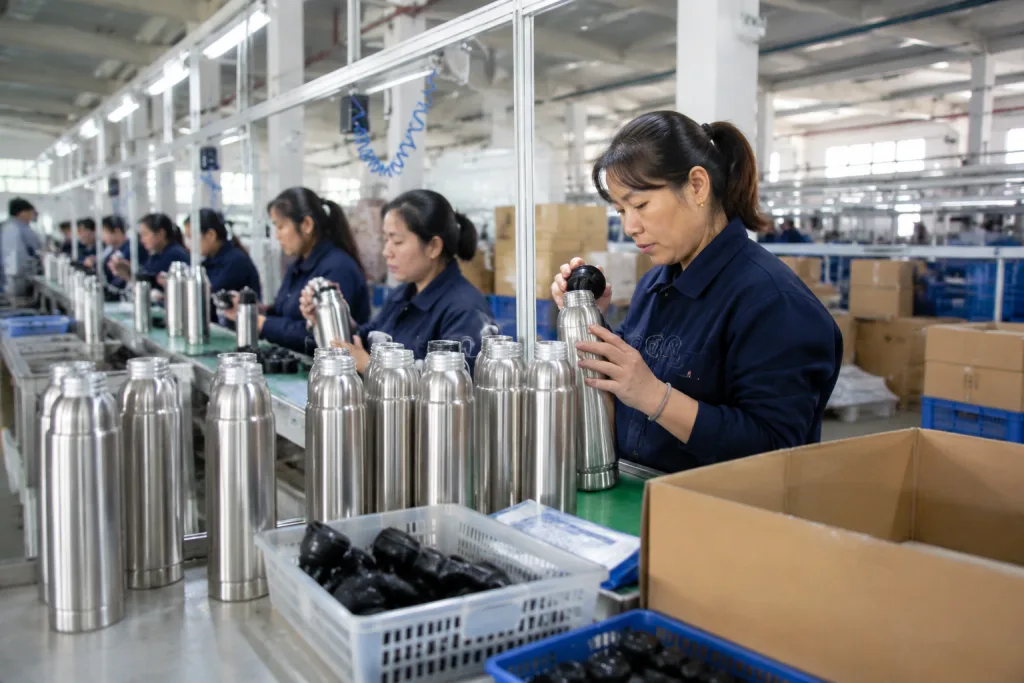
If you searched for a pp thermos bottle manufacturer, you probably do not want a cheap plastic flask. In 8 out of 10 RFQs we get from outdoor retailers and promo brands, “PP thermos” means a 304 stainless vacuum bottle with PP in the lid, carry handle, stopper, or drinking cup. Small part, big cost swing. On our line in Hangzhou, a 0.3 mm gap on the PP stopper can change leak-test results after the bottle sits upside down for 30 minutes, so the steel body, vacuum brazing, PP grade, silicone gasket, and lid fit all need to be priced together.
From our Zhejiang factory floor, finding a thermos supplier in China is not the hard part. The wrong question to ask is, “Can you make this design?” Almost every supplier will say yes. We have seen this go sideways when a buyer approved a clean PDF, paid a 30% deposit, then QC pulled the sample and found 14/80 bottles with weak paint adhesion after 3M tape testing. You need working numbers before artwork approval: target capacity in ml, MOQ, carton drop-test standard, leak-test time, packing method, and which PP parts touch hot water.
What PP means in thermos sourcing
In drinkware sourcing, PP thermos bottle manufacturer is a sloppy keyword. PP means polypropylene in 9 out of 10 buyer inquiries we see, not the vacuum bottle body. For outdoor retail or a promotional thermos that needs to survive real use, we run stainless steel for the body, usually 304 inside and 201 or 304 outside. PP sits in the lid shell, push button, carry handle, inner stopper, or drinking cup because it molds cleanly, keeps weight down, and holds up under normal hot drink contact. On the line, our mold tech checks the PP lid fit with a 0.05 mm feeler gauge before QC signs off the first shot.
For Europe and North America, ask for the PP grade and the exact food-contact report before price talk gets serious. We normally quote food-contact PP with FDA, LFGB, or EU 10/2011 support, depending on market. If your bottle has silicone seals, the gasket should be food-grade silicone, not cheap TPE unless the design has passed leak and odor testing. The math doesn't work if a buyer saves 0.08 USD on a gasket, then gets 300 cartons flagged for seepage after drop testing. QC pulled the sample last month after a lid gasket measured 1.6 mm instead of the 1.8 mm shown on the PO.
The body construction matters more than the word PP. A common 750 ml factory thermos uses 0.4 mm to 0.5 mm stainless wall thickness before forming. Heavier outdoor models may use 0.5 mm to 0.6 mm outer steel, especially when a cup lid or handle is added. Vacuum insulation comes from clean welding, steady vacuum pumping, and copper coating or reflective treatment, not from a nice product title. Good samples should keep water above 60°C after 12 hours when starting at about 95°C in a 20°C room. Ask for the test sheet. Do not accept claims like “all-day hot” unless the supplier gives the fill volume, start temperature, room temperature, and test hours.
If a thermos vendor cannot separate steel grade, PP grade, gasket material, and insulation method in writing, you are not dealing with a reliable manufacturer thermos partner. You are reading a trading reply sheet. We have seen this go sideways when the buyer flagged one typo on the PO, “PP body,” and the supplier used it to dodge responsibility for the stainless spec.
MOQ, price, and lead time reality
For a custom thermos program, buyers ask MOQ first. I’d push back a little: MOQ is the wrong first question if the lid is new. At BottleForge Industrial in Zhejiang, we run a standard stainless thermos at 1,000 pcs per color when the body uses an existing mold. For a new PP lid mold, the number moves up because the injection tool, Pantone matching, and first-shot trial all need to be paid back. Expect 3,000 to 5,000 pcs for a fully customized thermos with a new lid, handle, or cup structure; last month the toolroom needed two T1 shots before the PP flip lid closed within a 0.3 mm gap.
FOB Ningbo or Shanghai pricing for bulk thermos orders sits around USD 4.20 to USD 8.80 for 500 ml to 1,000 ml models, based on stainless vacuum construction, powder coating or spray paint, and one logo position. A simple laser logo costs less than full-wrap heat transfer because the line only needs the rotary laser jig, not film alignment and oven curing. A retail gift box can add USD 0.25 to USD 0.65. A heavier outdoor handle lid can add USD 0.35 to USD 0.90, mostly from PP weight, silicone parts, and extra assembly labor; QC pulled one sample at 312 g lid weight, and the buyer flagged the freight hit.
Normal sample timing is 7 to 10 days for a stock shape with laser engraving. Pre-production samples with custom color and packaging take 12 to 18 days. Mass production is 30 to 45 days after sample approval and deposit; before Christmas or Chinese New Year, plan on 45 days vs 30 days because polishing, coating, and packing lines get booked tight. Our Zhejiang line capacity is about 450,000 stainless drinkware units per month across thermos, tumblers, and sports bottles, but capacity only helps if artwork, color chips, and barcode rules are confirmed early. We’ve seen this go sideways from one PO typo: EAN-13 printed as EAN-8, and 96 cartons had to be relabeled by hand.
If you are a promotional thermos buyer with a fixed event date, add 10 days for inspection and booking space. Thermos bulk orders are not T-shirts; vacuum testing, curing time, and carton drop checks cannot be rushed without raising defects. AQL 2.5 inspection still needs cartons opened, 1.2 m drop tests run, and leak samples checked on the bench before we ship.
Build the specification before artwork
About 7 out of 10 failed thermos custom projects we see start with logo placement instead of product structure. Wrong question. Build the spec first: capacity, dimensions, steel grade, PP components, gasket material, coating, insulation target, packaging, and test standard before anyone argues over Pantone color. On our Hangzhou line, the engineer checks the first drawing with a 0.02 mm caliper before the artwork file even reaches the pad-printing table. Outdoor retailers selling into cold-weather use are tougher buyers because their customers actually test heat retention in the car, on trails, and at work sites.
A practical 750 ml outdoor bottle specification may read: inner wall 304 stainless steel, outer wall 304 stainless steel, outer thickness 0.5 mm before forming, food-grade PP stopper and cup, silicone sealing ring, powder-coated finish, leakproof when inverted for 30 minutes, 12-hour heat retention above 60°C, 24-hour cold retention below 12°C, carton drop test at 76 cm, and AQL inspection level II with critical defects 0, major 2.5, minor 4.0. Clear specs get clear quotes. If a buyer sends only “750 ml black bottle with logo,” we have to guess carton size, stopper PP color, and whether the cup needs a thread gauge check; that is how a USD 0.18 cost surprise appears after sampling.
For promotional brands, the spec can be lighter, but do not cut the functional tests. A promotional thermos still needs leak testing and coating adhesion. We run the tape test after 24 hours of coating cure, then QC pulls the sample for cross-hatch adhesion, salt spray on exposed metal parts, and dishwasher guidance. The buyer flagged this once after a PO typo said “dishwasher safe” instead of “hand wash only,” and the math did not work once replacement labels, rework labor, and 18 days of delay were counted. Powder-coated bottles often survive hand washing well, but do not market them as dishwasher safe unless the coating and logo method have passed repeated wash cycles.
The phrase customizable thermos sounds flexible, but every customization changes risk. A new paint color can shift after oven curing at 180°C. A wide laser logo can expose too much steel and look dull. A new PP color may need a 500 kg resin MOQ from the supplier, even if the bottle order is only 3,000 pcs. Good thermos manufacturers will push back on unsafe combinations. We have seen this go sideways when a buyer insisted on a soft-touch coating over a large laser mark; QC pulled the sample after the rub test and the logo edge already looked dirty. That pushback protects your margin.
Logo methods that actually hold
Branding is where buyers burn money or leave the spec too loose. For a stainless manufacturer thermos order, we usually run 6 logo methods: laser engraving, silk screen printing, pad printing, heat transfer, water transfer, and full powder coating with secondary print. Each method earns its place on the line. Laser engraving is tough and clean, but it cuts through to the metal color underneath, so the math does not work for 4-color mascot artwork. Silk screen fits simple one-color or two-color logos on straight walls; our fixture holds best when the print area stays within about 55 mm height. Heat transfer suits large graphics, gradients, and promo launches that need shelf impact. QC pulled one sample last month where the buyer’s 0.3 mm fine text filled in after screen printing, so we moved it to laser before bulk.
For a custom thermos in outdoor retail, I prefer powder coating plus laser engraving or one-color screen print. It survives carton rub and shelf handling better than glossy spray paint, and scratches look less ugly on matte textures. We run a 3M tape test after curing, then a quick rub test on the logo area before packing. For distributors thermos programs where the same bottle sells to 40 corporate clients, keep one neutral body color in stock and change the logo by laser. That cuts inventory pressure and can move a repeat order from 18 days to 12 days when blank bottles are already coated.
Logo tolerance needs to be written on the PO, not discussed in a call and forgotten. A normal logo position tolerance is plus or minus 1.5 mm on a cylindrical bottle. Color tolerance should use Pantone plus a physical approved sample, not a laptop screen. If your thermos distributor channel requires exact brand color, approve a sprayed color plate before production; we label ours with powder batch number and curing temperature. For large thermos promotional projects, ask for 20 pcs pilot production samples, not just one hand-made sample. Hand samples often look better than line production because the best operator made them slowly. We have seen this go sideways when a PO said “black logo” but the artwork file was Pantone Cool Gray 11 C.
For thermos customized packaging, confirm barcode, FNSKU if needed, suffocation warning on polybags, carton marks, and country of origin. Small stuff stops shipments. One Amazon buyer flagged a missing 5 mm suffocation-warning font on the polybag, and the cartons sat 3 days while we reworked packing at the end of the line. A perfect bottle in the wrong retail box still misses the delivery window.
Compliance is not optional paperwork
For European and North American orders, compliance sits inside the spec sheet. On stainless thermos work, we line up FDA food-contact compliance for the United States, LFGB or EU food-contact testing for Europe, REACH screening for coatings and plastics, and sometimes Prop 65 review for California exposure. If the bottle is for children, ASTM and CPSIA checks can land on the coating, accessible parts, and packaging warnings. We once had a 24 mm lid skirt pass the physical checks and still get held up because the warning copy was wrong.
A responsible thermos supplier should know factory audit requirements before the quote goes out. BSCI, Sedex, ISO 9001, or a customer social audit may be on the table for larger retailers. Not every good China factory holds every certificate, and the honest answer matters more than a polished brochure. If you need BSCI before shipment, say it early. Audit slots usually take 2 to 4 weeks, and corrective action can run past that if the buyer flags a labor record or fire drill gap.
Quality control belongs in the purchase order, not in a side email. We run 100% leak testing on the line, vacuum checks by batch, coating adhesion tests, lid torque checks, and final inspection to AQL 2.5/4.0. For a 3,000 pcs order, final inspection normally pulls 200 pcs under general inspection level II. Critical defects stay at zero: broken glass liners if any, sharp edges, contamination, severe leakage, wrong material, or a bad odor. The math does not work any other way.
Do not trust an old test report from a different model. A new PP lid, a new coating, or a new silicone ring can change the compliance result fast. We have seen this go sideways on a 500 ml sample when the buyer approved one lid and the factory shipped another with a typo in the PO code. Thermos suppliers that export regularly from Zhejiang and other China manufacturing areas should know this drill. If they tell you testing is unnecessary, change vendor.
How to qualify your thermos vendor
Outdoor retailers and promotional brands ask the same thermos manufacturer for different results. Retail buyers care about repeatable quality, shelf-ready packing, and complaint rates under 3 claims per 1,000 units. Promotional buyers care about artwork approval in 24 hours, stable logo color, and delivery dates that survive real production. We run both types in Hangzhou, and the first vendor call usually tells us plenty: if the salesperson cannot explain the carton drop test height or the lid gasket material, the buyer flagged the right risk.
Ask for current production photos, not catalog renderings. Ask which processes are in-house: stainless forming, welding, vacuum pumping, polishing, coating, laser engraving, assembly, and packing. We still see 6 out of 10 trading-style suppliers thermos companies outsource coating or printing. Outsourcing is fine if someone owns the schedule and the QC sheet. If the coating workshop is 40 km away, add 1 day for transfer, 1 day for incoming check, and make sure the inspector sees the coated bodies before assembly. The line cannot fix orange peel after the lid is packed.
Ask for defect data. A serious thermos factory should know typical leakage rate after assembly, paint rework percentage, and inspection failure history. For our own stainless programs, a normal internal target is below 0.5% leakage after 100% water test and below 2% coating rework before packing. These numbers are not magic. They show the factory measures problems instead of arguing after shipment. QC pulled one 500 ml sample last month with a 0.3 mm gasket offset; small finding, big leak risk.
If you are comparing thermos manufacturers, do not chase the lowest line item. This is the wrong question to ask. Compare the full landed cost: unit price, inner box spec, master carton strength, pallet option, inspection cost, testing cost, shipping volume, and expected defect allowance. A USD 0.25 cheaper bottle can become expensive if the lid leaks in 1% of orders or cartons crush in warehouse handling. We have seen 5-ply cartons save an order after a forwarder stacked 18 kg master cartons two layers too high.
For distributor thermos programs, ask whether the manufacturer can hold approved components for repeat orders. For thermos distributors serving 20 to 80 small accounts, a stable base model with flexible logo methods beats a new shape every season. Consistency sells better than novelty when your customers reorder. We usually reserve lids, gaskets, and approved color chips for 90 days after shipment, because one typo on a repeat PO, like “mat black” instead of “matte black,” can slow the next run by 3 days.
Packing and shipment details matter
Thermos bottles eat carton space, and freight will cut your margin if packing gets treated as an afterthought. A 750 ml stainless bottle with gift box often packs 24 pcs per master carton. We usually see carton size around 55 x 37 x 32 cm, depending on bottle diameter and cup lid design. Gross weight can reach 12 to 15 kg per carton. Before mass production, we run a carton load check with a tape measure, a digital scale, and 5 empty master cartons from the line; this is the wrong time to guess.
For Amazon-style or distributor warehouse delivery, confirm carton drop testing, barcode readability, FNSKU placement, polybag rules, and whether cartons need to stay under 50 lb. For retail distribution, check shelf box artwork, hangtag hole position if used, and whether the thermos custom label covers required country-of-origin information. QC pulled one sample last year where the PO said “Made in Chain” instead of “Made in China,” and the buyer flagged it before booking. Small label mistakes in China export packing can hold receiving for 7 to 14 days.
FOB is the cleanest term for about 8 out of 10 buyers because your forwarder controls the freight and booking schedule. If you need DDP, ask for a separate logistics quote; duty, tariff classification, and delivery zone can move the final cost after the first estimate. Stainless vacuum flasks normally ship under drinkware-related HS codes, but your broker should confirm the exact classification for your country. The math does not work when a pp thermos bottle manufacturer quotes one landed price without checking carton CBM and ZIP-code delivery fees.
A reliable thermos supplier asks annoying packing questions early. Good sign. We would rather spend 20 minutes confirming FNSKU size and carton marks with a 30 mm barcode scan test than spend 20 days explaining why a warehouse rejected the shipment. For outdoor retailers and promotional brands, the bottle is only sold when it arrives clean, scannable, and undamaged; we have seen this go sideways from one weak corner on a 5-ply carton.
Send your thermos spec for a factory quote
Share capacity, logo, target market, MOQ, and packing needs. We will return practical FOB pricing, sample timing, and compliance notes.
Frequently asked questions
Is a PP thermos bottle plastic or stainless steel?
In most sourcing requests, a PP thermos bottle means a stainless vacuum bottle with polypropylene parts, usually the lid, stopper, cup, or handle. The body should normally be double-wall stainless steel, often 304 inside and 201 or 304 outside. PP is used because it molds well, is light, and can meet food-contact requirements when the correct grade is used. For export, ask for FDA, LFGB, EU 10/2011, or relevant food-contact support for the PP and silicone components. If a supplier offers a fully plastic hot thermos for serious outdoor use, be careful. Heat retention, odor control, and durability will usually be weaker than a stainless vacuum structure.
What MOQ should I expect for a custom stainless thermos?
For existing molds, 1,000 pcs per color is a realistic MOQ for most stainless custom thermos orders from China. If you need a new PP lid, special handle, new cup mold, or exclusive bottle shape, expect 3,000 to 5,000 pcs because tooling and injection setup costs must be covered. Logo-only projects can sometimes start at 500 pcs if you accept stock colors, but FOB pricing will be higher and production priority may be lower. For distributor thermos programs, it is smarter to choose one base model and repeat it with different logos instead of buying many small shapes.
How much does a bulk thermos order cost?
A normal FOB China price for a 500 ml to 1,000 ml stainless thermos is about USD 4.20 to USD 8.80, depending on steel grade, capacity, coating, lid complexity, logo method, and packaging. Laser engraving may add USD 0.08 to USD 0.25 per unit. A color gift box may add USD 0.25 to USD 0.65. A heavy PP handle lid can add USD 0.35 to USD 0.90. Testing, inspection, and shipping are separate costs. Do not compare quotes unless the specification is the same, including wall thickness, 304 or 201 outer steel, AQL level, carton strength, and logo size.
Which logo method is best for promotional thermos orders?
For simple corporate logos, laser engraving is the safest choice because it is durable, fast, and clean. It works well on powder-coated bottles, but the logo color will be the exposed metal tone, not a Pantone ink. For one- or two-color artwork, silk screen printing is economical and looks sharper on straight bottle walls. For full-wrap graphics or gradients, heat transfer gives better visual impact, but you should test adhesion and abrasion before approving mass production. For a 2,000 pcs thermos promotional order, ask for a pre-production sample and at least 20 pilot pieces if the artwork is large.
How do I check if a thermos factory is reliable?
Ask for process details, not just certificates. A reliable thermos factory should explain stainless forming, welding, vacuum pumping, polishing, coating, assembly, leak testing, and final inspection. Ask whether they perform 100% leak testing and what AQL standard they use. A practical inspection plan is critical defects 0, major 2.5, minor 4.0 under general inspection level II. Also ask for current audit status such as BSCI, Sedex, or ISO 9001 if your retailer needs it. Good suppliers thermos teams will answer with numbers, photos, and sample timelines. Weak vendors usually answer with only catalog pages and very low prices.