Key Takeaways
- A realistic custom stainless thermos MOQ starts at 1,000 pcs per color for standard molds
- Normal production lead time is 30-45 days after sample and deposit approval
- Specify SUS304 inner steel, PP food-contact parts, AQL 2.5/4.0, and REACH or LFGB needs early
- FOB Ningbo or Shanghai pricing changes with wall thickness, lid complexity, carton size, and logo process
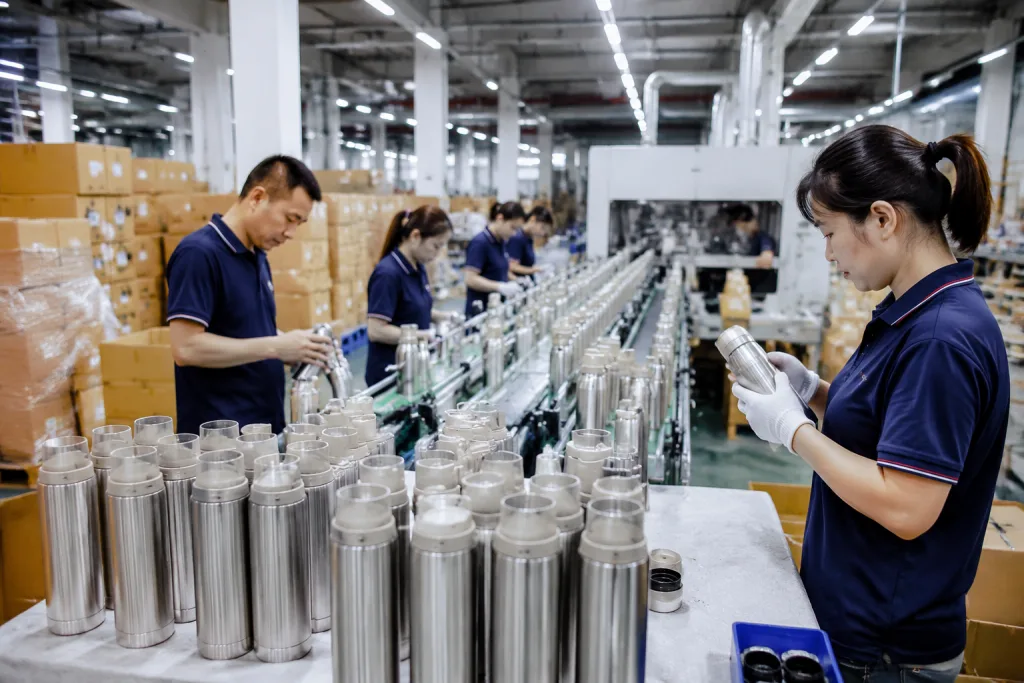
If you searched for a pp thermos bottle factory, you probably do not want a cheap plastic flask. Most buyers mean a stainless vacuum thermos with a food-grade PP lid, cup, handle, or stopper. That detail changes the job at the line: a 28 mm neck on one model, a different cap mold on another, and the right test report for customs, REACH, and the buyer’s own shelf check.
We run stainless drinkware in Zhejiang, China, and we see the same mistakes every season: a PO with “500ml” typed as “50ml,” artwork sent after the cap sample is already cut, and a bulk price that ignores the extra tooling. QC pulled the sample from the leak rack at 90°C, and the buyer flagged a drip at the stopper. That is the wrong place to save money.
What PP means in thermos sourcing
On our POs, PP means polypropylene. We use it for lid shells, stopper buttons, inner cup parts, handles, straw covers, and sometimes measuring cups; QC usually checks the resin mark with a small flame test and the supplier COA before the line starts. A stainless vacuum body is usually made from SUS304 inside and SUS201 or SUS304 outside. So if you ask a pp thermos bottle factory for a stainless thermos, split the body material from the plastic food-contact parts on the spec sheet.
For outdoor retailers, PP parts take the beating: 8,000 twist cycles, 1.2 m drop tests, hot liquid contact, dishwasher claims, and repeated opening at -10°C. The lid gets blamed first. For promotional brands, PP parts drive color matching and mold cost; last March, one buyer flagged a 2.1 Delta E gap on an orange lid against the Pantone chip. A black PP lid from an existing mold is simple. A Pantone-matched orange lid with a custom button shape is a different job.
Our Zhejiang line can produce about 450,000 stainless bottles and thermos units per month across shared models. Standard custom thermos MOQ is 1,000 pcs per color for existing molds, while new PP lid tooling usually makes sense from 5,000-10,000 pcs. Below that, the tooling cost per unit becomes ugly; we ran the math on a 2,000 pcs trial order, and the lid mold alone added about USD 0.46 per bottle before packing.
Ask your thermos supplier to list every food-contact component. A clean bill of materials should say something like: inner wall SUS304, outer wall SUS201, lid PP, gasket silicone, base pad silicone. If a supplier thermos quote only says “stainless steel + plastic,” the math doesn't work for a retail or distributor thermos program; we have seen approvals go sideways when QC pulled the sample and found the “plastic” straw cover was not listed for FDA or LFGB review.
Set the stainless body specification first
The bottle body sets the cost before the lid team even quotes. Capacity and diameter change the draw mold, wall thickness changes coil usage, and mouth opening changes the necking tool. A 500 ml factory thermos and a 1,000 ml outdoor thermos are not “same bottle, taller size.” We run different forming dies, laser welding speed, polishing wheels, vacuum oven slots, and carton inserts; last month QC pulled a 500 ml sample at 286 g body weight while the 1,000 ml flask came in at 512 g before coating.
For a mid-range manufacturer thermos program, we normally suggest SUS304 inner wall at 0.35-0.40 mm and SUS201 outer wall at 0.40-0.45 mm. For premium retail, SUS304 outside can be used, but the FOB math changes fast; on a 3,000 pcs PO, the buyer flagged a USD 0.42 increase and asked us to switch back to SUS201 outer. For large outdoor flasks, the bottom impact zone needs a thicker base or silicone boot if your customer sells to hikers and site workers. We have seen this go sideways when a 1.2 mm flat base passed desk review but dented after a 1 m drop test on the line.
Vacuum performance belongs in a test condition, not a slogan. Write it like this: fill with 95°C water, test at 20°C room temperature, record temperature after 6 hours and 12 hours. Many 500 ml double-wall models can hold above 60°C after 6 hours when properly vacuumed; our vacuum furnace log usually targets below 5 Pa before sealing. Wider-mouth food jars and cup-lid thermos models perform lower because the opening is bigger and the lid carries more plastic mass. The buyer may ask for “24 hours hot,” but this is the wrong question to ask unless the test temperature, room condition, and lid structure are locked.
Do not approve a thermos custom order from a glossy photo. Ask for body weight, wall thickness range, mouth diameter, lid exploded view, and packaging dimensions. Better still, put the numbers on the sample tag: 0.38 mm inner, 52 mm mouth, 24 pcs per carton, 13.6 kg gross weight. These details help you compare thermos manufacturers fairly and give your freight forwarder carton volume before you promise landed cost to a distributor. We once caught a PO typo showing 7.5 cm carton height instead of 75 cm; that single zero would have ruined the freight quote.
Logo choices change price and durability
A promotional thermos can carry a logo 6 or 7 ways, and the cheapest quote is often the wrong question to ask. Silkscreen printing fits clean one-color or two-color artwork on powder coating; our line checks it with a 3M 600 tape pull after curing. Laser engraving holds up better for corporate gifts, though the final mark reads silver, dark gray, or warm brown depending on the coating thickness and the 304 stainless under it. Heat-transfer printing gives richer color, but QC needs adhesion testing on the curved body, especially near the 72 mm radius where film edges like to lift.
For outdoor retail, we run buyers toward powder coating plus laser engraving or a small silkscreen mark. It survives carton rubbing and shelf handling better than a big full-wrap graphic. Simple wins. For a thermos promotional campaign with a 30- to 60-day use cycle, a large printed logo can pass if the buyer signs off on tape testing and 500-cycle abrasion testing; we have seen this go sideways when the buyer flagged peeling only after 12 cartons had already been packed.
Logo setup costs stay manageable on existing shapes. A screen plate may be USD 35-60 per color. Laser setup is often USD 30-50 per artwork. Full-wrap heat transfer can require USD 120-250 in film and setup depending on the pattern. The math doesn't break on setup fees; it breaks when artwork arrives late. Send vector AI, PDF, or EPS files before sampling, not after the sales order is signed. Last month one PO had “mat black” instead of “matte black,” and that typo cost 2 days before our pre-press operator would cut the film.
Color matching needs discipline. Powder coating can target a Pantone reference, but stainless drinkware is not paper printing. A workable tolerance is a close visual match under D65 light, with approval by physical swatch or pre-production sample. If your customized thermos needs campaign colors to match across bottles, boxes, and PP lids, approve all three materials together. We ship better color when the standard is real: a 50 mm sprayed metal chip, a printed box proof, and an injection PP lid sample on the same approval table, not a screenshot from a phone.
MOQ, pricing, and lead time reality
Most sourcing problems start with a buyer asking for 300 pcs, 3 colors, custom lid, retail box, and a FOB price lower than our raw cup cost. The math does not work. On the line, every color change means cleaning the powder booth, swapping jigs, and checking the first 20 pcs again under the D65 light box. Existing molds can handle a small test run, but stable production starts when steel purchasing, coating, logo printing, packing, and AQL 2.5 inspection can move without stop-start changeovers.
For our Zhejiang, China production, a typical MOQ is 1,000 pcs per color for existing stainless thermos molds and 3,000 pcs total when multiple colors share the same body. For custom PP lid tooling, we prefer 5,000 pcs or more because one lid mold trial already burns resin, CNC time, and 2-3 rounds of fit testing on the thread gauge. Standard lead time is 30-45 days after deposit, artwork, and pre-production sample approval. Peak season before Q4 can stretch to 50-60 days if powder coating capacity is full; last October we had 18 coating batches waiting, and the buyer flagged a 12-day delay on a PO that still showed the wrong Pantone code.
FOB prices vary by spec, but buyers still need a working range. A 500 ml stainless custom thermos with PP lid and one-color logo may land around USD 3.20-5.20 FOB Ningbo depending on steel grade, coating, carton, and testing. A 1,000 ml outdoor flask with cup lid, handle, and heavier wall may run USD 6.50-10.50. Retail packaging, hang tags, barcode labels, and FNSKU application add labor and material cost; QC pulled one Amazon sample last month because the FNSKU was 2 mm off-center and the scanner missed it twice.
If you are buying thermos bulk for distributors, build the price sheet by selling channel, not by hope. We run plain carton bulk thermos for warehouse buyers, retail box thermos customized for store shelves, and e-commerce packed units with drop-test cartons when the account needs it. Mixing these assumptions in one quote creates bad margin math. A serious thermos vendor will ask where the product sells before locking the packing method, because a 12 kg master carton for wholesale is not the same job as 24 single units packed for FBA.
Compliance for outdoor and promo channels
Compliance will not sell the bottle by itself, but it keeps the PO from getting blocked at shipment. For Europe, ask for LFGB, REACH, and food-contact declarations covering stainless steel, PP, silicone, coating, and ink. For North America, buyers usually ask for FDA food-contact statements, CPSIA if the thermos is aimed at children, and California Proposition 65 review for that market. Kids’ thermos models may also need ASTM F963 consideration depending on the lid design and the words printed on the carton. We had 1 promo buyer flag “school safe” on an artwork file because the test scope only covered adult use. QC pulled the sample from line 3 before logo printing.
A BSCI or similar social audit is often required by large retailers. ISO 9001 helps show process control, but it does not replace product testing. Different job. If your customer asks for recycled stainless steel or sustainability claims, document the claim with supplier traceability, material ratio, and carton wording before the PO is signed. Do not let a supplier thermos factory print “eco-friendly” on packaging without proof. The math does not work when a retailer asks for evidence 12 days before vessel closing and the lab needs 18 days for a full report.
Testing should happen before mass production where possible. For a customizable thermos program, test the exact PP color, gasket material, coating, and print ink you will ship. A black lid changed to bright red can change pigment compliance. A matte powder coating changed to metallic coating can change adhesion, especially after a 3M tape pull test on the curved cup body. Small changes need fresh judgment, and sometimes fresh reports. We have seen this go sideways when a buyer approved Pantone 186C on the PO, then sent artwork marked 185C after the injection mold trial.
Use AQL inspection on every order. A common standard is AQL 2.5 for major defects and 4.0 for minor defects, with critical defects not accepted. Check vacuum performance, leakage, coating scratches, logo position, lid fit, odor, carton drop condition, barcode scan, and quantity. We run a simple 95°C hot-water hold test, then check leakage after the bottle lies flat for 30 minutes. The line should also measure logo drift in mm, not by eye. Thermos suppliers who resist third-party inspection are not saving time; they are pushing the risk onto your warehouse.
Sampling should prove production risk
A clean sample helps, but it does not prove the line can repeat it. Sample room work is slow: one operator may hand-polish the cup mouth with 800-grit paper, pick the best PP lid from a tray, and tighten the gasket by feel. Mass production is different. We ask buyers to approve a pre-production sample made with the same steel coil, PP lid mold, silicone gasket, coating batch, logo jig, and color box paper that we run on the order. QC pulls that sample from the trial line, not from the showroom shelf.
For serious customized thermos projects, we run sample approval in 3 steps. Step 1 is a stock sample to check capacity, grip, cup diameter, and whether the 500 ml version feels too tall in hand. Step 2 is a decorated sample, where the buyer signs off the logo position in mm, coating shade, PP lid color, and barcode placement on the box. Step 3 is the pre-production sample from order materials before the full run starts. It adds 7-12 days. The math still works, because repainting 20,000 units after the buyer flags the wrong finish can eat 18 days and a lot of margin.
Leak testing should be strict. Fill with hot water, invert for 30 minutes, shake, then check the lid thread, button, gasket, and cup joint. QC uses a timer, a white tissue, and a bench marked by model number; if one button cap sweats, we stop and check the gasket compression in mm. For outdoor thermos models, add a carton drop test from 76 cm on edges and corners if the product ships through parcel networks. For Amazon or DTC programs, carton strength is not optional. We have seen this go sideways: one weak inner box makes the return report say “leaking bottle,” even when the bottle passed AQL 2.5.
For a thermos manufacturer, the best buyer is specific. Send the sales channel, capacity, target FOB, annual volume, compliance market, logo process, and required ship date, plus the boring details buyers sometimes skip: pantone code, lid material, insert card size, and whether the PO says “mat black” when the artwork says “matte black.” Then we can tell you if an existing mold works or if your thermos customizable design needs tooling. Asking only for the cheapest quote is the wrong question to ask.
How to brief a factory clearly
A clear RFQ saves 3 to 5 days. Send one file, not fifteen chat messages. Put the basics in the first page: capacity, rough height and diameter in mm, steel grade, lid style, PP color, silicone color, coating finish, logo artwork, carton plan, test market, order quantity, destination port, and delivery date. If you need FOB Ningbo, write FOB Ningbo. If you need DDP warehouse delivery, say it before we cost the job, because freight, duty, and local delivery sit in a separate quote sheet. Last month QC pulled a sample because the PO said “matte black” while the approved color chip was Pantone 426C. Small typo. Big delay.
Use plain wording for commercial buyers. If you are a distributor thermos buyer, tell us whether you need plain brown cartons for resale stock or printed cartons for one chain account. If you sell to outdoor retailers, send the shelf depth, hang tag hole size, and barcode position; our packing line checks barcode scan at 300 mm before carton sealing. If you buy for a promotional brand, give the event date and write the overrun or underrun tolerance, such as +3% / -0%. We have seen 20000-piece promotional thermos orders go sideways because the campaign date stayed fixed while artwork approval took 12 days instead of 3.
Do not hide the target price. This is the wrong question to ask: “What is your best price?” Give the number, then we can adjust body weight, outer steel thickness, coating, packaging, or logo method without pretending two different products are equal. If your target is USD 4.00 FOB for a 750 ml thermos with premium box, handle lid, laser logo, and EU testing, we should say on day 1 whether the math works. On the line, a 0.4 mm outer shell and a 0.5 mm outer shell do not cost the same, and the polishing wheel shows the difference.
For repeat thermos distributors, build a core line. Keep 2 or 3 bottle bodies, 6 stock colors, and one modular decoration system. That gives you better production slots, simpler spare gasket control, and steadier QC results under AQL 2.5. A pp thermos bottle factory can run complex custom projects, but the profitable programs are usually disciplined, not over-designed. We ship cleaner when the buyer does not change lid molds every season; one shared gasket bin on the assembly bench beats 5 look-alike parts every time.
Send your thermos specs before locking artwork
Share capacity, lid type, MOQ, target FOB, market, and logo file. We will check the fastest workable factory route.
Frequently asked questions
Is a PP thermos bottle the same as a stainless thermos?
Usually no. In sourcing language, PP refers to polypropylene plastic parts such as the lid, stopper, cup, handle, or button. The vacuum body is normally stainless steel, often SUS304 inside and SUS201 or SUS304 outside. When you ask a pp thermos bottle factory for a quote, specify both parts: stainless body grade and PP lid material. For food-contact markets, also list silicone gaskets and coating or ink requirements. This avoids a vague quote and helps confirm whether REACH, LFGB, FDA, or other reports are needed for the exact materials you will ship.
What MOQ should I expect for a custom thermos order?
For existing molds, a practical MOQ is 1,000 pcs per color. If you can accept one body shape and split two colors, many factories prefer at least 3,000 pcs total to keep coating and packing efficient. A new PP lid, handle, or stopper mold usually needs 5,000-10,000 pcs to make commercial sense because tooling, testing, and setup cost must be absorbed. For a distributor thermos trial order below 1,000 pcs, use stock colors and a simple laser or one-color silkscreen logo.
How long does production take after sample approval?
Standard lead time is 30-45 days after deposit, artwork approval, and pre-production sample confirmation. Sampling usually adds 7-15 days depending on coating, logo process, and whether PP color matching is required. Before Q4 retail and promotional season, lead times can stretch to 50-60 days because coating, vacuum testing, and packing lines get booked. If your event date is fixed, approve artwork and packaging before placing the purchase order. Late barcode, FNSKU, or carton mark changes are common causes of shipment delay.
Which logo method is best for outdoor retail thermos bottles?
For outdoor retail, powder coating plus laser engraving is usually the safest choice because it handles abrasion better than large printed areas. One- or two-color silkscreen is fine for clean logos, especially on matte coating, but it should pass tape and rub testing. Heat transfer works for full-color graphics, though it adds setup cost and needs careful adhesion checks on curved bodies. For promotional thermos orders, the best method depends on campaign life, budget, and artwork complexity. Always approve a physical decorated sample before mass production.
What quality checks should I require before shipment?
Use AQL inspection, commonly 2.5 for major defects and 4.0 for minor defects, with zero tolerance for critical safety issues. Check leakage, vacuum performance, lid fit, gasket placement, coating scratches, logo position, odor, sharp edges, carton drop condition, barcode scan, and final quantity. For vacuum performance, define the test: 95°C fill temperature, 20°C room temperature, and measurement after 6 or 12 hours. If selling through e-commerce, inspect master carton strength and inner box protection because parcel damage can quickly become a return-cost problem.