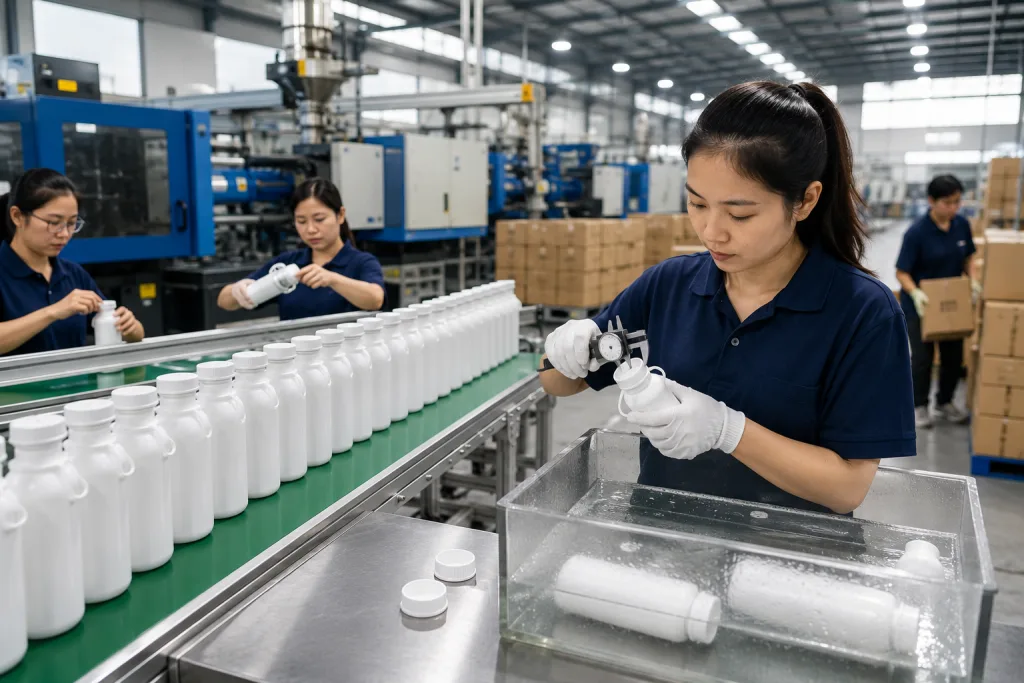
Key Takeaways
- Typical pp drink bottle bulk MOQ starts at 3,000 pcs, with factory prices often $0.38-$1.25 depending on size and decoration
- For export, ask for REACH, LFGB where needed, FDA-related material declarations, and AQL 2.5/4.0 inspection terms
- PP bottles usually run 0.8-1.5 mm wall thickness; thin walls save cost but raise deformation and leak risk
- Lead time from sample approval is usually 18-25 days in Zhejiang factories, plus 25-40 days ocean transit
If you are sourcing pp drink bottle bulk, the question is not whether a factory can mold it. We can. The real question is whether the bottle passes your market rules, stays stable at scale, and still leaves margin after freight, duty, and packaging. A $0.38 bottle turns into a bad buy fast if the wall thickness shifts by 0.3 mm, the cap leaks on a 48-hour upright test, or the resin grade is wrong for the buyer’s use case.
PP is light, takes impact well, and usually costs less than Tritan or stainless steel, so procurement teams like it. The wrong question is “Can you quote it?” The better one is “What resin, what drop test, what temperature range, and what print method are we signing off?” At our Hangzhou, Zhejiang plant, we run 180,000 units a month across the drinkware line, MOQ starts at 3,000 pcs, and lead time is 18-25 days after sample approval. QC pulled the sample last week because a PO typo said 3000ML instead of 300ML. That kind of thing happens. What matters is whether the supplier can repeat the same result on the next order without drifting on thickness, fit, or finish.
What PP bottles actually suit
PP means polypropylene. For drinkware, we run it on cold or room-temperature fills, and that is where it pays its way. Campus bottles, gym bottles, promo runs — those jobs want low unit cost and decent impact resistance. If your buyer asks for freezer-safe, microwave-safe, or hot-fill above 90°C, stop there and check the resin grade and bottle structure first. Standard PP will not cover bad specs.
For pp drink bottle bulk, the clean range is usually 400 ml to 1,000 ml. A 500 ml PP bottle often lands at 48-72 g, depending on wall thickness and cap build. QC pulled a sample at 62 g last month; the buyer flagged the lighter one because the cap felt flimsy in hand. That 10 g swing across 50,000 pcs changes freight and carton count. We ship enough of these to know the math does not work if the spec is vague. In China, a lot of factories blur PP and PE in the quote, and that is the wrong question to ask. Put resin name, melt flow index, and process type on the sheet. Injection-blow and injection-molded with assembled parts price out differently, even before the first tray hits the line.
Best fit use cases
- Promotional wholesale drinkware for sports events
- Entry-level canteen bulk programs for schools and camps
- Light-duty travel bottles where weight stays under 70 g
- Budget retail sets sold as the best wholesale drink bottle for casual use
Pricing, MOQ, and what moves cost
For a plain 500 ml PP bottle, factory pricing in Zhejiang starts around $0.38-$0.62 at 3,000 pcs. Add one-color silk screen and the line lands at $0.48-$0.78. Add custom cap tooling, a spray finish, or a two-part design and you are at $0.90-$1.25. That is normal. What is not normal is a quote with no clear line on packaging, carton marks, or test fees. We had one buyer flag a PO typo on “1,000 pcs” that was meant to be “10,000 pcs” — the math changed the whole order.
The cost drivers are plain: wall thickness, cap complexity, mold cavitation, print area, and packaging level. A 12-cavity mold cuts unit cost, but only if your annual volume backs it. For drinkware wholesale private label, 3,000 pcs MOQ is workable. For a bulk canteen program with three colors and two lids, plan on 5,000-10,000 pcs before the price stops looking forced. The cheap quote is usually the one that skips secondary operations. QC pulled the sample with a 1.8 mm wall on the body and it still passed, but the buyer wanted the lighter weight without the mold cost. That is the wrong question to ask.
Ask for an itemized quote: bottle, lid, gasket, decoration, packaging, test report, and carton spec. If the supplier will not break it out, you are not comparing real numbers. We ship better when the carton mark is fixed on day one.
Specs that stop leaks and complaints
Most returns on PP bottles come from bad sealing, not from the PP resin. Set the neck finish, gasket material, cap torque, and closure cycle before we open the mold. A serious bulk supplier talks in numbers, not adjectives. A 28 mm neck with a 1.5-2.0 mm silicone gasket behaves differently from a TPE seal after 3,000 opens. For school and sport bottles, a 1.2 m drop to concrete is the baseline test. We run that on the line.
Wall thickness usually sits between 0.8 mm and 1.5 mm. Below 0.8 mm, you lose rigidity and the bottle can twist in hot washing. Above 1.5 mm, resin use goes up and cooling time drags; on one run, that added 18 seconds per cycle. For canteen wholesale buyers, that is not a small detail, because 5,000 pcs at +8 g each turns into a freight bill nobody likes. Ask for shrinkage rate, gate location, and 3,000-5,000 open-close cycles without thread damage. The buyer flagged a PO typo on “28mm” versus “28 mm” once, and we had to stop the tool check. That is where a Zhejiang factory earns its keep.
- Leak test: inverted 24 hours at room temperature
- Drop test: 1.0-1.2 m, 3 times minimum
- Dishwasher check: confirm top-rack only if claimed
- Odor check: no plastic smell after first wash
Compliance for US and EU buyers
If you sell into Europe or North America, compliance is table stakes. For PP drinkware, we run a material declaration, migration testing where it applies, and lot traceability from resin bin to finished carton. On the EU side, buyers ask for REACH alignment and food-contact paperwork if the bottle touches food. In the US, they want a supplier declaration tied to FDA food-contact expectations, then they still ask for the lab report. Fair enough. QC pulled a 3-sample check from the line last week, and one carton label typo would have broken the file trail.
Do not accept a generic “safe material” statement from a supplier. Ask for the exact resin code, the additive package if there is one, and test coverage by color. Dark colors, metallic pigments, and printed decoration can shift migration results. If you are importing wholesale canteen or wholesale drinkware into distribution channels, tie the paperwork to the SKU, not a sample photo. For larger programs, we still lock in AQL sampling at 2.5 major / 4.0 minor and keep one signed golden sample on the shelf. If you are planning alcohol flask bulk or alcohol flask wholesale bulk beside PP bottles, do not mix the compliance file. The math does not work, and we have seen that go sideways when the buyer flagged one missing test page at 500 MOQ.
Decoration and branding choices
PP takes branding well, but the decoration choice has to match the order size and how the bottle will be used. Silk screen is the cheapest route for one or two colors. We run that on the line all the time. Laser engraving is a poor fit for PP because the surface does not react like metal or coated stainless steel. Heat transfer and in-mold labeling give a cleaner look on larger drinkware wholesale programs, though they add setup steps and push lead time out.
For a private label launch, one-color screen print is usually the cleanest call. At 3,000 pcs, plan on 1-3 extra production days for decoration and curing if the factory is organized. QC pulled the sample once and found a 1.2 mm logo shift after the first pass, so we stopped the line and reset the jig. If you want a premium matte shell, add UV coating or a textured mold finish, then check scratch resistance with a coin rub test. If your catalog includes beer tumbler bulk, beer growler wholesale, or growler bulk items, keep those decoration specs separate from PP bottles. A supplier that throws beer growler in bulk and PP orders into one quote without breaking out the process steps is hiding complexity, not solving it.
Practical rule: if the logo gets touched every day, put the money into print quality before you spend it on a fancy cap.
Factory checks before you place order
Before you sign a bulk PO, check the factory first, not the sales email. A real Zhejiang supplier should send production photos, mold list, QC points, and a business license you can trace. Ask how many injection machines they run, how many cavities each mold has, and whether leak testing happens on the line or only by eye. If they stall, you are likely talking to a trader or a thin middle layer. That is not a sin, but you need to know who you are buying from.
For a standard PP bottle line, we expect at least one QC station, carton drop testing, and incoming resin checks. One buyer once pushed back on our claim of 50,000 pcs/month for a custom bottle, and the math was right: no mold count, no line plan, no schedule. We ship better when the factory can show the mold trial date, the pre-production sample, and the mass production slot. If you are also sourcing bulk growler or growler wholesale SKUs, ask whether stainless and plastic stay in separate workshops. QC pulled the sample, found a 1.2 mm wall mismatch, and the buyer flagged it before we loaded the cartons. Mixed processes work only when the inspection sheet is strict.
How to buy without wasting freight
Freight eats margin fast when carton size and product density are off. A 500 ml PP bottle packed at 48 pcs/carton can look fine on paper, but if the carton is 58 x 38 x 32 cm instead of a tight pack, the air goes with you all the way to port. We run these checks before artwork release: gross carton weight, carton cube, and pallet pattern. Change the cap by 3 mm or swap the insert, and a 40HQ can lose 240 to 360 units.
For North America and Europe, I tell buyers to look at landed cost, not just ex-factory price. A bottle at $0.52 FOB Ningbo or Shanghai can beat a $0.44 quote if the first factory uses tighter cartons and the second one sends you a claims file. The buyer flagged a carton typo once, 36 pcs/carton became 48 pcs/carton on the PO, and the math did not work. If you are building a mixed program with canteen bulk, canteen wholesale, or alcohol flask wholesale items, split the SKUs by material and pack format so the warehouse does not mix labels on the line. Cheap freight turns expensive at the DC.
Use one rule: if the supplier cannot send carton dimensions, net weight, gross weight, and HS code guidance within 1 working day, do not place the order. QC pulled the sample, checked the carton at 62 x 41 x 35 cm, and found the packing sheet was missing the tare weight. We have seen that go sideways more than once.
Get a real quote from Zhejiang
Send your size, lid style, logo file, and target market. We will quote MOQ, lead time, and packaging with no guesswork.
Frequently asked questions
What is a realistic MOQ for pp drink bottle bulk?
For a standard PP bottle with existing mold, a realistic MOQ is usually 3,000 pcs. If you want custom color, custom lid, or logo print, many Zhejiang factories move to 5,000 pcs to keep the line efficient. For new tooling, expect 10,000 pcs or more, depending on cavity count. Small runs below 1,000 pcs are possible, but the unit price can jump 30% to 70% because setup cost gets spread over too few bottles.
What price should I expect from a China factory?
For pp drink bottle bulk, a plain 500 ml bottle often lands around $0.38-$0.62 FOB at 3,000 pcs. Add one-color printing and you may see $0.48-$0.78. Premium caps, special finishes, or extra testing can move the price to $0.90-$1.25. If a supplier gives you a much lower quote, check whether it includes packaging, labeling, test reports, and carton marks. In China, incomplete quotes are common.
Which tests should I request before shipment?
At minimum, request leak testing, drop testing, and material documentation tied to your SKU. For EU-bound orders, ask for REACH-related declarations and any food-contact migration reports your market requires. For US programs, keep supplier declarations and third-party lab results on file. If you are ordering 5,000 pcs or more, use AQL 2.5 major and 4.0 minor as your inspection baseline. Also confirm color consistency and cap torque on random samples.
Can PP bottles handle hot liquids or dishwashers?
Some can, but you should not assume it. Standard PP is better for cold or room-temperature drinks. If the bottle is marketed for hot use, ask for the exact maximum temperature and test data, because deformation can start if the design is too thin or the cap seals are weak. For dishwashers, top-rack only is a safer claim unless the factory has validated the bottle under repeated heat cycles. A 0.8 mm wall is not the same as a 1.5 mm wall.
How do I choose between PP, Tritan, and stainless steel?
Choose PP when you want low cost, light weight, and decent impact resistance. Choose Tritan when clarity and a more premium look matter, and stainless steel when insulation or a higher perceived value is needed. A PP bottle may cost $0.38-$1.25, while stainless programs often cost several times more depending on gauge and insulation. For bulk drinkware or canteen wholesale orders, PP is usually the best value if the use case is casual, not thermal.