Key Takeaways
- A serious polypropylene water bottle supplier should quote MOQ, lead time, and monthly output up front: for example 3,000 pcs MOQ, 25-35 days, and 200,000 units/month.
- For export orders, ask for REACH, LFGB, FDA, and ISO 9001 evidence, plus AQL inspection terms before you approve production.
- Polypropylene works best for lightweight custom drinkware, but wall thickness, cap fit, and print method decide whether the bottle feels cheap or retail-ready.
- Distributor programs need predictable packing: carton counts, barcode labels, and FNSKU-ready cartons matter as much as the bottle itself.
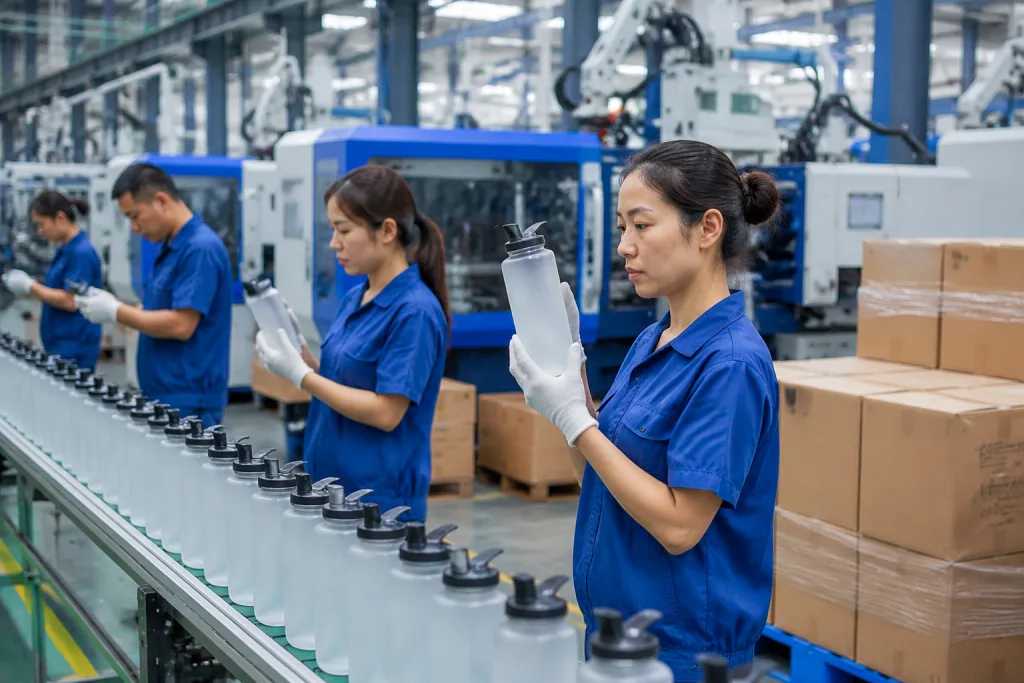
If you are sourcing from a polypropylene water bottle supplier, the first question is not unit price. It is whether the bottle runs clean on the line, prints without smearing, survives drop tests, and clears EU and North American compliance without a late surprise. We have seen orders stall on a 0.2 mm lid mismatch, a wrong resin grade on the spec sheet, or artwork that looked fine on screen and failed on the first pad print. The math does not work when the factory says yes to everything and QC pulls the sample at 8:30 a.m. only to find the cap torque is off.
Polypropylene works well for custom drinkware because it is light, impact resistant, and cost effective for canteen custom programs, promotional campaigns, and distributor drinkware lines. The real job is choosing a canteen manufacturer that knows tooling, decoration, and export packing, not just molding a bottle. On our line in Zhejiang, we ship PP pieces with 5,000-unit MOQ runs, and the buyer usually flags the same issue first: lid fit, not the bottle body. That is the wrong question to ask if the supplier cannot hold tolerances, because a 30-day launch slips fast when the carton marks, color chip, or logo placement are off.
Why polypropylene wins on value
I’ll rewrite the prose in place, keep the HTML exactly as-is, and tune the copy to sound like a factory-side sales engineer.What a supplier must show you
Start with papers, not promises. A polypropylene water bottle supplier should put ISO 9001 on the table, BSCI if the order goes into retail or licensed channels, plus fresh REACH reports and, when the market asks for it, LFGB or FDA food-contact reports. If the plant says it has export experience but cannot show recent test files, we move on. Europe and North America do not buy on goodwill.
Then look at process control. Ask how they handle incoming resin, mold maintenance, in-process checks, and final inspection. A solid canteen manufacturer will state the AQL without stalling, often AQL 2.5 for major defects and 4.0 for minor defects on consumer drinkware, and will know the limits for lid torque, leak resistance, and print adhesion. If they cannot give acceptance criteria, they are not running a buyer-facing export line.
Packaging matters too. A proper canteen supplier should tell you whether bottles go polybagged, sleeve-wrapped, or nested to stop scuffing in transit. Carton count has to match your warehouse flow and retail plan, especially on distributor canteen orders. If you need FNSKU labels, barcodes, or master carton marks, bring it up before sampling. We have seen POs go sideways over a 12-pack versus 24-pack typo.
Ask for output, not workshop size. A Zhejiang plant shipping 200,000 units per month usually has the line discipline to repeat an order without reshuffling every job. That is the number that matters if your canteen custom program has seasonal reorders and a 15-day ship window. Capacity on paper is cheap; stable production is the part you pay for.
Custom options that actually sell
Customization should make the bottle easier to sell, not harder to run on the line. For polypropylene water bottles, the options that move are one-color screen print, wrap print, embossing on the mold, and cap color matching. Laser engraving is usually a dead end on PP, so do not push a decoration method just because it sounds premium. We have seen buyers ask for it anyway, then QC pulled the sample and the mark looked weak after the first wipe test. For a canteen promotional campaign, clean print contrast and fixed placement matter more than flash.
If you are building a custom canteen range, pick the decoration method by volume and channel. Screen print makes sense at 3,000-10,000 pcs, where the setup cost still fits the order. Molded-in branding works better when the same body comes back every season, and the tool does not need a new plate every time. A canteen customized for retail should also cover volume marking, mixing ratio marks for sports use, or handle geometry for a better carry grip. This is the wrong question to ask if the goal is only to make it look fancy; the buyer cares about sell-through, not your mood board.
Color matters too. Transparent and semi-transparent PP let buyers see the liquid level, while opaque colors hide scuffs and give the brand a stronger read on shelf. For distributor drinkware, we usually standardize 3-4 stock colors because it keeps MOQ under control and cuts sample rounds from 12 days to 18 days when the artwork keeps changing. If your customer wants a customizable growler look, PP can mimic that broad-shoulder shape at lower weight and lower freight cost than glass or stainless. We ship a lot of those, and the math does not work if you chase a heavy body just for appearance.
Ask your supplier for a decoration proof before production. A solid canteen vendor will send artwork placement, Pantone references, and print tolerance so you can approve the final look without guessing. We usually check the proof against a 0.2 mm registration tolerance and the actual cap sample, because a small shift there turns into a complaint on arrival. That is the difference between a canteen manufacturers program that scales and one that turns into endless email corrections.
MOQ, price, and lead time
For B2B buyers, the commercial structure matters more than the catalog. A solid polypropylene water bottle supplier gives a clear MOQ: usually 3,000 to 5,000 pcs for custom color or print, and lower on a stock mold with simple logo work. We once had a buyer flag a PO that said 500 pcs for a full custom mold. That math does not work. If the quote looks that light, ask what cost is being hidden, because it usually comes out of QC or material thickness.
Lead time should be plain. Sample time is often 7-10 days if no tooling change is needed. Mass production usually runs 25-35 days after sample approval and deposit. That is normal export timing for a canteen factory in China or Zhejiang with live production slots. We run the line every day, and a faster promise only holds when the mold, resin, and decoration setup are already in place. QC pulled the sample on a 2.0 mm wall check before it moved ahead.
Price comes down to three things: resin grade, mold complexity, and print method. A simple custom drinkware bottle in PP may start low at factory level, but add a sport lid, silicone seal, color matching, and retail packaging, and the landed price climbs fast. Do not compare unit price alone. Compare the full FOB package, including carton count, sample fee, artwork setup, and any extra charges for color matching or leak-test fixtures. We had one PO typo where the buyer wrote 12,000 pcs on the item line and 1,200 pcs in the total; the line caught it before it became a loss.
For canteen distributors and distributor canteen buyers, ask whether the factory supports mixed-SKU cartons or same-print repeat orders. That changes inventory turns. The right canteen supplier gives a price break when the design stays stable and the reorder risk drops. We ship mixed cartons only when the carton mark and inner pack are fixed, and if the buyer wants a split load, we say so up front instead of pretending it is free.
How to source without getting burned
The safest sourcing process is boring. Good. Start with 2 or 3 factories, not 10. Ask each polypropylene water bottle supplier for a technical sheet, compliance documents, sample photos, and a written quote with MOQ, lead time, and Incoterms. If a factory will not put those basics in writing, they are not export-ready. We run into this on the line all the time.
Then test the sample like a buyer, not like a marketer. Fill it with hot water and cold water, check lid torque with a torque wrench, shake it upside down, and smell it again after 24 hours. If the bottle is for a customized drinkware program, print it, rub it, and wash it. For a custom growler or canteen customized for events, check the handle when wet and see whether the cap still seals after 50 open-close cycles. These are simple checks, and they save you from 5,000 bad units. QC pulled one sample last month with a 0.8 mm gasket lip issue; the buyer flagged it before shipment.
In China, the stronger suppliers usually ask smart questions back: target retail price, shipping country, compliance requirement, and whether you need a canteen promotional SKU or a long-term distributor drinkware line. That is the right signal. It means the factory is working toward a production result, not just sending samples. A weak vendor only asks for logo files and says yes to everything. We saw a PO last quarter with the logo size typed as 15 cm on a 750 ml bottle. The math does not work.
If you want a reliable canteen manufacturer, look for one that speaks plainly about risk. They should tell you if a wide-mouth lid needs a thicker gasket or if one color needs 72 hours of curing instead of 48. That kind of answer saves more money than a cheap quote ever will. Ask for the mold report and a photo of the cavity mark, not just a sales brochure.
Distributor programs need structure
A distributor program only works when the spec stays fixed. If you run canteen distribution, the same bottle has to land with the same print, the same carton count, and the same master case size every time. Once that drifts, the warehouse eats extra labor and the margin gets thin fast. We lock the production spec before the first shipment leaves the line.
Ask for a packing standard that fits the channel. Retail cartons may need barcode labels, SKU stickers, and pallet labels. Amazon can ask for FNSKU application, carton warnings, and exact case pack control. For distributor growler or distributor drinkware orders, even bottle direction in the carton matters when you want fewer scuffs and fewer returns. That is not a small point. We have seen a buyer flag a PO typo on case pack as a 12-day delay.
Product architecture needs discipline too. A customizable canteen line should share the same lid family, the same gasket size, and the same bottle neck where the mold allows it. That cuts spare-part risk and makes reorder forecasting cleaner. QC pulled the sample on one job because the gasket was 1 mm off, and the buyer was right to push back. A canteen vendor that keeps adding unique parts is usually building complexity for the buyer, not value for the market.
Built this way, PP drinkware becomes a platform, not a one-off item. That is how a canteen manufacturer in Zhejiang or elsewhere in China supports repeat business instead of just one shipment. We ship this kind of program every week, and the math only works when the spec stays boring.
Request a PP bottle quote with real specs
Send your target MOQ, print method, and destination market. We will quote the bottle, lid, packing, and compliance path clearly.
Frequently asked questions
Is polypropylene safe for drink bottles?
Yes, if the supplier uses food-contact-grade virgin PP and can document compliance. For EU and North America, ask for REACH and FDA or LFGB test reports, plus migration data where relevant. A proper bottle should not carry strong odor, and the lid seal should hold after repeated use. For hot-fill applications, confirm the temperature limit with the factory; PP can handle everyday use well, but you should not assume every design is suitable for boiling water.
What MOQ should I expect from a polypropylene water bottle supplier?
For a custom PP bottle, a realistic MOQ is often 3,000 to 5,000 pcs. If you need color matching, custom printing, or a new lid, expect the lower end to move up. Stock molds with simple logo work can sometimes start below that. For a canteen manufacturer running export lines, the MOQ should be tied to resin setup and decoration cost, not guesswork.
How long does custom production usually take?
Typical sample time is 7-10 days when the mold is already available. Mass production is usually 25-35 days after sample approval and deposit. If you are changing tooling, lid geometry, or packaging, add time. A factory in Zhejiang with stable capacity can hold these timelines, but only if your artwork and specs are approved early.
Which decoration method works best on PP bottles?
Screen printing is usually the best balance of cost and durability for standard orders. Molded branding works well if you want the same design repeated across seasons. Heat transfer and wrap print can work for larger artwork, but they add complexity. Laser engraving is generally not the first choice for polypropylene. For canteen promotional orders, simple high-contrast print usually sells better than a complicated finish.
What should I check before placing a distributor order?
Check carton dimensions, unit weight, barcode format, label placement, and whether the supplier can support FNSKU if needed. Confirm AQL terms, leak testing, and which spare parts are included. If you are building a canteen distributor program, ask for repeat-order consistency and whether the factory can keep the same resin color and lid tooling across future runs.