Key Takeaways
- A solid MOQ for a custom thermos is usually 1,000 pcs per color, with 7-10 day samples and 25-35 day bulk lead time.
- For 500-750 ml bottles, 304 stainless and 0.35-0.45 mm wall thickness are common; 316 usually adds $0.20-$0.60 per unit.
- A Zhejiang thermos factory can support 120,000 units/month, but only if lids, printing, and packaging are planned early.
- For Europe and North America, ask for REACH, LFGB or FDA, BSCI, ISO 9001, and AQL 2.5/4.0 control, not just a nice sample.
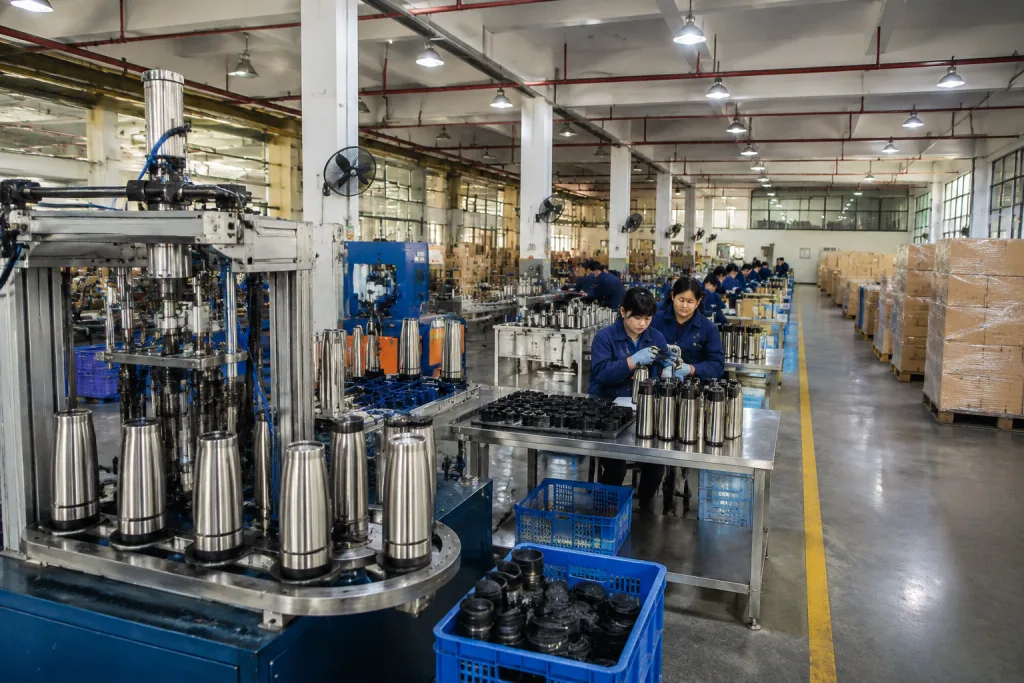
If you are talking to a polypropylene vacuum flask manufacturer, do not assume the plant only understands plastic. In Zhejiang, we run lines where the same shop molds polypropylene lids, fits silicone seals, assembles carry handles, and matches them to stainless vacuum bodies. On one line last week, QC pulled a sample with a 0.8 mm lid gap; the buyer flagged it, and that is the kind of detail that decides whether a custom thermos works or leaks.
For outdoor retailers and promotional brands, the question is not whether the sample looks good. The question is whether the thermos bulk order holds temperature, passes REACH or LFGB checks, and lands with the right carton marks for your market. A serious thermos manufacturer in China should give you MOQ, FOB port, lead time, and test standards in plain numbers. If the PO says 12,000 pcs and the art file has one wrong carton code, we catch it before the line runs, because the math does not work any other way.
Why PP Factories Win Projects
A polypropylene vacuum flask manufacturer already knows lids, seals, and assembly tolerances. That matters on a stainless thermos job too. The cap system is where most custom thermos failures start. If the lid leaks, cracks at -10°C, or opens too easily in transit, the whole order turns into a warranty claim. We have seen a buyer flag 2 mm of lid wobble on the line and cancel the trial. A factory thermos operation that molds PP parts usually controls the details that decide whether a distributor thermos program ships clean or comes back.
In Zhejiang, a lot of suppliers built their business on vacuum flasks first, then added stainless lines when export demand moved. That is not a weakness. It usually means the factory already knows how to balance tooling cost, export carton count, and a custom logo without blowing up the mold budget. One PO we fixed had a typo on the lid color code, and QC pulled the sample before packing. A good thermos supplier will tell you which parts run in-house and which parts go out for printing or plating.
- In-house PP parts usually give tighter fit and faster first samples; we can often turn a lid in 7 days instead of 12.
- In-house assembly usually cuts leak risk, because the line can spot a 0.5 mm seal mismatch before packing.
- Outsourced decoration can work, but you need adhesion data and a color check, not just a glossy photo.
If you are buying thermos custom or thermos customizable products for outdoor retail, this structure matters more than a polished sales deck. We ship enough of these to know the wrong question is “who has the nicest brochure?” Ask who owns the mold, who checks the torque, and who signs off when the buyer pushes back on the handle finish. You want a manufacturer thermos partner, not a thermos vendor reselling whatever is on hand.
Spec the Bottle, Not the Sample
A sample can hide a lot. The real work is locking the spec before you place the PO. If you ask only for a sample, that is the wrong question. For a stainless custom thermos, pin down the metal grade, wall thickness, vacuum performance, and lid construction. Most bulk runs use 304 stainless for the inner and outer shell. If the drink is acidic, salty, or the buyer wants a premium outdoor line, 316 is the safer call. On a 500-750 ml body, 0.35-0.45 mm is common. QC pulled the caliper on line 3 last week, and anything under 0.32 mm started to dent in carton drop tests. Go too thin and you lose dent resistance. Go too thick and the bottle gets heavy, then the freight math stops working.
What to lock before sampling
Ask for the retention target in writing. A practical commercial spec is 12 hours hot and 24 hours cold, but the result still depends on lid design, fill ratio, and ambient temperature. If a thermos manufacturer says only “good insulation,” that is not a spec. The buyer flagged a PO last month that said 120 hours instead of 12, and that kind of typo burns a week. You should also confirm the silicone ring material, the venting path in the lid, and whether the PP cap can handle repeated torque without whitening or cracking. On our bench, a 0.8 mm vent slot changed the whistle issue fast.
For outdoor retailers, the best custom thermos is the one that stays boring in use: no leaks, no loose lid, no fading print, no customer complaints. We tested 20 pcs from carton A12 on the drop rig, and the weak ones showed up fast.
This is where a serious supplier thermos partner earns its margin. A better factory will show you cutaway samples, vacuum test data, and thermal retention results from real production, not just a hand-picked prototype. We pull samples after the line has run 600 pcs, because that is where the real drift shows up.
MOQ, Pricing, and Timing
Price goes sideways when buyers mix stock items with true custom work. A plain promo thermos with a standard lid and one-color print usually sits at $2.40-$3.20 FOB China at volume. Step up to a powder-coated outdoor model with laser logo and an upgraded lid, and you are more in the $3.80-$6.80 range. Add 316 steel, gift box, or a special PP cap, and the number moves again. If a supplier sends one flat quote without asking about decoration, carton style, or destination port, the quote is not ready. We had a buyer flag a PO typo once—“3,000 pcs” on the order, “300 pcs” in the artwork file—and the math broke before we even started the line.
MOQ needs to be stated cleanly. For most custom thermos programs, 1,000 pcs per color is a workable number. Stock mixed orders can go lower, but that is a different job from a custom flask build. If you want a new color, new lid, or new logo setup, the factory may ask for 3,000 pcs across the run to cover tooling and setup. This is the wrong question to ask if you only look at unit price; the mold insert for a special PP cap can eat the margin fast. QC pulled the sample on a 1,000 pcs run last month because the cap torque was off by 0.8 N·m.
Lead time is usually 7-10 days for samples, 25-35 days for production, and 45-60 days when new tooling is needed. A mid-size Zhejiang thermos factory can run around 120,000 units/month, but only if art, carton marks, and packaging are approved early. One buyer delayed carton text by 4 days, and the ship date slipped 12 days. Slow approvals cost more than steel. We ship faster when the print file is clean on day one.
Decoration That Survives Field Use
Outdoor retailers care about scuff marks. Promo buyers care about logo visibility. We need one decoration method that holds up for both. On a 1,000-piece run, silkscreen is still the lowest-cost way to put a custom logo on a thermos bulk order, especially for 1 or 2 colors. Laser engraving costs more, but it leaves a mark that does not peel. UV print handles fine line art and photo-style graphics, while powder coat gives the body better grip and a cleaner hand feel. QC pulled a sample with a 0.2 mm ink edge bleed last week, and that is the sort of detail that turns into a buyer complaint fast.
The right choice depends on how the bottle will actually be used. For a giveaway thermos at an event, simple silkscreen and a plain box are enough. For a distributor program going into hiking stores, we usually push the buyer toward laser or a tough transfer print, because bottles get dragged across packs, car doors, and tent poles all day. If you want a deep brand color, ask the thermos manufacturer for a sample panel before you lock the order. Stainless and PP react differently under heat, and we have seen a Pantone match look fine in the shop at 6500K, then shift under office LEDs. This is the wrong question to ask if someone says, "Can you just print it now?"
- Silkscreen: best for low cost and simple logos.
- Laser engraving: best for durability and retail presentation.
- UV print: best for complex art and short runs.
- Powder coat: best for grip, color, and field durability.
If you need a practical comparison of logo methods, review the decoration process before you commit to a thermos promotional run. A bad print job turns a good bottle into dead inventory. We had one PO last season where the buyer flagged a 2 mm logo shift on the approval sheet, and that small typo would have cost a full rework on 5,000 units.
Compliance for EU and North America
For Europe and North America, compliance is not optional. Your supplier should be ready to provide REACH documentation for materials, and for many EU buyers, LFGB testing on contact parts is still the cleanest proof. In the United States, FDA-oriented material declarations are common for drinkware programs. If the body is stainless steel and the lid is polypropylene, the lid, silicone gasket, and coating all need separate attention. On our line, QC pulls the lid sample before leak testing, because a good shell does not save a bad seal. A polypropylene vacuum flask manufacturer usually knows how to keep PP traceability and seal performance straight from the first sample.
Ask for ISO 9001 if you want a basic quality system, and BSCI if your retail customer expects social compliance. For production control, AQL 2.5 is common for major defects and AQL 4.0 for minor defects, but the factory should define the inspection plan in the purchase order. We write that into the PO, not into a sales promise. Do not accept a vague promise of “100% good quality.” The math does not work. Ask how they test leak resistance, vacuum retention, drop performance, and carton compression. A proper thermos factory in Zhejiang will know the difference between a visual check and a functional test on the 1.2 m drop rig.
For export, packaging matters too. Carton marks, barcode placement, inner box strength, and pallet height all affect damage rates. We ship with 6-layer cartons when the route is rough, and the pallet height has to stay within the freight limit. If the supplier cannot explain these details, or if the buyer flagged a barcode typo on the PO and nobody caught it, the risk moves to your warehouse.
Vet The Supplier Before You PO
The fastest way we filter thermos suppliers is with five direct questions, then we wait for real numbers. First, do they mold PP lids and silicone seals in-house, or do they buy them out? Second, what is the stainless line output per month, not the factory’s total headcount story? Third, what leak test do they run, and how many samples per lot? Fourth, can they handle retail packaging and barcodes on the same run? Fifth, which port are they quoting, and is it FOB Ningbo, FOB Shanghai, or another port?
A solid thermos distributor partner answers cleanly. No drama. If the buyer flags vague replies, we treat that as a stop sign. Show us a workshop photo, a sample report, and a 14-day production schedule, and you are talking to a factory thermos team that can likely handle a bulk launch. We always ask for the same item three ways: bare bottle, printed bottle, and packed master carton. That tells you more than a glossy brochure ever will. QC pulled the sample, measured the lid fit at 0.3 mm, and that kind of detail matters more than sales talk.
For promotional brands, after-sales speed is the other filter. If you launch a custom thermos in three countries at once, one wrong carton label or a 2 mm color shift can wipe out margin fast. This is the wrong question to ask: “Can they make it?” The math does not work if they cannot fix a typo on the PO, resend labels, and move the line without missing ship date. You want a manufacturer thermos partner who treats export work as process control, not marketing language.
When the factory shows the same discipline for Zhejiang export orders that it shows for China domestic orders, you are close to a supplier you can reuse. We run a 24-hour water check on the line, and that simple test tells you a lot about how they handle repeat business.
Get a thermos quote built for your channel
Send your size, lid style, logo method, and target market. We will quote MOQ, lead time, and FOB China pricing without guessing.
Frequently asked questions
Can a polypropylene vacuum flask manufacturer make stainless thermos bottles?
Yes, if the plant controls the PP lid, silicone seal, and final assembly. That is usually where leak risk starts, so a factory that already makes polypropylene vacuum flask components often has an advantage. Ask whether the stainless line is in-house or outsourced, and request vacuum test data, not just photos. For a 500-750 ml custom thermos, a normal MOQ is 1,000 pcs per color, with 7-10 days for samples and 25-35 days for production. If the supplier can also manage export packaging and carton marks, the project is much easier to run.
What MOQ should I expect for a custom thermos order?
For most customized thermos projects, 1,000 pcs per color is a realistic starting point. If you want a new lid, a new PP part, or special packaging, some thermos manufacturers will ask for 3,000 pcs or more to cover tooling and setup. Smaller quantities are possible from stock, but that is not the same as thermos custom production. A distributor thermos buyer should also confirm whether MOQ changes by decoration method, because laser engraving, silkscreen, and powder coat can each have different setup rules.
Should I choose 304 or 316 stainless steel?
For most bulk thermos programs, 304 is the standard choice because it gives a strong cost-performance balance. Choose 316 if you want extra corrosion resistance, sell into harsher outdoor environments, or use the bottle with more acidic drinks. The price premium is usually about $0.20-$0.60 per unit, depending on size and finish. For Europe and North America, the key is not only the steel grade but also the lid materials, coatings, and test reports. A reputable thermos supplier in China should explain all three before you place the order.
How do I compare thermos suppliers from China?
Start with evidence. Ask for ISO 9001, BSCI if needed, REACH or LFGB material files, and a real inspection plan with AQL 2.5/4.0. Then ask for monthly capacity, sample lead time, and whether they make PP lids in-house. A Zhejiang thermos factory that can show 120,000 units/month is useful only if it can also hold quality on your exact build. Check if the supplier can support FOB Ningbo or FOB Shanghai, and whether they know how to handle retail cartons, master cartons, and barcode labeling.
Can you support Amazon or retail packaging for thermos bulk orders?
Yes, but you need to specify it early. If your custom thermos needs FNSKU labels, barcode placement, polybags, drop-test packaging, or shelf-ready gift boxes, those requirements affect carton size and cost. A factory thermos partner should be able to print, label, and pack to your channel spec without guesswork. For Amazon-style fulfillment, also ask for master carton weights, inner box dimensions, and whether the bottle can survive a drop test from 1.0-1.2 meters. The right supplier will build the packaging around the channel, not force you to adapt later.