Key Takeaways
- A realistic MOQ for a new polypropylene vacuum flask custom SKU is usually 3,000 pieces, while stock shapes with logo-only work from 500 to 1,000 pieces.
- For Europe, ask for REACH and LFGB on the finished assembly; for North America, request FDA contact declarations and a finished-product compliance file.
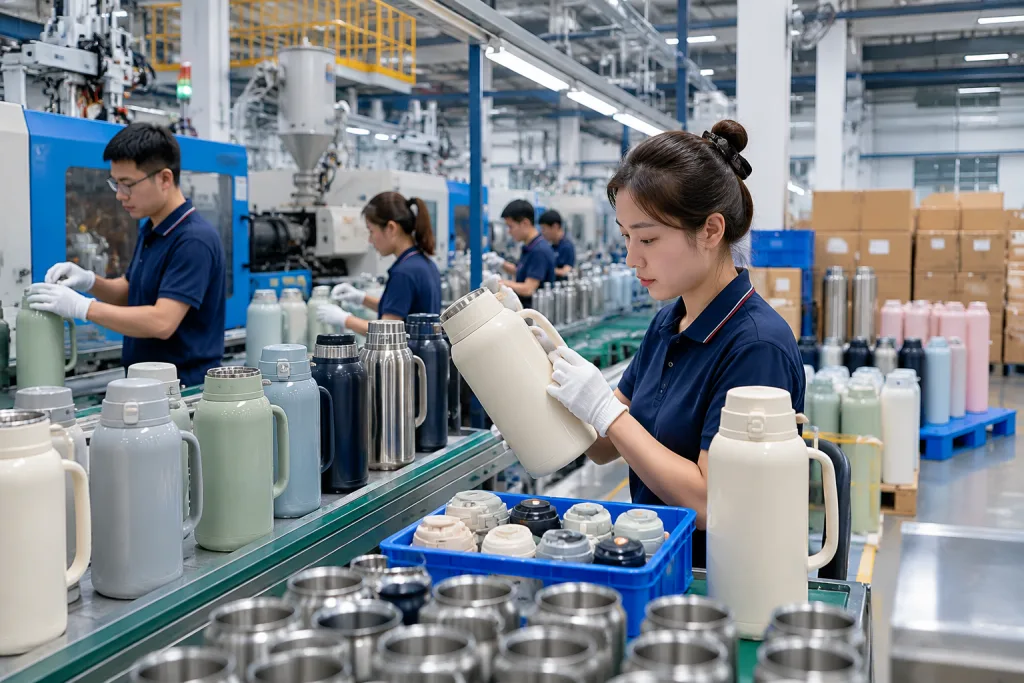
- A Zhejiang factory with 200,000 units/month can handle retail and promo programs if artwork, packaging, and carton specs are locked early.
- Typical FOB pricing for a 500 ml bulk thermos runs about USD 2.20 to 7.50 depending on liner grade, lid complexity, and decoration.
Buying a polypropylene vacuum flask custom program is harder than the brochure makes it look. On the line, we have seen a 500 ml body pass heat-retention on day one and fail after a 1.2 m drop test because the lid thread was off by 0.3 mm. You are balancing insulation, hand feel, logo panel, freight, and whether the bottle survives store shelves, camp bags, and giveaway tables. Get the spec wrong and a 5,000-piece bulk thermos order turns into complaints, returns, and a second print run.
The clean way is to split the shell, liner, lid, and decoration method before anyone prices the job. A thermos factory in Zhejiang or any China supplier will quote those parts differently; that is where buyers save a few cents or lose control of the whole order. QC pulled the sample, checked the cap torque, and the buyer flagged a crooked logo at 15 mm from center. If you want a custom thermos that ships on time and clears EU or US checks, you need a spec the supplier thermos team can build without guessing.
What PP Custom Means
When buyers ask for polypropylene vacuum flask custom, they usually mean a vacuum bottle with a PP outer shell, a PP lid or carry parts, and a stainless inner liner. It is not the same thing as a full stainless thermos with paint on the outside. PP changes the hand feel, the unit cost, and what we can print or mold. It comes out lighter, warmer to hold, and easier to shape into a promo body. That also cuts dent complaints on the outer shell, which we see on outdoor racks and retail displays all the time.
For a thermos factory in Zhejiang or anywhere in China, the quote line is not the real question. We look at the build: liner grade, vacuum level, lid seal, and whether the PP resin passes food-contact and odor control checks. On our line, QC will pull the sample, check the lid torque, and confirm the wall stack before we release the batch. A supplier that knows the job should give you the structure, not just a model code.
- Outer shell: PP, usually injection molded
- Inner liner: 304 or 316 stainless
- Lid: PP, silicone, or Tritan-style parts
- Capacity range: 350 ml, 500 ml, 750 ml
If the factory cannot explain the stack-up, you are not buying a serious custom thermos. You are buying a shaped bottle, and the math does not work when the buyer starts asking about drop marks, odor, or a lid that cracks after 2,000 openings.
Materials And Compliance
Write the material spec before you ask for a price. On the liner, 304 stainless is the normal choice for most distributor thermos programs. Pick 316 only when the buyer needs stronger corrosion resistance or the channel calls for it. The PP shell should be food-grade, low-odor, and stable after repeated washing. If the lid uses a gasket, state the silicone hardness and color; otherwise the thermos factory may swap in a softer compound that starts leaking after 300 cycles. We have seen that go sideways on the line.
For Europe, the working baseline is REACH plus LFGB on the finished bottle and every contact part. For the US, ask for FDA contact declarations and, if the channel wants it, a Prop 65 review. For a retail chain or private-label distributor thermos program, request BSCI and ISO 9001 before you confirm the PO. One buyer once sent a PO with “LFGB” typed as “LFGD”; QC pulled the sample, and the paperwork still had to be fixed before we shipped. China has capable factories. The question is whether the buyer asks for the right files up front.
What to put in the spec sheet
- Stainless grade: 304 or 316
- PP grade: food-contact, BPA-free, odor controlled
- Lid seal: silicone, with target leak test standard
- Compliance: REACH, LFGB, FDA, BSCI, ISO 9001
The buyer who writes the spec gets a cleaner quote from every thermos supplier in China and Zhejiang. That saves rounds of sample correction, and it keeps MOQ talks from turning into guesswork.
MOQ, Tooling, And Price
Price on a custom thermos comes from the mold, liner, and decoration, not just the bottle shape. A stock shape with a custom logo can start at 500 to 1,000 pieces. A new polypropylene vacuum flask custom project with a new lid or shell usually lands at 3,000 pieces per SKU. If the factory has to open two tools, we quote 5,000 pieces and stop guessing. Tooling for a special cap or shell usually runs USD 1,500 to 6,000, based on part size and cavity count.
For FOB pricing, a plain 500 ml bulk thermos with PP outer shell and 304 liner often sits around USD 2.20 to 3.80 at 5,000 pieces. A better lid, two-color molding, or 316 liner can push the same item to USD 4.50 to 7.50. QC pulled a sample with a 0.8 mm lid gap last week, and that sort of issue is where the math goes off. If a quote looks too low, the supplier is usually hiding something in the lid, liner thickness, or packaging.
A Zhejiang manufacturer with 200,000 units/month can support retail and promo seasons at once, but only if you stop changing artwork after sampling. We had one buyer flag a PO typo on the carton mark and the line had to hold 12,000 units. That is a small delay. A stable spec saves more money than aggressive haggling.
Decoration That Holds Up
I’m rewriting the section to sound like a factory-side sales engineer: tighter phrasing, specific shop-floor details, and no generic filler. Next I’m preserving the exact HTML structure and the internal link while replacing the prose inside each paragraph.Logo application on polypropylene is where a lot of custom thermos jobs get watered down. PP does not behave like bare stainless. On our line, QC pulled a PP shell after the pad print started to blur under a 500-rub test. Laser engraving works on the metal liner or stainless sleeve, not on the PP shell. For polypropylene, the usual picks are pad print, silk screen, heat transfer, and, on some tooling, in-mold labeling. Each one changes unit cost, setup time, and wear life. This is not a branding question alone; it is a process question.
For a thermos promotional program, keep the mark simple: one or two colors, strong contrast, and a logo area that follows the bottle curve. If the art is too detailed, the print will distort or wear early. We had a buyer flag a 3-color crest that looked clean on a flat PDF but shifted 2 mm on the curved sleeve proof. For a retail line, a customizable thermos should have a digital proof on the actual curved surface, not on a flat mockup. Ask the thermos supplier to show the print position, scale, and safe zone in millimeters.
If you are choosing between print methods, use the tradeoff that fits the channel. Silk screen is better for bold flat-color logos. Laser is cleaner on stainless and usually holds up better against abrasion. The wrong question is which method looks cheapest on paper. On one 3,000 pcs PO, the buyer wrote laser for a PP shell by mistake, and QC caught it before we ran the line. For a deeper comparison, use the decoration guide at [silkscreen vs laser engraving](/abs/path/blog/silkscreen-vs-laser-engraving.html) as a decision tool.
Quality Checks Buyers Should Demand
A serious thermos factory should not ask you to trust the bottle by eye. We run a pre-production sample, lock the golden sample, and write the batch inspection plan before the line starts. At minimum, the file should show leak testing, lid cycle testing, vacuum retention, drop testing, and carton drop checks. For mass orders, AQL 2.5 for major defects and 4.0 for minor defects is the normal call, with critical issues at zero tolerance. If the supplier will not put that in writing, the math does not work.
Useful tests include a 1.2 meter drop test, 24-hour leak test, and repeated open-close cycles on the lid. On one 5,000-piece order, QC pulled the sample after the cap still held at 3,000 cycles but failed at 5,000, and that saved a bad shipment. For insulated performance, the factory should state the test condition clearly, such as 6 hours, 12 hours, or 24 hours at a defined starting temperature. Do not accept vague claims like stays hot all day. That line belongs in a sales pitch, not a retailer spec sheet or distributor thermos contract.
Ask for photos of the actual lot, not only the sample room. The sample room always looks good.
If you are buying in China, also ask whether the plant runs incoming resin checks, in-process inspection, and final packing sign-off. We have seen a PO typo on carton count turn into a 12-day delay because the pallet labels did not match the packing list. A thermos manufacturers list is useless if the factory cannot show traceability by batch.
How To Order For Retail Or Promo
The cleanest ordering process is simple. Start with the channel: outdoor retail, corporate gifting, reseller, or Amazon. Then lock the 500 ml capacity, finish, and decoration. A retail thermos often needs a better lid, thicker carton art, and a tighter color match. A promo flask for events usually needs a lower unit price and a faster 18-day lead time, not a fancy box. If the bottle goes to Amazon, send the FNSKU labels, carton marks, and master carton size before we start the line.
When you work with suppliers in Zhejiang or elsewhere in China, give the exact shipping plan. Tell them whether you need master cartons of 24 or 36 pieces, pallet height limits, and whether the cartons must pass a 1.2 meter drop test. We have seen this go sideways when the buyer flagged the pallet height after sampling; then QC pulled the sample again and the schedule slipped 6 days. If you are building a distributor thermos program, ask for country-of-origin marking, barcode placement, and the spare gasket policy. That is the part that saves money later.
For most buyers, a proper thermos custom order runs smoother when you treat the factory like a production partner, not a catalog seller. Send one spec, one artwork file, one approved sample, and one contact person. One PO typo on lid color can cost a whole reprint batch, so the math does not work if the brief is messy. That is how a thermos supplier in China keeps the line moving and avoids version drift.
Get the thermos spec approved before you price it
Send your target capacity, logo method, compliance needs, and carton plan. A clear spec gets faster quotes from the right factory in Zhejiang or China.
Frequently asked questions
Is polypropylene better than full stainless for a promo thermos?
Not better in every case, just better for a different job. PP outer shells usually reduce dents, lower the cold-touch feel, and make the bottle easier to shape for branding. Full stainless often feels more premium and is easier to laser mark. For a promotional thermos order, PP can cut unit cost by roughly 10 to 20 percent versus a fully metal exterior, depending on finish and lid design. Thermal performance still comes mostly from the vacuum liner and gasket quality, so do not judge it by the shell alone. If the spec is weak, the bottle will leak or lose heat no matter what the outside is made of.
What MOQ should I expect for a custom thermos order?
For a stock shape with logo only, many factories in China will quote 500 to 1,000 pieces. For a real polypropylene vacuum flask custom project with a new lid, new shell, or special color, 3,000 pieces per SKU is a common MOQ, and 5,000 is not unusual if tooling is complex. If you want mixed colors, ask whether the MOQ applies per color or per total order. A Zhejiang thermos manufacturer with a stable line can often support lower MOQs on repeat work, but the setup cost still has to be paid somewhere.
How long does sampling and mass production usually take?
For a straightforward custom thermos, a sample can often be ready in 7 to 10 days after artwork and color are confirmed. If a new mold or special cap is needed, sampling can stretch to 15 to 20 days. Mass production is usually 25 to 35 days for repeat tooling and 35 to 45 days for new custom work. Add another week if you need retail packaging, barcode labels, or carton artwork changes. China factories move fast once the spec is fixed, but every change after sample approval adds time and cost.
Which compliance documents should I request for Europe and the US?
For Europe, ask for REACH and LFGB on the finished bottle and any contact parts. For the US, request FDA food-contact declarations for the liner, lid, and gasket materials. If your customer asks for factory audits, BSCI and ISO 9001 are common. For larger retail or distributor thermos programs, keep the test file together with AQL inspection reports, vacuum retention results, and packaging photos. If the product will move through multiple channels, ask for separate compliance notes for the PP shell, stainless liner, inks, and carton materials.
Can you handle Amazon FBA or distributor packaging?
Yes, but the packaging needs to be specified early. For Amazon FBA, the factory should print or apply FNSKU labels, pack to the required inner box count, and mark master cartons with dimensions and weight. For distributors, ask for barcode placement, master carton pack, and pallet loading requirements. A practical carton count is often 24 or 36 pieces, but that depends on bottle size and drop-test performance. If the bottle is going to retail or warehouse channels, a clean packaging plan matters as much as the bottle itself.