Key Takeaways
- A workable custom stainless thermos MOQ is usually 3,000 pcs per SKU in China.
- 304 stainless steel is the default; 316 only makes sense when corrosion resistance justifies the extra cost.
- For Europe and North America, ask for REACH, food-contact declarations, leak tests, and AQL 2.5 inspection data.
- A 500 ml thermos custom run often lands at USD 2.80-4.20 FOB China, with 35-45 day production after approval.
If you are a polypropylene vacuum bottle manufacturer moving into stainless, this is not a simple material swap. Buyers still want thermos bulk pricing, clean branding, and a lid that holds up after 30 days in a school bag or a delivery run, not just on a sample shelf. For Europe and North America, the spec has to cover retention time, leak risk, packaging, and the paperwork behind each shipment.
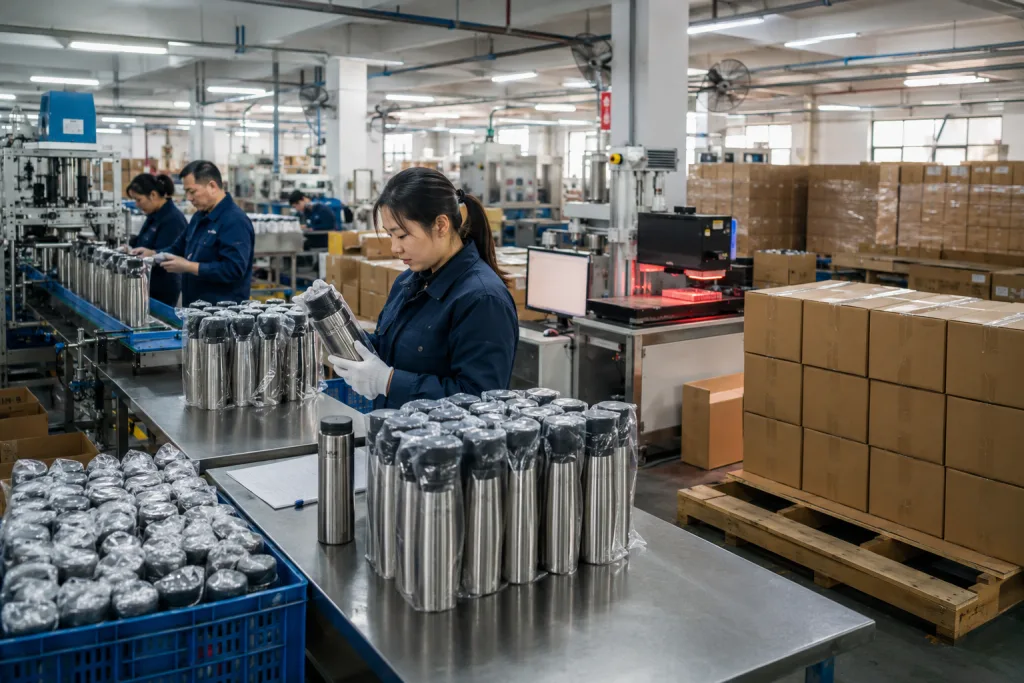
At our Zhejiang factory, we see outdoor retailers and promo brands push for the same result: a custom thermos that ships on time, passes REACH and basic drop-test checks, and stays inside a unit cost they can sell. We run 320,000 units per month, MOQ starts at 3,000 pcs, and standard lead time is 35-45 days after sample approval. QC pulled the sample twice last week because one buyer flagged a lid tolerance issue at 0.3 mm. That is the wrong question to ask if you start with the material alone.
Why Stainless Changes the Buying Rules
The biggest mistake is treating stainless like a prettier polypropylene vacuum bottle. The buying logic changes fast. With PP, we mostly watch injection molding, weight, and lid fit. With stainless, we run shell thickness, weld quality, vacuum stability, and finish durability. A 304 inner wall and outer wall are standard for most custom thermos orders; 316 makes sense if the buyer wants stronger corrosion resistance, but it adds cost and usually does not move retail on a normal distributor program. I have seen buyers push for 316 on a 5000-piece run, then drop it after the math came back.
For bulk thermos orders, ask for these numbers before sampling: inner wall 0.35-0.45 mm, outer wall 0.35-0.45 mm, vacuum retention target, and whether the seam is fully automated or semi-manual. QC pulled the sample on one line after a 2 mm wobble at the neck, and that is the kind of detail that saves you from a late complaint. If a supplier cannot explain where the heat loss comes from, they are not quoting a thermos manufacturer job; they are quoting decoration on top of a metal shell.
- 304 is the default for most custom stainless thermos builds.
- 316 fits harsher use cases, not every promotional thermos.
- Wall thickness affects durability, weight, and freight cost more than most buyers expect.
A good thermos factory in China gives you those numbers before the first sample, not after the first complaint. We have seen this go sideways when a PO typo changed the wall spec and nobody caught it until the vacuum test. That is the wrong question to ask if you are only comparing shell price.
Start With Steel, Not Decoration
Material choice decides whether the bottle feels premium or just expensive. Start with food-contact stainless steel for the body, usually 18/8 or 304, then check the lid stack: PP, Tritan, silicone, and a stainless insert each behave differently under heat and torque. We run a 3.2 mm wall on the body, and QC pulled the sample when the lid torque drifted after 18 cycles. If your distributor thermos line needs a lighter carton and lower freight, a PP lid can make sense. If the market is more gift-oriented, a two-piece lid with a stainless cap and silicone gasket usually looks better and carries more shelf value.
Pay attention to the details buyers rarely see in a catalog. The silicone gasket should come out for washing. The base pad should be bonded cleanly, not glued in a way that peels after 20 dishwasher cycles. Powder coating should pass cross-hatch adhesion; if you are selling as customized thermos stock into outdoor retail, a 30-40 micron coating is a safer target than a thin cosmetic finish. The buyer flagged a PO typo on the vent hole spec once, and the line caught it before molding. For stainless thermos custom runs, the lid thread count, vent path, and seal compression matter more than an extra decoration process.
When a polypropylene vacuum bottle manufacturer adds stainless, the real gain is system design: one body, multiple lids, one cap platform, fewer SKUs. The math works only if the MOQ stays sane; we ship better when one tool serves four capacities instead of forcing a new mold for every size. That is how thermos suppliers protect margin without pushing MOQ into nonsense.
- One lid platform can support several capacities.
- Removable gaskets reduce service issues and return rates.
- Coating thickness should be measured, not guessed.
Customization That Sells
Customization should help the cup sell, not turn the line into a mess. On our shop floor, the cleanest promo run is still one body color, one logo method, one carton spec. If a chain retailer wants a custom thermos, we keep the decoration plan tight: silkscreen for a big flat logo, laser engraving for a permanent metal mark, or heat-transfer print when the brand needs two or three colors without wrapping the whole barrel.
For a thermos custom project, the spec sheet should lock capacity, diameter, height, lid color, inner cup polish, and packaging. We have run 500 ml, 750 ml, and 1,000 ml bodies off the same shell with shared gaskets, but only when the neck finish stays at 51 mm. Promotional brands may only need one 500 ml body and three print zones. A thermos manufacturer should tell you where one mold can carry three options and where it cannot. The math does not work if you pay for three molds when one mold plus three lids gets the same result.
In practice, the cleanest thermos customizable range is the one that cuts changeovers. If the body stays put and only the lid and print change, we ship faster and the re-order cycle shrinks. On our line, a lid swap takes 12 minutes; a body color change can burn 40 minutes and two test shots. That is why we push back when a buyer asks for six "simple" variants in one PO.
- Keep one primary logo position.
- Use one carton size if you want lower thermos bulk freight.
- Ask for barcode and FNSKU placement before production, not after packing.
Testing, Compliance, and Proof
Compliance is where buyers get caught. For Europe, ask for REACH documentation, food-contact declarations, and, for German retail, LFGB test support on the wetted parts. For North America, FDA food-contact support on the parts that touch the beverage is the baseline. The real proof is on the line: leak tests, thermal retention logs, and a drop test on the assembled custom thermos. We run the heat chamber at 95 C and record every curve, because paperwork alone does not hold up when the buyer pushes back.
A practical factory thermos test pack includes a 1-meter drop on six faces, vacuum retention after heat cycling, lid torque checks, and a 24-hour inverted leak test. In our workshop, QC pulled the sample after the cap torque hit 1.8 N·m, then the team checked the seam under a gauge light. For carton quality, ask for AQL 2.5 for major defects and 0.65 for critical defects, with photos of the inspection lot. If you are ordering thermos manufacturers' promotional stock, insist on sample-retention tags and one sealed golden sample per SKU. We have seen this go sideways when the PO typo changed one code by a single digit.
Look for ISO 9001 and BSCI if your retail channel asks for factory social compliance. A good thermos supplier in China will already know which documents your importer, distributor, or marketplace prep center needs. On a recent audit, the buyer flagged a missing carton label, not a product flaw, and that is the kind of miss that burns time. If they cannot turn the file over without delay, they are not ready for repeat distributor thermos work. We run a document checklist before release; no checklist, no shipment.
For transit, ask for packaging that can survive ASTM D4169-style carton handling, especially if your units move by sea freight to Europe or North America. We test with a 55 kg compression stack and a 1.2 m corner drop, because the pallet crew will not baby it. A box that looks fine on the warehouse floor can still fail in a container, and we have seen that cost two weeks. The wrong question is whether the outer carton is thick enough; the real question is whether the packed set survives the route.
MOQ, Lead Times, and Pricing
I’m rewriting the four HTML paragraphs to sound like a factory-side sales engineer: tighter language, more concrete numbers, less generic phrasing, and no change to the tags or structure.Pricing only makes sense when the spec is frozen. For a standard 500 ml custom stainless thermos with 304 body, powder coat, and one-color logo, we usually see factory pricing in China at USD 2.80 to 4.20 ex-factory at 3,000 pcs, depending on lid complexity and packaging. Move to a gift-style box, laser logo, or a 316 inner wall, and it climbs to USD 4.80 to 6.50. If a quote lands far below that, check the vacuum layer, steel grade, and carton spec. We have seen a PO typo turn "304" into "202" on the sample sheet, and that kind of slip is where the cheap offer starts to fall apart.
Lead time is usually 35-45 days after sample approval, with a first sample in 7-10 days if the body style already exists. New tooling can add 15-25 days. For bulk thermos orders, the cheapest mistake is rushing the artwork and approving a weak proof. QC pulled the sample once and found the barcode 3 mm too low, which turned a 2-day art job into a 10-day hold when the carton marks and language warnings had to be redone. A 3,000 pcs order needs clean files on day one.
In Zhejiang and other manufacturing hubs in China, the factories that handle real volume quote capacity in units per month, not just in product photos. That matters because a thermos factory with 320,000 units monthly output can usually support multiple thermos distributors at once without breaking your launch date. We run two assembly lines and a 48-cup leak test rack; smaller shops may be fine for a test order, but they often stall once you add a second color or a second shipping window. This is the wrong question to ask if you only compare sample quality. Capacity is what pays the freight.
If you are comparing thermos custom offers, compare FOB China, not just headline unit price. One supplier with clean packing and fewer defects can beat a cheaper quote by 8-12% once freight and rework are counted. We have seen a 1,200 pcs shipment lose margin because the buyer had to replace 24 dented cartons on arrival. The line can make a low price look good; the warehouse bill tells the truth.
Choosing a Factory in China
If you are choosing between a thermos supplier, a thermos vendor, and a full thermos manufacturer, start with process control. Ask who runs the vacuum welding station, who checks the seal ring with a pressure gauge, and who signs the final carton count. The good factories in Zhejiang do not hide behind sales talk. They send a spec sheet, a sample lead time, and defect photos from the last AQL 2.5 lot. If they dodge those three, the quote is noise.
A serious polypropylene vacuum bottle manufacturer that wants to move into stainless should ask for three things before a trial order: a factory audit video, one pre-production sample with measured dimensions, and a packing plan that fits your channel. Amazon prep needs FNSKU placement and carton labels. Outdoor retail needs shelf-ready packs. Promo thermos orders need fast art approval and a clean blank zone for logos, usually 25 to 35 mm wide. QC pulled the sample from the line and measured the shoulder with calipers; that is the level you want. If the factory cannot change the pack plan, you pay for rework later.
One rule we use on the buying side: if the supplier cannot break out body, lid, print, and carton cost, they are not ready to quote the job properly.
That rule saves days when you are buying thermos custom units for two markets at once. A solid China supplier should support both custom thermos launches and repeat factory thermos replenishment without rewriting the spec on every PO. We have seen buyers flag a lid price that was 0.18 USD off, then the whole margin moved. The math does not work if the breakdown is vague.
For long-term programs, choose the partner that can repeat the same result on the second order. That is what matters when your thermos manufacturer moves from sample room approval to distributor replenishment. On the line, we check the same 500 ml body depth and the same carton weight before shipment. If the second run drifts, even by 1 mm, the buyer will catch it fast.
Send Your Thermos Spec For A Factory Quote
Share capacity, lid style, logo method, and target market. We will price the build, confirm MOQ, and map a 35-45 day production schedule.
Frequently asked questions
What is a realistic MOQ for custom stainless thermos orders?
Most custom stainless thermos projects start at 3,000 pcs per SKU in China. If you need two colors or two lids, treat that as two SKUs unless the tooling is shared and the carton art is identical. For simple promotional thermos runs, some factories will accept 1,000 pcs, but the unit cost usually jumps 18-30%. A practical MOQ is the point where your logo method, packaging, and freight still leave you margin. If your buyer wants 500 ml, one-color print, and standard gift box, 3,000 pcs is the cleanest starting point. Below 1,500 pcs, expect sample-style pricing, not distributor pricing.
Can a polypropylene vacuum bottle manufacturer switch to stainless without new systems?
Yes, but not by converting the same mold. A polypropylene vacuum bottle manufacturer can leverage lid design, packaging, and distribution, but the stainless body needs new tooling, welding, vacuum control, and finish QC. The fastest path is to reuse the PP lid geometry only if the sealing interface is compatible. Many factories in Zhejiang, China do this as a two-platform program: PP for entry price, stainless for higher perceived value. Expect 15-25 days for new tooling and 7-10 days for samples if your artwork is ready. The biggest risk is assuming the old PP quality checks cover steel. They do not.
Which lid style is best for outdoor retail and promo thermos orders?
For outdoor retailers, a screw-top lid with a silicone seal and a direct-drink or cup function is usually the safest custom thermos choice. Promotional brands often prefer a simpler lid because it keeps the unit cost in the USD 2.80-4.20 range at 3,000 pcs. If the product will be carried in a backpack or shipped through Amazon FBA, prioritize leak resistance over gimmicks. A flip lid may look convenient, but it adds failure points and can raise the return rate by 1-2% if the hinge is weak. Ask for a 24-hour inverted leak test on the assembled unit, not just on the lid by itself.
What compliance documents should I request before placing a purchase order?
For Europe, ask for REACH, food-contact declarations, and if the external finish is coated, the coating compliance statement. For North America, ask for FDA food-contact support for wetted parts, plus a simple migration or material declaration if your importer requests it. On the factory side, ISO 9001 and BSCI help if you sell through retail or big distributors. Also ask for AQL inspection reports, ideally 2.5 major and 0.65 critical, and thermal retention data for your exact capacity, such as 500 ml or 750 ml. If the supplier cannot provide documents in 24-48 hours, they are not organized enough for repeat thermos bulk business.
How do I protect margins when sourcing thermos bulk from China?
Lock the spec before you ask for a quote. The margin killers are packaging creep, logo revisions, and hidden freight weight. A 500 ml custom thermos can move from 280 g to 360 g if the wall thickness or lid stack changes, and that affects cartons and shipping cost. Use one body, one lid platform, and one carton size across the range when possible. If you are buying thermos bulk for a distributor program, ask for a landed-cost sheet that separates product, packaging, testing, and freight. Then compare FOB China pricing, not just unit price. The lowest factory quote is useless if it adds 12% in rework or air freight.