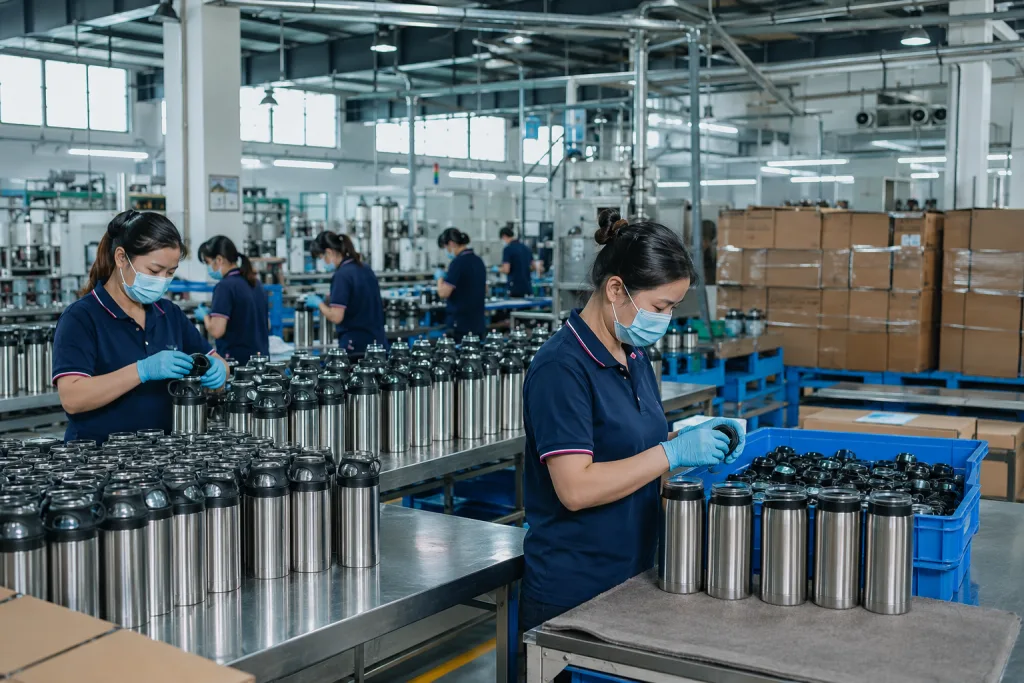
Key Takeaways
- A real custom thermos program often starts at MOQ 3,000 pcs per SKU, with 25-35 day production after approval.
- 304 stainless is enough for most retail and promotional thermos orders; 316 is worth it only when corrosion risk is real.
- For export buyers, ask for AQL 2.5, 100% leak testing, REACH or LFGB documents, and 1 m drop testing.
- A Zhejiang factory with 300,000 units/month can support thermos bulk orders, but only if lid tooling and packing are already mature.
If you are looking for a polypropylene vacuum bottle factory, you are usually buying more than a plastic bottle. You need a line that can handle caps, silicone seals, printing, carton marks, and export packing without letting the cost creep or the lead time slip. We run into this on the floor all the time: a buyer wants 3,000 pcs, then flags a logo shift of 1.5 mm after pre-production, and the whole schedule moves if the factory has no grip on the process. For outdoor retailers and promo brands, that is the point. A bottle that leaks loses the order faster than a plain design ever will.
The better factories in Zhejiang know this. They often start with polypropylene parts, then move into stainless vacuum lines for custom thermos programs, thermos bulk orders, and distributor thermos replenishment. QC pulled the sample, checked the seam on the lid, and the buyer still asked for a 12-hour heat retention claim against a 24-hour target. That is the wrong question to ask if the price math does not work. What matters is whether the customized thermos passes inspection, holds temperature, and lands at a unit cost your channel can actually carry.
Why PP Factories Enter Thermos Work
A polypropylene vacuum bottle factory usually starts with parts that look plain: lids, handles, caps, drinking spouts, and mouth rings. That is where the lid system starts to matter. We run a 12-cavity injection machine for those parts, and the fit on a 0.2 mm thread gap can make or break the user feel. A stainless thermos is not a PP bottle with a metal shell. It needs deep drawing, welding, vacuum control, and sealing discipline that a plastic-only shop usually does not have.
When you review a thermos factory in China, ask where the stainless work happens and where the PP work happens. A credible manufacturer will show separate blocks for injection molding, shell forming, vacuum sealing, and final assembly. A weaker supplier bundles everything into one tour and hopes you do not ask where the line stops. That is the wrong question to skip if you are buying a distributor thermos line for outdoor retail, because the buyer flagged a 2 mm gasket mismatch on one PO and the returns started there, not in marketing photos.
- Ask whether the plant owns the PP mold shop or outsources every lid.
- Ask whether vacuum sealing is done in-house or by a third-party workshop.
- Ask for finished goods photos from the last 30 days, not catalog renders.
If the answer is clear, you are likely dealing with a real thermos supplier. If it stays vague, treat it as a trading setup, no matter how good the sample looks. QC pulled the sample on one line last month and found a loose lid thread after only 18 drops from 1.2 meters. We see this go sideways fast.
Materials That Actually Matter
For a custom thermos, buyers often lock onto print color before steel grade. Wrong order. We start with the body because that is where the money sits. 304 stainless covers most retail and promo orders; 316 is the call when the bottle sees salty air, sports drinks, or long storage after use. For most customizable thermos programs, 304 is the practical default. It is easier to source in stable lots from China, and we run it every week on the line.
Wall thickness matters too. A common export build uses 0.4 to 0.5 mm for the inner and outer shells, with a vacuum gap set for heat retention, not just lower weight. QC pulled the sample on a 500 ml body and checked the seam with a caliper at 0.02 mm resolution. On the lid side, polypropylene still earns its place because the touch points stay light and handle daily heat well. The gasket should be food-grade silicone, not mystery rubber, and the thread fit needs to stay steady across a full carton.
If you sell into Europe or North America, do not accept vague compliance claims. Ask for REACH on the finished item, LFGB or FDA paperwork on food-contact parts, and a BPA-free statement for the PP components. We once saw a PO spell “bottle” as “botte”; the buyer flagged it, and the same file had no coating spec. That is the wrong question to ask. A powder-coated shell should show a film thickness around 50 to 80 μm, not a sales promise. That is how a thermos manufacturer protects margin: fewer returns, fewer disputes, cleaner shipments.
Decoration That Survives Retail
Custom branding is where bulk thermos orders go sideways fast. We have seen a logo look perfect on a sample, then start peeling after two weeks in a backpack, a truck cab, or a giveaway run. For a thermos custom program, the decoration method follows the use case, not the buyer’s taste. Silk screen suits one or two spot colors. Laser engraving gives a clean mark that holds up. Heat transfer and full wrap graphics work only when the artwork, coating thickness, and cure time are controlled on the line.
A customizable thermos for outdoor retail should keep the body finish simple and the mark tough. If you need a matte powder coat, lock the color match before we start production. If you want the logo to show bare metal, test laser depth on the actual coating, not on a demo plate. QC pulled the sample last month on a 0.35 mm coat, and the buyer flagged the contrast as too weak. For promotional thermos projects, a lower decoration cost makes sense only when the item will live a short, easy life. Channel retail is different. The bar is higher.
On price, a clean one-color silk screen logo may add only a few cents per piece at scale. Laser engraving is often the better pick for long service. A new lid mold or a special PP insert can add USD 1,200 to 3,500 and push lead time by 20 to 30 days. We had a PO last quarter with the lid code typed one digit off, and the whole sample run stalled for a day while we corrected it. That cost is normal. The wrong move is approving a low-cost print method and then acting surprised when it fails after the first wash.
For outdoor buyers, decoration is not a branding decision first. It is a durability decision.
QC That Protects Your Margin
If you buy from a thermos supplier with no written QC plan, you are paying for returns later. We run AQL 2.5 for major defects and AQL 4.0 for minor defects, then QC pulled the sample and checked every finished bottle for leaks. For vacuum retention, we also cut open sample units and log the failure point. That is the floor, not a premium. Ask for the inspection standard in writing, or the line will give you excuses after the carton is already on the water.
Thermal claims need repeatable test data. If the sample says 12 hours hot and 24 hours cold, the factory should show fill temperature, ambient temperature, the cup-to-water ratio, and the exact test method, not a sales sheet with no numbers behind it. A vague claim is not a claim. We also ask for a 1 m drop test, a torque check on the cap threads, and carton compression or a shipping simulation when the order is going into Amazon FBA or another rough lane. The math does not work if the bottle passes in the lab and fails in the warehouse.
For coated stainless parts, ask for salt spray results if the product is going near humid ports or coastal markets. For PP lids, check odor, fit, and dishwasher behavior. On the line, we inspect thread gauge fit, gasket placement, and print alignment before packing, because a buyer will flag a 2 mm offset faster than a factory can hide it. A bad supplier sorts problems at the end and hopes you miss them. We have seen that go sideways too many times.
MOQ, Pricing, and Lead Time
Buyers usually open with price, but MOQ and lead time decide if the job is real. For a custom thermos built on an existing mold, 3,000 pcs per color or per print setup is a clean starting point. If you want a stock body with a new logo, some suppliers will start at 1,000 pcs, though the moment you change the lid color, carton art, or coating, the math shifts fast. On the line, we see the same issue every week: one buyer flags the packout at PO stage, and that changes the whole cost picture.
For a 500 ml thermos bulk order from a China factory, a working FOB range is about USD 3.40 to 5.90 at 3,000 pcs, depending on lid design, coating, and decoration. A special cap mold can add a few thousand dollars. Sample lead time is usually 5 to 7 days, pre-production confirmation 7 to 10 days, and mass production 25 to 35 days if the SKU is already running. New tooling can stretch that to 45 or 60 days. QC pulled the sample on a 0.2 mm print shift once, and that one miss delayed the approval by 3 days.
A serious factory in Zhejiang can run around 300,000 units per month across multiple lines, but only when the schedule stays fixed. If you want thermos manufacturers to support a seasonal rollout, lock the artwork, cartons, and carton quantity early. Every change after PO approval burns time. This is the wrong question to ask if you only chase unit price; a typo on the carton spec or a lid color change can wipe out the margin on the whole order.
Working With a China Supplier
Do not get stuck on the word supplier. A real thermos supplier is a factory with export habits, not a middleman forwarding samples from another workshop. Ask for the company license, ISO 9001 certificate, BSCI audit if you sell to large retail chains, and fresh production photos from the same line that will run your order. If the plant is in Zhejiang or another export-heavy region of China, that matters only when the paperwork matches the tools on the floor, like a 12-head ultrasonic welder or a laser marking station actually in use.
Ask how the factory handles spare lids, replacement seals, and after-sales claims. We run 1 to 2 percent extra lids in reserve on distributor programs because channel buyers lose parts faster than they report it, and the math still works better than a rush remake. Ask about FOB, CIF, and DDP too. For North American and European buyers, clean Incoterms beat a small quote gap. A thermos distributor should care about carton size, pallet count, and shelf-ready packout just as much as unit price. QC pulled the sample last week and found a 2 mm lid gap on one batch, which is the kind of miss that turns into a complaint later.
Use this rule: if the factory cannot explain how it will protect your margin on QC, packing, and replenishment, it is not ready for a serious custom thermos order. We have seen this go sideways when a buyer approved the sample and then the PO typo changed the carton mark from 24 pcs to 20 pcs, so the line had to stop and rework labels. That is not a small problem. It is a cost problem.
Request a thermos quote with real specs
Send your target size, logo method, MOQ, and market. We will map the build, packing, and testing before you commit to a PO.
Frequently asked questions
Can a polypropylene vacuum bottle factory really make stainless thermos products?
Yes, but only if the factory has added stainless forming, welding, vacuum sealing, and final assembly lines. PP alone covers lids, caps, handles, and some mouthparts. A real stainless thermos manufacturer will show deep drawing or shell forming equipment, leak testing, and vacuum ovens. If they only show injection molding machines, they are not set up for the full job. For a first order, expect samples in 5 to 7 days and production in 25 to 35 days if the mold is already running. If the supplier cannot separate the PP process from the steel process, treat them as a trading middleman, not a factory.
What MOQ should I expect for custom thermos orders?
For a standard shape with one logo, 3,000 pcs per SKU is a normal starting point from a China factory. If you only need stock color and a simple print, some suppliers can go to 1,000 pcs, but the unit price usually rises by 15 to 30 percent. New lid colors, special boxes, or custom packaging can push MOQ to 5,000 pcs or more. For thermos bulk programs, the real cost driver is not just the body; it is how many variants you create. Keep to one size, one lid style, and one carton spec if you want a supplier to hold pricing.
Which decoration lasts longest on a stainless thermos?
Laser engraving usually lasts longest because it removes or exposes material instead of sitting on top of the coating. That makes it strong for outdoor retail and distributor thermos programs. Silk screen is still fine for one-color logos if the print is cured well and the customer is not washing the bottle aggressively every day. Heat transfer and full wrap graphics can look good, but they need better process control and are more sensitive to abrasion. If the body has a powder coat around 50 to 80 μm, ask the factory to test the actual logo on the actual finish, not on a sample plate.
Do I need 304 or 316 stainless steel?
For most custom thermos orders, 304 is the right balance of cost, availability, and performance. It is the standard choice for retail and promotional thermos products. Move to 316 only when the use case justifies it: salty air, heavy corrosion exposure, or liquids that are more aggressive than plain water. The price delta can be meaningful, and for many distributors it does not pay back in the field. If a supplier cannot explain why 316 is needed for your market, 304 is probably the correct spec. Always confirm the exact steel grade in writing before production.
What documents should I request before I place the PO?
Ask for a test report set that matches your market: LFGB or FDA for food-contact parts, REACH for Europe, and a BPA-free statement for the PP components. Request the factory audit file, ideally ISO 9001 and BSCI if you sell through larger retail channels. You should also get AQL inspection terms, carton specs, master carton dimensions, and a thermal retention test method. If you sell into Amazon, ask whether the pack can be labeled with FNSKU and whether the carton counts align with FBA rules. A supplier that takes paperwork seriously usually handles production more cleanly as well.