Key Takeaways
- A realistic MOQ for a custom polypropylene Tritan bottle bulk program is usually 3,000 to 5,000 pcs per color, with 25 to 35 days production time.
- FOB China pricing often lands around USD 1.40 to 2.80 for Tritan bodies and PP closures, depending on mold complexity, printing, and packaging.
- For Europe and North America, ask for LFGB, REACH, FDA food-contact declarations, and an AQL plan of 2.5 major and 4.0 minor.
- A Zhejiang factory with 120,000 units per month can support drinkware wholesale programs, but only if the artwork, carton spec, and leak test are fixed early.
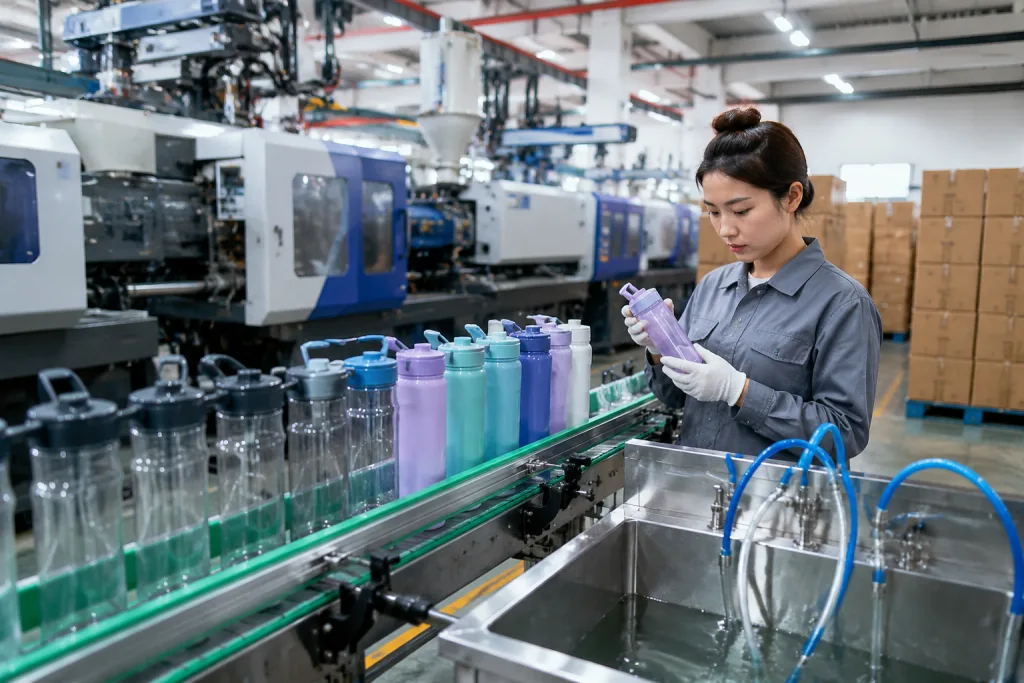
Buying polypropylene Tritan bottle bulk is a spec decision, not a unit-price chase. The bottle has to survive a 1.2 m drop test, stay clear on shelf, pass food-contact rules, and arrive in your warehouse without leaks or warped shoulders. If you only compare price, the bill shows up later in carton damage, reject rates, and customer complaints. QC pulled the sample with a caliper at the neck finish, and that is where a lot of bad orders start.
For procurement teams in Europe and North America, the real job is turning a retail idea into a factory spec that runs cleanly on the line. A Zhejiang supplier will ask about channel first and quote the bottle second if they know what they are doing. That is the right order. We have seen buyers insist on logo first, then wonder why the MOQ jumps or the cap leaks after 500 cycles. The math does not work.
Choose the Right Resin Mix
When buyers ask for polypropylene Tritan bottle bulk, they usually want a clear Tritan bottle body with PP caps, seals, or handles. That mix works. Tritan gives the bottle the clear look buyers want on shelf, better impact resistance, and a cleaner premium feel. PP keeps lid cost down and fits parts that do not need optical finish. On our line, QC pulled the sample and checked the cap on a torque meter before we quoted. If you are building a best wholesale drink bottle program, this is where you stop using brochure language and start talking like a factory.
Material choice should track the job. For cold-fill and daily hydration, Tritan is the better call. For economy canteen wholesale programs, PP still makes sense for lids, spouts, and carry loops. For a wholesale drinkware line sold through retail or corporate gifting, a clearer bottle usually wins because it photographs better and cuts down stress-crack complaints. The buyer flagged a 2 mm wall on one PO and asked for a lower price. The math does not work that way. Good factories in China and Zhejiang will ask for target temperature, drop height, dishwasher cycles, and closure type before they lock the quote.
Use the same logic if you are comparing bulk canteen, bulk growler, growler wholesale, beer growler wholesale, beer tumbler bulk, or alcohol flask bulk programs. The shape changes. The questions do not. What has to stay clear, what has to seal, and what needs to survive a 1.2 m drop in transit?
- Tritan body: clear, impact-resistant, usually 1.8 to 2.5 mm wall thickness
- PP closure parts: lighter and cheaper, ideal for caps, lids, and spouts
- Best fit: wholesale drinkware for fitness, travel, office, and premium retail
Set Specs Before Quoting
Price means nothing until the spec is locked. A supplier can throw out a low number on a 650 ml bottle, then the buyer flags soft-touch paint, a stainless-steel collar, a two-color logo, and Amazon FBA carton inserts. We have seen this go sideways on the line. One extra insert can wipe out the margin. Set capacity, closure style, gasket material, logo area, and packaging before you ask for quotes.
For sourcing teams, a useful spec sheet is short and exact. Put down capacity in ml and oz, bottle height, neck finish, wall thickness, color code, lid torque target, and whether the bottle must be dishwasher safe. If you need a retail pack, define the inner box and master carton on day one. QC pulled the sample with a caliper and a torque wrench, and that is when the gaps show up. A Zhejiang factory running 120,000 units per month moves fast when the drawing is clear, not when someone writes “premium.”
Good buyers plan adjacent SKUs early. If your channel wants a wholesale canteen, the matching Tritan line may need the same cap family. If you are building growler wholesale or beer growler bulk programs, the closure and handling load change fast. This is the wrong question to ask after sampling starts. Stop the redesign loop before it starts. We have shipped enough rework to know the math does not work.
- Fix capacity, weight, and lid style before requesting a quote
- Define packaging for retail, Amazon, or carton-only shipment
- Ask for a separate price for logo, color match, and custom mold work
Understand MOQ and Price Drivers
Most buyers ask the same two questions: MOQ and target price. For a stock-shape polypropylene Tritan bottle bulk order, 3,000 pcs is the normal starting point. Once you add a custom Pantone color, a new cap, or printed gift box, 5,000 pcs is the number we run. If a factory says 500 pcs on a fully custom bottle, ask what is actually new. Nine times out of ten, it is a stock body with a logo, and QC pulled that sample off the line in 2 minutes.
For FOB China pricing, a plain Tritan bottle with a PP closure often lands around USD 1.40 to 2.80 at mid-volume. Simpler PP bodies can be lower, often USD 0.65 to 1.20, but the shelf value is lower too. Mold design drives the spread. An 8-cavity injection mold with a matte finish can sit at USD 3,500 to 8,000, and the tooling room will ask for a 0.03 mm tolerance before signoff. Printing, silicone gaskets, carton inserts, and individual boxes add up fast, so compare landed cost, not just bottle price.
The same math shows up in beer tumbler wholesale bulk or alcohol flask wholesale bulk. The product name changes, the cost stack does not. Resin, tooling, decoration, packaging, and freight drive the quote more than the headline unit price. We've seen buyers chase a USD 0.12 print saving, then lose it on a heavier carton and a 12-day delay at the packing table. That is the wrong question to ask.
Ask for a split quote: product, mold amortization, print, packaging, and shipping. If the supplier will not break it out, the comparison is weak. We caught a PO once with "indvidual box" typed three ways; the carton line still needed a clean breakdown before we could ship.
Check Compliance And QA
Compliance is where a lot of bulk drinkware programs break. A sales sample can look clean, then the line sends out a 20,000-piece lot that fails on odor, migration, or leak performance. For Europe, ask for LFGB and REACH documentation. For North America, ask for FDA food-contact declarations and any state paperwork your buyer asks for. If the bottle is for children, get the child-use checks done before you approve artwork or packaging; once the PO goes to print, fixing it costs time and cash.
Your QC plan should be written into the purchase order. On our side, we run incoming material checks, in-process inspection, and final inspection at AQL 2.5 for major defects and 4.0 for minor defects. For liquid containers, leak testing is not optional. Ask for closure torque control, drop tests, dishwasher cycles if claimed, and carton compression or drop tests for export. ISO 9001 and BSCI help, but they do not replace a product-specific test report. QC pulled the sample on the bench, checked the cap at 18 Ncm, and that is the level of detail you want.
One rule we stick to: do not approve a new mold until you have a signed golden sample and a test pack. That pack should include dimensional data, closure performance, and the required food-contact declaration. The buyer flagged a PO typo once, 58 mm written as 85 mm, and the whole mold approval went sideways. This is the wrong question to ask if someone says, "Can we fix it after mass production?" The answer is no. The best wholesale drink bottle supplier will already have a template ready.
- Request LFGB, REACH, and FDA documents before mass production
- Use AQL 2.5 major and 4.0 minor for final inspection
- Demand leak, drop, and torque tests for every new closure design
Plan Branding And Packaging
Decoration has to fit the channel, not fight the material. On clear Tritan, we run pad printing and silk screen for one-color or two-color logos, and the line keeps those stable when the mark stays under 60 mm wide. If you want a more premium look, UV print can work, but QC pulled the sample after an adhesion rub test and that check matters more than the art file. Laser engraving is usually the wrong first move on plastic bodies; it does not behave like it does on 304 stainless. The right method comes down to logo size, wash resistance, and the retail price you want to hit.
Packaging is part of the product, not an afterthought. For drinkware wholesale programs sold through distributors, a plain bulk carton can be enough. For Amazon FBA, we check barcode placement, polybag rules, and FNSKU labels before the first 500 units move. For retail chains, you may need an inner box with hang-tab and a master carton that survives 1.2-meter transit drops. If you are building custom-logo lines for a wholesaler, make the carton spec as deliberate as the bottle spec. The buyer flagged a 2 mm label shift on one PO, and that sort of thing turns into a rework bill fast.
That is where adjacent categories help. A buyer who already understands custom drinkware can carry the same packaging logic into canteen wholesale, wholesale canteen, growler bulk, or beer tumbler wholesale bulk without restarting sourcing from zero. This is the wrong question to ask: are we buying a bottle only? No. We ship a shelf-ready unit, and the outer carton, inner tray, and artwork need to land together. We saw a PO typo on one master carton size, 58 x 38 x 32 cm instead of 56 x 36 x 30 cm, and the math did not work on the pallet.
- Choose decoration by wash resistance and retail position, not by what looks easiest on screen
- Set FNSKU, inner box, and master carton rules before sample approval
- Keep artwork simple if you want fewer defects and a cleaner run on the line
Run The Order From Sample To Shipment
A clean order flow saves weeks. We run the line the same way every time: RFQ, drawing approval, sample, golden sample, then mass production. On a Zhejiang floor turning 120,000 units a month, the bottleneck is rarely the molding machine. It is usually a buyer sending artwork in the wrong AI format, changing the carton print after sampling, or leaving out the REACH note until QC has already pulled the first piece.
For a standard polypropylene Tritan bottle bulk order, sample lead time is often 5 to 7 days if the mold already exists, or 10 to 15 days if the factory needs a new prototype insert. Mass production usually takes 25 to 35 days after deposit and sample approval. Sea freight from China to Europe or North America can add 18 to 35 days depending on port and season. The math does not work if you wait for the retail launch date to start sourcing.
Ask for a pre-production meeting that locks print position, carton count, spare parts, and the inspection point. We ship fewer problems when that meeting is on the calendar, and the buyer flags issues early instead of on the PO. If the timeline is tight, use an existing mold, a standard PP lid, and a one-color logo. That is the fastest route from quote to container, and we have seen the opposite go sideways fast.
- RFQ to sample: 5 to 15 days depending on tooling
- Production: 25 to 35 days after approval
- Ocean freight: 18 to 35 days depending on destination and season
Request a custom bulk bottle quote today
Send your capacity, lid style, logo, and target market. We will return a practical China quote with MOQ, lead time, and compliance options.
Frequently asked questions
What MOQ should I expect for polypropylene Tritan bottle bulk orders?
For a stock mold with standard PP closure, 3,000 pcs is a normal MOQ in China. If you want custom color, a new lid insert, or retail packaging, plan on 5,000 pcs or more. A Zhejiang supplier with stable production can usually support repeat orders faster than first orders, but only after the drawing, logo, and carton spec are locked. If the factory offers 500 pcs on a custom bottle, ask what is actually custom and what is just stock inventory. True custom tooling rarely makes sense below 3,000 to 5,000 pcs because mold cost, setup, and print loss will push the unit price too high.
Can I sell Tritan bottles in Europe and the US?
Yes, but only if the documentation matches the market. For Europe, ask for LFGB and REACH paperwork, plus a food-contact declaration. For the US, ask for FDA food-contact compliance and any additional retail or marketplace test file your customer needs. If the bottle is for kids or school programs, add a stricter review on lid torque, leak resistance, and label language. Do not rely on a generic factory certificate. A proper compliance pack should match the exact resin, color masterbatch, gasket, and print method you are buying. That is the difference between a sample folder and usable import documentation.
What is a fair FOB China price for this bottle type?
A fair FOB China price for a Tritan body with PP closure is often USD 1.40 to 2.80 at mid-volume, depending on size, mold detail, and decoration. Simple PP economy bottles can be lower, around USD 0.65 to 1.20, but they do not give the same shelf value. If your quote includes a new mold, add roughly USD 3,500 to 8,000 once, then spread that cost across the expected volume. Always ask whether the price includes one-color print, individual box, silica gel pack, and export carton. Those extras are where many drinkware wholesale budgets break.
How long does sampling and mass production take?
If the mold already exists, a sample usually takes 5 to 7 days. If the factory has to cut a prototype insert or adjust the closure, expect 10 to 15 days. After sample approval and deposit, mass production commonly needs 25 to 35 days. For a normal China-to-Europe or China-to-US shipment, ocean freight can add another 18 to 35 days depending on port congestion and sailing schedule. If you need a faster launch, use an existing mold, one logo color, and standard packaging. Every change after sample approval usually adds time and raises the risk of a missed ship date.
Can I combine bottle, canteen, and growler items in one order?
You can combine them in one sourcing program, but not always in one production run. A bottle, a wholesale canteen, and a growler wholesale item may use different molds, closures, and test requirements. Factories often allow mixed SKUs for packaging, carton loading, or container consolidation, yet still require separate MOQs per mold or per color. That means you can build a broader drinkware wholesale line, but you should expect each item to be priced on its own tooling and printing cost. If your portfolio also includes beer growler wholesale bulk or beer tumbler wholesale bulk, keep the compliance file separate so you do not mix specs across products.