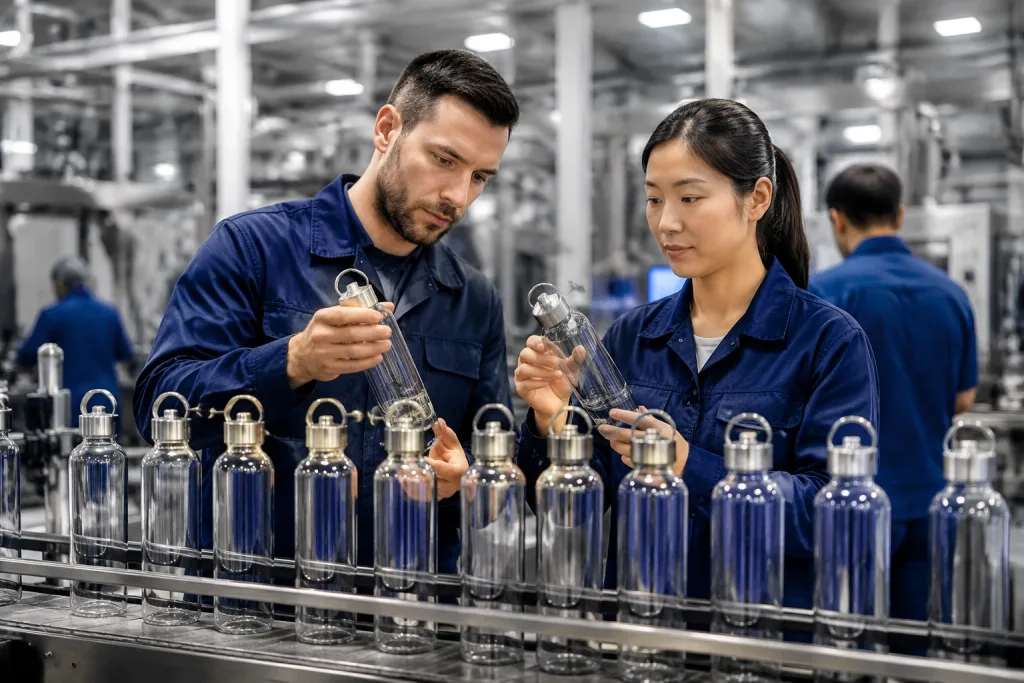
Key Takeaways
- For custom glass water bottle projects, realistic MOQ is usually 3,000 to 5,000 units per size, while new mold programs often start at 10,000 units.
- FOB China pricing for a 500 ml borosilicate bottle commonly lands around USD 1.25 to 2.80 before complex sleeves, bamboo lids, or gift boxes.
- Production lead time is typically 25 to 40 days after sample approval, with logo decoration adding 5 to 10 days depending on process.
- Ask vendors to inspect to AQL 2.5, confirm REACH or LFGB compliance, and share breakage targets below 1.5% for finished export cartons.
Picking a dependable glass water bottle vendor is harder than most buyers expect. A sample can look clean, a lid can feel solid at 14 kgf.cm on the torque tester, and the quote still misses the real risk: 4% breakage in transit, decal lead time sliding from 12 days to 18 days, export cartons failing a 1.2 m drop test, or a 3,000 pcs MOQ turning into 6,000 once the gift box is split by color. We see this every month on the line. Low price is the wrong question if you are building a wellness brand or supplying sustainable retail, because the problem shows up late, the buyer flagged it after receiving the goods, and the chargeback lands on you. Then the math does not work.
If you source from China, especially Zhejiang, split a trading quote from real production control on the line. A serious borosilicate glass bottle manufacturer talks in numbers: wall thickness at 1.8 mm or 2.2 mm, thermal shock range, carton drop testing standard, AQL inspection limits, screen print in 12 days, decal in 18. Last month QC pulled the sample and found a 0.3 mm lip chip under the inspection lamp; it never showed in the sales photos. That is how returns start. If a factory cannot walk you through that and still comes back with "we will check," keep moving. We have seen this go sideways.
What good vendors actually control
Start with ownership. Ask who runs the furnace, who owns the forming line, and who is only booking the order from a sales office. Some vendors melt and form in-house. Some are trading teams with no shop floor. Some are strongest in decoration, so they buy plain bodies from a separate borosilicate glass bottle supplier and handle decoration and assembly in-house. That model works. Hidden ownership is the problem. Last quarter a buyer flagged a 34 mm neck tolerance, the sample sat on the bench, and the sales office still had to call another plant before anyone could answer.
A capable borosilicate glass bottle factory should explain four basics in plain language: the glass composition, the wall thickness range, the forming process, and the packing method. For standard 500 ml and 750 ml bottles, high borosilicate bodies usually land around 2.2 mm to 3.0 mm wall thickness. We check that on the sample rack with a digital caliper. Not from a PDF drawing. If the quote is unusually cheap, the math doesn't work unless something was cut. It shows up fast. The glass drops below target. The lid shell drops to a lighter stainless gauge. The carton partition changes to a softer board that buckles in transit.
For wellness brands, check accessory control before bulk starts. Ask this late, and the line pays for it. Tea infusers need clean thread fit, checked on live samples. Silicone sleeves need a real pull test; we use a 5 kg hand gauge on first articles. Bamboo lids need moisture control because a 2-day swing in humidity can change the closing feel. Leak-proof PP inserts need torque and leak checks. Barcode labels need scan checks at pack-out because one wrong EAN on a PO will stop inbound at the retailer. We run a 20-set assembly trial on the line. Some borosilicate glass bottle distributors quote a good unit price, but if they do not control accessories, your assembly defect rate goes up. We have seen sleeves come in 1 mm tight, and QC pulled the sample within ten minutes.
In Zhejiang and other export clusters in China, good suppliers support 300,000 to 500,000 units per month across standard bottle programs, with custom runs starting from 3,000 units for existing molds. We ship repeat models every week, and those runs stay smooth once the carton spec and pallet pattern are locked. If you need a custom glass water bottle with a new silhouette, expect more friction. New mold work moves slower. Sampling is less predictable. The vendor who says that upfront is usually the safer one. A sales team promising 5 days on a fresh mold is selling hope, not production. We have seen this go sideways. First samples often take 12 days, and the flat-plate check shows right away if the base sits uneven.
MOQ, pricing, and where quotes go wrong
In 6 of 10 first-round RFQs, buyers ask for borosilicate glass bottle bulk pricing before the spec is fixed. Wrong question. We quote from a BOM, not from a photo pulled off Alibaba or a sketch in Excel. A 550 ml body with a bamboo lid and silicone sleeve sits in one cost band. Add a one-color silkscreen logo and a standard mail-order carton, and it still does not price like a 600 ml bottle with full-wrap decal, tea filter, gift box, and e-commerce drop-test standard. On the line, a 1.2 mm sleeve wall, a 32 mm neck finish, or one extra torque check at the lid station will move unit cost by USD 0.03 to 0.08.
Use these FOB China bands as a starting point. QC signs the golden sample first. Then we lock the 5-ply export carton and clear a 76 cm packed drop:
- USD 1.25 to 1.75 for a basic 450 ml to 550 ml bottle with standard lid and plain carton at 5,000 units
- USD 1.80 to 2.30 for a borosilicate glass bottle custom project with sleeve or infuser
- USD 2.40 to 3.50 for decorated retail packs with thicker glass, or for lower-volume customized glass water bottle orders
If a borosilicate glass bottle vendor comes in far below this band, ask what they cut. Most of the time it is the outer carton or the glass base. We also see paint with no food-contact paperwork, or a lid assembly with loose sealing tolerance. QC pulled one sample last month with a 0.6 mm gasket; it leaked after 20 minutes upside down during a 1 kg fill test, and the buyer flagged it the same day. The math doesn't work once you start replacing broken stock.
MOQ needs the same level of detail. Some borosilicate glass bottle manufacturers advertise 1,000 units. That figure is for unprinted stock colors packed in a plain white box from existing inventory. For a borosilicate glass bottle customized with logo print and dedicated packaging, realistic MOQ is 3,000 to 5,000 units per SKU. Add a custom sleeve color and the line gets less flexible. On 8 of 10 quotes, borosilicate glass bottle manufacturers in China ask for 10,000 units or a mold charge of USD 1,500 to 4,000 depending on complexity. We have seen this go sideways when the PO says "black sleeve" but gives no Pantone code. The line stops. The lab dip gets rejected, then approvals start over.
Ask for the quotation in a clean matrix. Break out body cost by bottle size and lid cost by material. Put decoration by color count on its own line. Show packaging by box type, then list testing scope and freight terms separately. Put carton spec and sample charge on the same sheet. If a supplier cannot break it down, comparing vendors is guesswork. We ship cleaner when the quote shows 24 pcs per carton and spells out whether testing means a 30-minute leak test or a full drop test.
Why borosilicate matters for your market
About 6 out of 10 bottles we check from open-market listings are not high borosilicate, and wellness buyers catch that gap fast once they ask about heat swing, breakage, and daily use. A proper borosilicate glass bottle manufacturer puts the grade on the spec sheet. No “premium glass” shortcut. On our 550 ml and 800 ml samples, we print 3.3 borosilicate on the sheet and confirm it again in the carton file check before artwork release, because buyers ask for it and the sales pitch is cleaner.
It still breaks. We have seen this go sideways on the line after a 1 m corner drop, with a chipped shoulder found at final inspection under the light table. The wrong question is whether glass survives careless drops. It does not. Borosilicate gives you better heat resistance, clearer walls, and a firmer hand feel in hand, which buyers notice fast on tea-infuser bottles and any hot-and-cold claim, usually within 10 seconds of picking up the sample.
If you are comparing borosilicate glass bottle wholesale offers, ask about end use first. Price per piece is the wrong first filter. A studio brand might want a 2 mm wall customizable glass water bottle with no sleeve and a one-color print, and they will push back on every extra gram once the sample hits the scale. A gift buyer may need a customizable borosilicate glass bottle with bamboo cap, laser logo, and a rigid box that still fits a 24-bottle master carton. An Amazon seller usually cares more about breakage rate, FNSKU labeling, and a carton drop from 76 cm than a fancy shelf pack. Different jobs, different bottle.
Good glass water bottle vendors also talk about closure compatibility. Most leakage complaints come from the lid, not the glass, and we run a torque check on the cap every batch with a digital torque tester. If the setting is off by 0.3 N·m, QC pulled the sample before it left the packing table. Check the food-contact silicone, thread engagement, and assembly after decoration, because we have seen logos print clean but the cap seat crooked after rework. A strong borosilicate glass bottle supplier ships repeatable tolerances, not just a pretty sample.
For sustainable retailers, ask where the sleeve, lid insert, and carton board come from. The bottle body gets the first click. The accessory pack decides the second sale. If the sleeve is cork, the insert is PP, and the carton is only 3-ply board, the buyer flagged it fast on one PO last year, right after opening the incoming sample at 9:20 a.m. The math does not work if the bottle looks premium and the pack-out feels cheap.
Customization without expensive surprises
Most buyers sourcing glass water bottle vendors do not want a plain catalog SKU. They want a custom glass water bottle with enough brand character to hold retail margin. Fair ask. Problems start when a factory says "custom" before checking the 3 mm shoulder clearance, cap tooling, and carton size. We saw one carton fail a 1.2 m drop test because the neck finish did not match the insert.
Customization has three levels, and each needs a separate quote. Level one is decoration on an existing mold: silkscreen, heat transfer, laser marking on lid parts, sleeve color changes, and packaging edits. We run this on existing jigs, so it moves fastest and gives the safest first order. Level two changes one component, such as a new lid shape, a custom sleeve texture, or a different tea infuser structure. Level three is a fully customized borosilicate glass bottle body with new mold development. If a supplier gives one blended price for all three, the math doesn't work. The quote usually hides tool wear, extra setup hours, or rework on the line.
If you are new to sourcing in China, start with level one unless your brand needs a unique bottle profile. Existing molds can ship in 25 to 35 days after pre-production sample approval. We ship repeat decoration jobs in that window because the neck finish and carton drop test are already proven on the line. A new body mold can push the timeline to 45 to 60 days before mass production is stable. That is normal. We have seen this go sideways when a buyer puts new tooling and a fixed launch date on the same PO, then asks why the first 500 pcs slipped.
For artwork, ask the vendor for a print area drawing with dimensions in millimeters, Pantone references, and logo position tolerances. Ask for the actual straight-wall height and shoulder radius, not a pretty PDF from sales. On one borosilicate glass bottle promotional order, QC pulled the sample and found the logo had crept 2 mm into the curve, which looked fine in photos and wrong in hand. Also confirm rub resistance and dishwasher expectations. Some decoration methods look sharp on first pass and fail after 20 wash cycles. This is the wrong question to learn late.
Better borosilicate glass bottle customizable programs include a pre-production sample, not just a digital mockup. That matters because curved glass can distort logo placement and decal alignment; on a recent sample, the buyer flagged a front logo that sat 1.5 mm off center once the bottle was capped. A vendor that wants your deposit before showing a real pre-production sample is asking you to pay for their guesswork. We ask for sample sign-off first, then we run.
Testing, audits, and defect control
This is where buyers separate a reliable borosilicate glass bottle distributor from a supplier who only knows how to quote. Lock the quality plan before the PO hits the line. Last month QC stopped a sample at incoming check because the PO said a 3 mm silicone sleeve and the approved drawing showed 2.5 mm. For Europe and North America, start with food-contact compliance for every material in the bottle set, plus one written inspection standard that both the factory and your inspector use against the same checklist.
Ask for these 5 items at minimum; on our side they go into the pre-production QC file before mass production:
- AQL 2.5 final inspection standard for appearance defects on the glass and print, lid function after torque check, and packing condition on inner tray and outer carton, with defect photos tied to the checklist
- LFGB or REACH-related material declarations for EU programs, plus California Proposition 65 screening when that market is on your PO
- Leak test criteria for every bottle, including upside-down hold time, test quantity per lot, and a clear pass/fail record signed by line QC
- Thermal shock or heat resistance data to back up borosilicate claims, not just a note on the spec sheet or a line from sales
- Carton drop testing if you sell online or ship through Amazon FBA; we usually run 76 cm drops on the master carton and record corner hits
If the supplier has BSCI-audited social compliance or runs under ISO 9001 processes, file it as background paperwork. This is the wrong question to ask first. A framed certificate at reception does not tell you whether the line caught a loose PP lid insert at 11:00 a.m. during assembly check. Those documents screen the supplier. They do not control your bottle quality.
For a bulk borosilicate glass bottle order, ask for a defect photo standard tied to the approved sample. Put numbers on every callout. Set the limit for bubbles, print misalignment, scratch length, and seam marks near the logo: bubble size under 1.5 mm, logo shift within 1 mm, scratch length under 8 mm, and a seam standard matched to the approved sample or the buyer's own limit if the PO is tighter. Glass is not injection-molded plastic. QC pulled one sample last quarter from the light box that passed in-house and got rejected by the buyer over a 2 mm seam mark near the logo. We've seen this go sideways. Set the standard early, or the factory and buyer will judge appearance with two different rulers.
On a normal bulk run, a dependable borosilicate glass bottle distributor or factory in Zhejiang should hold leakage defects below 0.3% and keep finished-goods breakage from factory to FOB loading below about 1.5% with proper partition packing and a 5-layer outer carton. We ship against numbers like these, and the pack-out whiteboard gets updated lot by lot by carton count. If they refuse to discuss defect percentages at all, assume they are not measuring them.
How to compare China suppliers efficiently
If you are screening borosilicate glass bottle vendors in China, skip broad questions like "Can you do custom?" 9 out of 10 sales reps will say yes in 10 minutes. Send a tight RFQ and make them reply line by line. Put the neck finish and box drop-test standard in the first mail. If the model is not fixed, add target capacity too. On our line, the 38 mm finish gauge comes out before we quote. Buyers lose 6 days on this. The delay usually starts with one vague email.
Your RFQ should include bottle capacity. Add target dimensions, wall thickness preference, lid material, accessory list, decoration method, packaging requirement, compliance market, MOQ target, and delivery term such as FOB Ningbo or FOB Shanghai. If you have a drawing, send tolerances too, even something basic like ±1.5 mm on height. Ask for sample lead time, production lead time, and monthly capacity. Ask what they are in plain words: a borosilicate glass bottle factory making in-house, a borosilicate glass bottle distributor buying from other plants, or a managed exporter controlling the order flow. Ask who packs the goods on the line and who signs the carton check sheet. One PO typo on carton spec can turn a 24-pack master into a breakage claim; we have seen "6 pcs/inner" typed as "8 pcs/inner," and the stack crushed at 1.55 m pallet height.
Score them on execution, not just price. If you only want the lowest number on day one, this is the wrong question to ask. A borosilicate glass bottle wholesale quote sent in 24 hours with no packaging or testing detail is weaker than one sent in 72 hours with the hard parts answered. The supplier you want will push back. If you ask for a thin-wall 750 ml customized borosilicate glass bottle with bamboo lid and individual gift box at a USD 1.40 target, the honest vendor should say the math doesn't work. We run this check fast. QC pulled the sample, put it on the scale at 420 g, and the cost was upside down before decoration started.
For sustainable retailers, ask where they load from and how they protect glass in peak season. This part matters. China winter and summer swings change transit risk, especially for mixed-container programs. A mature exporter in Zhejiang should already have standard pallet rules, carton moisture control, and loading photos from previous shipments. Ask for one real example: 35 x 35 x 5 mm corner board, 1.45 m pallet height, or whether they use 5-layer outer cartons. We ship with a moisture meter on the dock in August. We've seen humid cartons soften before loading.
When you finish the comparison, you should know more than who is cheapest. Cheap is not enough. You should know who understands your category well enough to protect margin after the goods leave China. If a supplier cannot answer the breakage rate, show the loading method, or pull the sample revision record, that tells you a lot. We ask for one live record from the line: breakage under 0.5%, a pallet map with carton count, and sample Rev B vs Rev C dated on the same sheet. If they cannot show it in 15 minutes, we've seen the order drift later.
Source glass bottles with numbers, not guesswork
Send your target capacity, logo method, packaging spec, and MOQ. We will quote the workable options, lead time, and test path before you commit.
Frequently asked questions
What MOQ should I expect from glass water bottle vendors for a custom order?
For an existing bottle mold with your logo and standard export packaging, expect MOQ around 3,000 to 5,000 units per SKU. If you want a custom sleeve color, bamboo lid engraving, or a different gift box, the MOQ may stay in that range but component minimums can push your total higher. For a fully new bottle shape, many suppliers in China will ask for 10,000 units or a mold fee of roughly USD 1,500 to 4,000. If a vendor offers 500 units for a fully customized glass water bottle, check whether they are only reselling stock or quoting an unrealistic setup. Low MOQ is attractive, but stable repeat production matters more.
How do I know whether a borosilicate glass bottle supplier is a real factory or just a trader?
Ask direct operational questions. A real borosilicate glass bottle factory should answer about wall thickness, forming limits, annealing control, leak testing, packing structure, and daily or monthly output. They should also provide factory photos that match the product category, not generic office shots. Request a breakdown showing which parts are made in-house and which are outsourced, especially lids, sleeves, and gift boxes. It is also useful to ask who handles final assembly and AQL inspection. Traders are not automatically a problem if they manage quality well, but you need transparency. In Zhejiang and wider China, some very capable exporters coordinate multiple component suppliers better than small standalone factories do.
What tests matter most for bulk glass water bottle orders into Europe and North America?
Start with food-contact compliance for every material touching liquid or lips: glass body, silicone seal, PP insert, stainless components, inks, and coatings. For Europe, buyers often ask for LFGB or REACH-related declarations depending on the materials involved. For North America, California Proposition 65 screening may be relevant. Beyond compliance, ask for leak testing, thermal shock data for borosilicate claims, and carton drop testing if you sell through e-commerce or Amazon FBA. I would also require a final inspection to AQL 2.5 and a visual standard for bubbles, scratches, and logo alignment. Without written acceptance criteria, glass quality disputes become subjective and expensive.
What is a realistic lead time for a borosilicate glass bottle customized with logo and retail packaging?
For a standard mold with one-color logo, normal export carton, and approved materials, 25 to 35 days after sample approval is a realistic production window. Add 5 to 10 days if you are using more complex decoration such as decals, multiple logo locations, or rigid gift boxes. A new mold or major lid development can push the total project timeline to 45 to 60 days before mass production is stable. Sample development usually takes 7 to 15 days for existing items and longer for new tooling. If your target ship date is fixed, lock artwork and packaging early. Most delays come from approval loops, not from the glass furnace itself.
How much should I budget for a bulk borosilicate glass bottle program?
For a straightforward 500 ml bottle with standard lid and plain carton, FOB China pricing often starts around USD 1.25 to 1.75 at 5,000 units. Add silicone sleeves, tea infusers, bamboo lids, or higher-end decoration, and you may land closer to USD 1.80 to 2.80. Premium gift packaging or low-volume runs can go above USD 3.00. Budget separately for testing, mold charges, and freight, because those items distort comparisons if they are hidden inside a unit price. Also factor in breakage allowance. Even with good packing, many buyers keep a reserve assumption of 1% to 2% across the full logistics chain when planning inventory.