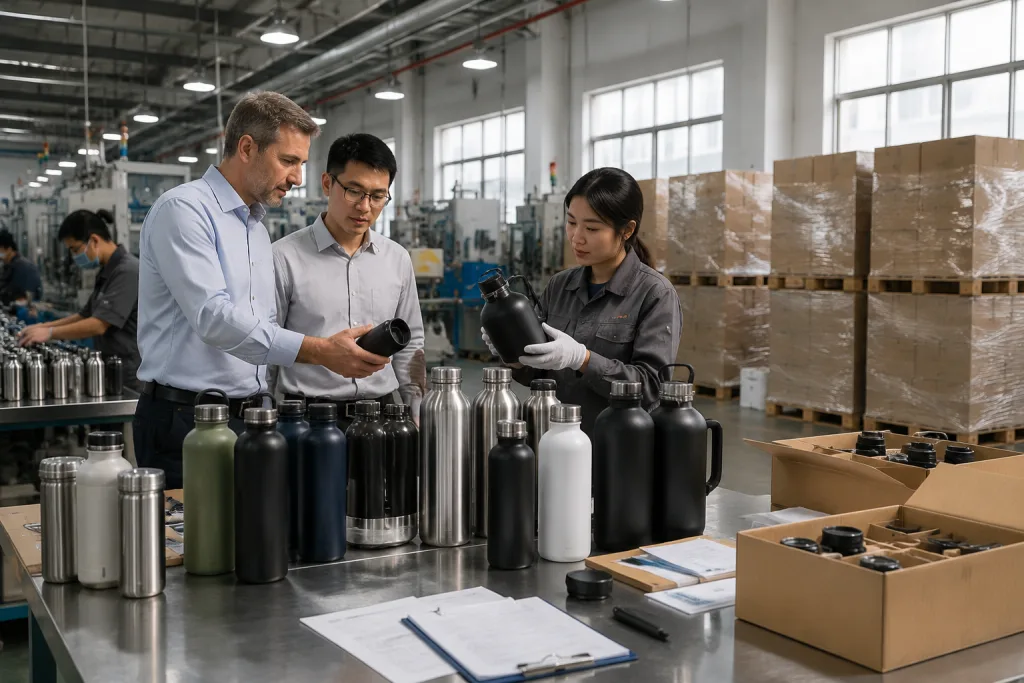
Key Takeaways
- A realistic MOQ for custom stainless steel bottles is 1,000-3,000 units per model, with lower MOQs costing 8-18% more
- Standard production after deposit and artwork approval usually takes 25-40 days in Zhejiang, China
- FOB China prices can range from about USD 1.35 for simple single-wall bottles to USD 7.80+ for premium insulated growlers
- Decoration, packaging, testing, and carton labeling can add USD 0.08-0.90 per unit before ocean freight
If you are buying wholesale water bottles for American retail shelves, corporate programs, outdoor shops, or distributor stock, the quote is not just the unit price. The real number comes from 304 stainless thickness, lid mold, logo process, carton drop-test rules, lab testing, and whether we pack one logo or 6 color SKUs. Small detail, big cost.
From the lines we run in Zhejiang, China, we see the same mistake 3 or 4 times a month: buyers compare FOB prices without locking the spec sheet. A 500 ml single-wall bottle at 0.5 mm body thickness is not the same job as a vacuum insulated bottle with powder coating, laser logo, retail box, and REACH testing. Last week QC pulled a sample because the PO said “matte black,” but the artwork called for Pantone Black 6C; that kind of mismatch adds 2 to 4 days before production even starts. Here is the cost and lead-time breakdown you can use.
Start with the landed cost
For wholesale water bottles american buyers, the FOB unit price is only the first line on the sheet. Landed cost means the bottle cost plus decoration charge, retail packaging, inspection fee, China inland handling from our Hangzhou plant to Ningbo or Shanghai, international freight, U.S. duty, customs brokerage, then final delivery to your warehouse or 3PL. Retail buyers also need compliance documents and label checks before goods leave the line; we have had QC pull cartons because the PO said “dishwasher safe” but the artwork file did not.
A basic stainless steel sports bottle in drinkware bulk may quote at USD 1.35-2.10 FOB Ningbo or Shanghai at 3,000 units. A double-wall vacuum bottle with 18/8 stainless steel, powder coating, leakproof lid, and one-color logo often sits around USD 3.20-5.20 FOB. A bulk growler or beer growler wholesale project can move from USD 5.80 to USD 9.50 depending on capacity, handle tooling, silicone lid seal, wall thickness, and whether it is 64 oz, 40 oz, or 32 oz. Small change, big cost. On the factory floor, a 0.1 mm wall-thickness change can change polishing time and scrap rate, so the math does not work if you compare quotes without the spec sheet.
Do not ignore freight math. A 20 oz insulated bottle may pack 24 pieces per master carton. A 40 oz tumbler or growler bulk order eats more container space, so ocean freight per unit rises fast. For U.S. buyers, a rough ocean freight and destination handling allowance can be USD 0.25-0.90 per bottle depending on carton volume, port, and season. Air freight can add USD 2.00-6.00 per unit, which only makes sense for samples or urgent replenishment. We have seen this go sideways when a buyer approved a 10.5 kg master carton but forgot Amazon carton drop-test limits.
When you request quotes, ask for FOB, carton dimensions, gross weight, HS code, and estimated production lead time in the first email. Also ask for master carton CBM to 3 decimals, not “about one carton.” We run this off the packing trial: caliper on the bottle height, carton tape test, then weight check on the digital scale. A supplier who cannot give carton CBM before order confirmation is not ready for serious wholesale drinkware planning.
What really moves the unit price
The cost drivers rarely show up in a product photo. Material comes first. For food-contact stainless steel, most American programs use 304 stainless steel for the inner wall. Some cheaper canteen wholesale offers use 201 stainless steel on the outside to cut cost, but the inner wall should stay 304 for taste, corrosion resistance, and buyer confidence. We run an XRF gun check on incoming coil; if a buyer asks for full 316 stainless steel, the price jump is not “supplier margin,” it is raw material math.
Wall structure is next. Single-wall bottles are cheaper, lighter, and faster to produce, but they sweat with cold drinks and do not hold temperature. Double-wall vacuum bottles need more forming, welding, vacuum pumping, and insulation testing. On the line, QC pulls samples after vacuum pumping and checks heat retention after 6 hours. That is why wholesale drinkware for fitness clubs may be USD 2.00 per unit, while a premium corporate bottle can be USD 5.00 or more. Same shape. Different work.
Lids hide cost. A simple screw cap costs much less than a flip straw lid, chug lid, carry handle, or dual-use lid with silicone gasket. For kids and outdoor programs, we usually recommend budgeting USD 0.18-0.65 extra for better lid engineering instead of saving pennies and creating leak complaints. We have seen this go sideways: the buyer flagged 37 leaking samples after a carton drop test because the gasket groove was 0.4 mm too shallow.
- Surface finish: powder coating usually adds USD 0.25-0.55 per unit versus plain stainless steel, and the coating line still needs tape test checks after curing.
- Logo method: silkscreen may add USD 0.06-0.18; laser engraving often adds USD 0.12-0.35 depending on area, especially when the logo wraps over a taper.
- Retail box: kraft or color box can add USD 0.18-0.70 per unit; one PO typo from “white box” to “color box” can change a 10,000 pcs order fast.
- Testing: FDA/LFGB/REACH/California Prop 65 support can add lab fees of USD 180-650 per model or material group, and labs will ask for material breakdown, not a sales screenshot.
If you are comparing the best wholesale drink bottle suppliers, force all vendors to quote the same gauge, capacity, lid, coating, logo size, packaging, and AQL level. Ask for the steel thickness in mm and the lid drawing revision. The cheapest quote is usually just the least complete quote, and the math does not work once QC pulled the sample and the missing details appear.
MOQ tiers buyers should expect
MOQ is where first-time buyers burn 7-10 days. Factories in Zhejiang do not set MOQ just to be difficult; the number is tied to steel coil purchasing, mold setup, powder-coating color change, logo screens, printed cartons, line labor, and the reject allowance QC will pull after polishing. For a standard bottle using an existing mold, a workable MOQ is usually 1,000 pieces per model and 500 pieces per color if the coating color is common, such as matte black or white. For a fully custom shape, expect 3,000-5,000 pieces or a tooling charge. We run this check before quoting, because a buyer once approved artwork first and then flagged the 3,000-piece custom shoulder MOQ on the PO.
For canteen bulk or wholesale canteen programs, MOQ depends on whether the body shape already exists. Existing military-style or hiking canteens may start at 1,000-2,000 units when the mold is on our shelf and the cap thread matches our current gauge. A custom cap, strap, or molded accessory can push the MOQ to 3,000 units because injection molding, buckle sourcing, and assembly jigs all need a stable run. Alcohol flask wholesale bulk projects follow the same math: common 6 oz or 8 oz stainless flasks can start around 1,000 pieces, but leather wrap with glue testing, embossed logo plates, funnel sets packed by hand, or a rigid gift box will increase MOQ and lead time. The math doesn't work on 300-piece custom flasks.
Beer tumbler wholesale bulk and beer growler wholesale bulk orders have a different problem: carton volume. A 64 oz beer growler in bulk takes more warehouse and container space, and one 5-layer master carton can hit 12-14 kg before we even talk about pallets. Factories prefer larger production runs because the line needs fewer changeovers and the packing team can keep one carton spec on the table. For a bulk growler with powder coating and laser logo, 1,000 pieces may be accepted, but 2,000-3,000 pieces usually gives better pricing and cleaner production scheduling. QC pulled the sample last month because the laser logo sat 3 mm off center; small runs leave less room to absorb that kind of rework.
As a practical rule, 500 units is a sample marketing order, 1,000-3,000 units is a normal custom wholesale order, and 5,000+ units is where pricing starts to become efficient.
At BottleForge Industrial, a typical stainless steel bottle line can support about 180,000-240,000 units per month across standard models, but small fragmented orders still slow down coating and packing. Six colors and three lid types means 18 packing combinations. That is not a small order anymore. If your PO has mixed lids, PMS colors, and separate Amazon carton labels, we need the MOQ talk before design approval, not after the buyer asks why production is 18 days instead of 12 days.
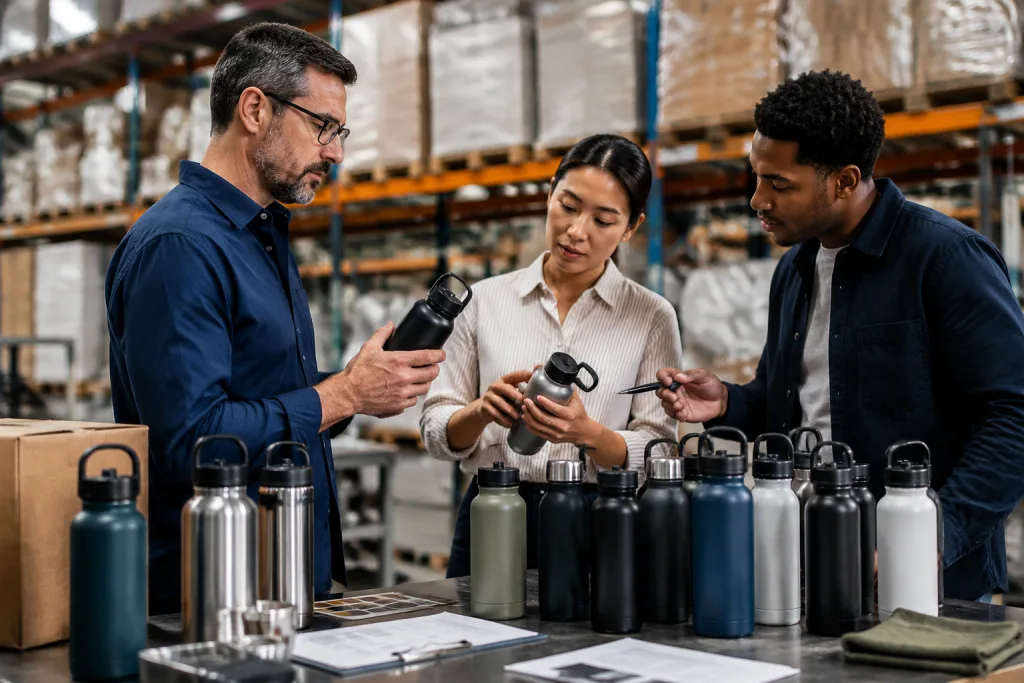
A realistic production calendar
Lead time is not one number. It is a chain with 4 locks: deposit received, final artwork, confirmed packing details, and approved pre-production sample. For American wholesale drinkware buyers, we start the calendar from the last lock, not from the first email. We had one PO last month with the carton mark typed as “12 pcs/ctn” while the buyer’s routing guide said “24 pcs/ctn”; the line waited 2 days while sales, packing, and the U.S. warehouse fixed it. No approval, no clock.
For existing molds, digital mockups usually take 1-2 working days. Physical samples with logo take 5-10 days if the bottle body is in stock, or 10-18 days if we need a fresh body and coating color. New tooling can add 18-35 days before mass production. A custom lid often eats more time than a custom body, because the silicone ring, thread fit, and leak test are less forgiving; QC pulled one sample at 0.6 mm lid gap, and the buyer was right to flag it.
Mass production for drinkware wholesale usually takes 25-40 days after sample approval. Simple single-wall bulk drinkware can land closer to 20-30 days. Vacuum bottles, canteen wholesale, beer tumbler in bulk, and beer growler wholesale orders are often 30-45 days because vacuum testing, coating cure time, assembly checks, and inspection sit on different parts of the line. The math doesn't work if a buyer wants 20,000 pcs, powder coating, individual gift boxes, and a 22-day ship date during May promo season. Peak season before summer promotions and Q4 gifting can add 7-15 days.
After production, inspection normally needs 1 day for booking and 1 day on site. If you use AQL 2.5 for major defects and AQL 4.0 for minor defects, clarify that before production, because changing the standard after cartons are sealed wastes time and tape. We ship most containers from Ningbo or Shanghai; U.S. West Coast port-to-port may take around 15-25 days, and East Coast can be 28-40 days. Rail or truck after port clearance adds more time. For a retail launch date, count backward 90-120 days from the required in-warehouse date for a custom order from China, and add 3 days if your forwarder still asks for manual ISF data by spreadsheet.
Decoration and packaging costs
Decoration is where brand owners overspend, or worse, leave the spec loose. A one-color silkscreen logo is still the lowest-cost choice for simple promo bottles, especially on 10,000 pcs runs where the buyer only needs a clean front mark. It works for large solid artwork, but we have seen ink lift during a 3M tape test when the powder coat and ink system were not matched. Laser engraving costs more, usually with a slower fixture setup on the line, but it gives a permanent mark on powder-coated 304 stainless and fits corporate programs, outdoor brands, and higher-priced wholesale drinkware.
For full-color artwork, heat transfer or UV printing can work, but abrasion testing should be in the quote, not discussed after the PO lands. We run tape tests, alcohol rub tests, and dishwasher guidance checks before bulk production; QC pulled one 20 oz sample last month after 50 alcohol rubs dulled the red logo. Do not assume dishwasher safety unless it is tested and written into the specification. About 7 out of 10 powder-coated bottles we ship for US promo orders are marked hand wash only, even when the steel body itself is durable.
Packaging affects both price and logistics. Bulk pack is cheapest for distributors who repack locally. A polybag plus egg-crate divider may add only USD 0.03-0.08. A retail color box can add USD 0.25-0.70 depending on paperboard, print coverage, and whether the insert is E-flute or molded pulp. For Amazon or 3PL shipments, you may also need FNSKU labels, suffocation warnings, carton labels, and stronger boxes for drop tests. Those details can add USD 0.05-0.20 per unit, but they prevent receiving problems; we have seen a whole 48-carton pallet delayed because “FNSKU” was typed as “FNSK” on the PO artwork note.
For alcohol flask in bulk, gift packaging is common. A flask, funnel, and two cups in a rigid box can look premium, but the packaging may cost nearly as much as the flask body. This is the wrong place to chase the cheapest box if the set is going into retail. For beer tumbler wholesale or growler wholesale sets, foam protection may be needed to avoid dented bodies during ocean transit; QC once found 14 dented growlers in a 200 pcs trial carton after we skipped the 8 mm foam sleeve. Cheap packaging saves money at the factory gate and loses it in claims.
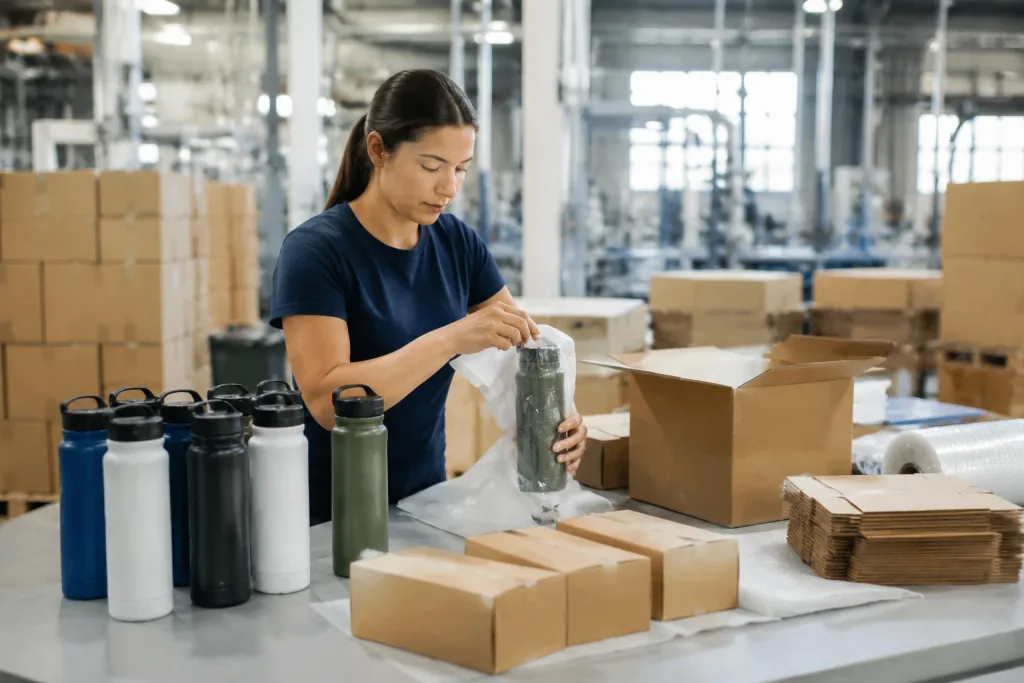
Compliance for American sales channels
If you sell into the United States or Canada, compliance is a gate, not a nice extra. Food-contact bottles need safe materials, and the paperwork has to match the PO line item we run, including color, lid type, logo process, and gasket material. Ask for material declarations, 304 stainless grade confirmation where applicable, coating information, silicone gasket material, and current test reports. For American channels, FDA food-contact expectations, California Prop 65 risk review, CPSIA considerations for kids products, and ASTM testing apply by product type. We have seen this go sideways when a buyer approved a black powder-coated bottle, then the PO typo said “matte balck”; QC pulled the sample before packing because the test report was for a different coating batch.
For European distributors, REACH and LFGB come up often. If one production run ships to both Europe and North America, tell the factory before we book coating and lid materials. Coating, ink, plastic lid, and silicone gasket choices can change, especially on soft-touch finishes and colored PP lids. A China supplier can support both markets, but the math does not work if documents are requested after 312 cartons are sealed and strapped. By then the line has moved on.
Quality control belongs inside the purchase order. Write the checks clearly: capacity, weight, wall thickness, coating adhesion, logo position, lid torque, gasket fit, leak test, vacuum insulation test, odor check, carton drop condition, barcode scan, and packing count. Better yet, set tolerances, such as 500 ml capacity within ±5%, logo position within 2 mm, and lid torque checked with a torque meter. For insulated bottles, we often test with hot water for 4-6 hours during internal QC; one 40 oz tumbler sample dropped from 86°C to 61°C in 6 hours, which passed that buyer’s spec. For large production, a third-party inspection using ANSI/ASQ Z1.4 sampling is a smart use of USD 250-350 per inspection day.
BSCI or similar social compliance matters when you sell to larger retailers. ISO 9001 certification helps, but it is not a substitute for order-specific QC. The purchase order should say what happens if the order fails inspection: rework, sorting, replacement, discount, or reinspection at supplier cost. Do this before the deposit. We push for this because once 30% is paid and stainless bodies are already welded on the line, the buyer’s options get narrower fast.
How to keep pricing stable
Drinkware pricing moves with 304 stainless steel coil, USD/RMB exchange, powder coating, labor, and freight. You cannot make it flat, but you can stop most ugly surprises. Freeze the spec first. Then ask for 15-30 days quote validity and get the steel basis written on the PI, such as “304 coil at RMB 14,800/ton.” For larger wholesale growler, beer growler bulk, or canteen bulk orders, ask if we can hold the unit price after a 30% deposit; on our line, the buyer flagged this after a 12,000 pcs PO came in with “matte black” on the artwork but “gloss black” on the item sheet.
Payment terms change the price more than some buyers expect. New accounts usually run 30% deposit and 70% balance before shipment. Repeat buyers with 3-4 clean orders behind them can sometimes move the balance to after inspection or against copy documents, but first-order credit is the wrong question to ask. The math does not work for the factory. If a quote is low and the payment terms are loose, check the supplier carefully; we have seen this go sideways when QC pulled the sample and found 0.42 mm body thickness against a quoted 0.50 mm.
You can cut cost by using existing molds, reducing color changes, sharing one lid across 2-3 SKUs, and planning cartons around pallet or container loading. Six powder colors means six booth cleanouts, and each cleanout can burn 35-50 minutes plus scrap hooks on the coating line. Moving from six powder colors to three can reduce coating changeover waste and cut lead time by 2-4 days. Combining wholesale canteen, sports bottle, and travel tumbler orders into one shipment can lower freight per unit if carton dimensions are fixed early, such as 58 x 39 x 32 cm before the forwarder books space.
The best procurement method is boring because it works: freeze the spec, approve one golden sample, define AQL, confirm carton data, and keep every change in writing. Short sentence. No mystery. We ship steadier pricing to American buyers when the PO, artwork, and carton marks match before mass production; one missing hyphen in a UPC file has delayed a 9,600 pcs reorder for 3 days. That is how buyers get reliable wholesale water bottle pricing from Zhejiang, China without turning every reorder into a fresh negotiation.
Get a costed quote before you brief retail buyers
Send your target bottle, logo, MOQ, market, and delivery date. We will return a practical FOB quote with timeline and packing data.
Frequently asked questions
What MOQ should an American buyer expect for custom wholesale water bottles?
For an existing stainless steel bottle mold, expect 1,000-3,000 units per model. Some factories accept 500 units, but the unit price may be 8-18% higher because coating, printing, and packing setup costs are spread over fewer pieces. If you need a custom shape, custom lid, or private mold, 3,000-5,000 units is more realistic, plus tooling fees. For beer growler wholesale bulk or alcohol flask wholesale gift sets, MOQ also depends on packaging components. Always confirm MOQ by model, color, lid type, and logo version, not only by total order quantity.
How long does a wholesale drinkware order from China to the U.S. take?
A safe custom order calendar is 90-120 days from specification approval to U.S. warehouse arrival. Sampling usually takes 5-18 days, mass production takes 25-40 days for most stainless steel bottles, and inspection plus export booking adds several days. Ocean freight is roughly 15-25 days to the West Coast and 28-40 days to the East Coast, depending on routing and congestion. If you need a new mold, add 18-35 days. Air freight is faster, often 5-9 days after pickup, but it can add USD 2.00-6.00 per unit.
What is the price difference between single-wall and insulated bottles?
Single-wall stainless steel bottles are usually the lowest-cost metal option, often around USD 1.35-2.10 FOB China at 3,000 units, depending on capacity and logo. Double-wall vacuum insulated bottles usually start around USD 3.20 and can pass USD 5.20 with powder coating, premium lids, and retail packaging. Larger items such as a bulk growler or beer growler in bulk can run USD 5.80-9.50 or more. The insulated product costs more because it requires two steel walls, welding, vacuum processing, insulation testing, and stricter leak control.
Which logo method is best for drinkware wholesale programs?
For basic promotional drinkware bulk orders, one-color silkscreen is usually the cheapest at about USD 0.06-0.18 per unit. It works well for simple logos and large runs. Laser engraving costs more, often USD 0.12-0.35 per unit, but it is permanent and looks better on powder-coated stainless steel. Heat transfer or UV printing can handle full-color graphics, but you should request abrasion and tape testing before mass production. For retail or outdoor brands, we usually recommend laser engraving or a tested transfer print rather than the cheapest ink option.
What documents should I ask for before placing a bulk drinkware order?
Ask for a written specification sheet, material declaration, stainless steel grade confirmation, coating and plastic information, carton dimensions, gross weight, HS code, and available test reports. For U.S. sales, review FDA food-contact expectations, California Prop 65 risk, and CPSIA if the product is for children. For Europe, ask about REACH and LFGB. You should also define AQL inspection levels, usually AQL 2.5 for major defects and 4.0 for minor defects. If selling through Amazon or a 3PL, confirm FNSKU labels, carton labels, and packaging rules before production.