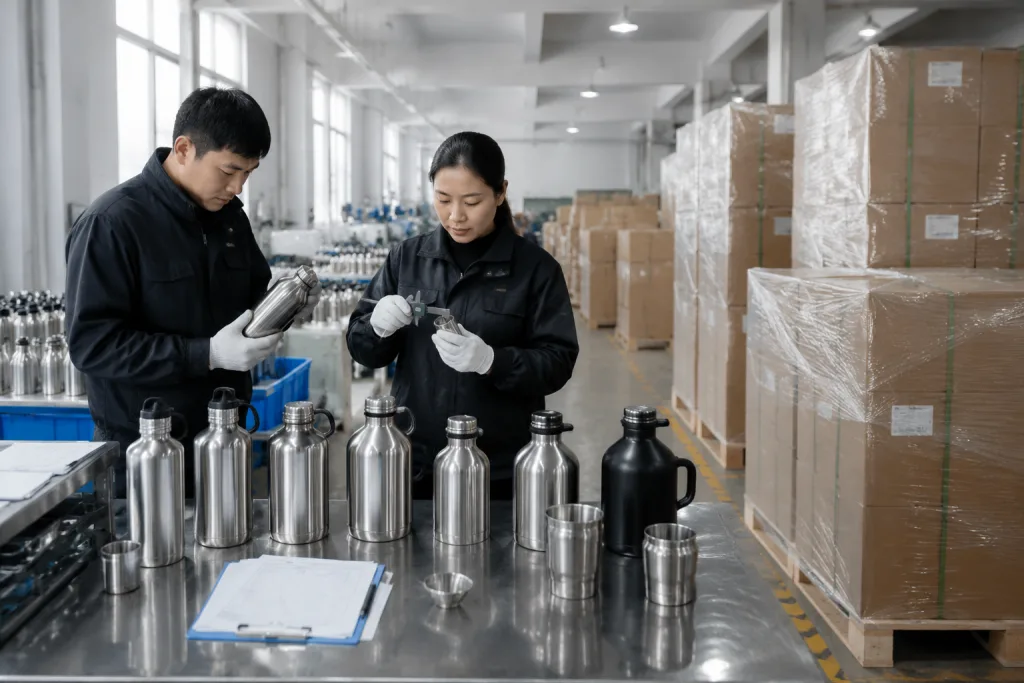
Key Takeaways
- A practical wholesale water bottle UK RFQ should specify material grade, capacity tolerance, finish, logo method, packing, AQL, and Incoterm
- For custom stainless bottles, a realistic MOQ is usually 1,000-3,000 pcs per SKU, with 30-45 days production after sample approval
- UK compliance checks should cover LFGB/REACH where relevant, food-contact migration, BPA status, and factory audit expectations such as BSCI
- Carton specification matters: a weak 5-ply carton can add 1-3% damage risk on mixed-pallet or courier distribution
Search “wholesale water bottle UK” and you’ll get pages of the same studio photos, but almost no data a buyer can approve. Photos don’t pass incoming QC. You buy 0.5 mm or 0.6 mm wall thickness, 304 stainless, carton burst strength, FDA or LFGB files, logo adhesion after 3M tape testing, ETD dates, and landed cost per piece. Last month QC pulled a matte black sample because the laser logo shifted 2 mm off the agreed position; the photo looked fine, the spec did not.
From our factory network in Zhejiang, China, we see UK buyers lose 7 to 12 days when the first enquiry says only “send your best wholesale drink bottle.” Wrong question. A workable RFQ reads like a spec sheet: capacity in ml, lid type, MOQ, Pantone code, packing method, barcode need, target delivery window, and test standard. Below is the line-by-line version we run when quoting bulk drinkware, wholesale canteen, beer growler wholesale, and custom bottle programs for European buyers. We also ask buyers to check small PO errors early; “750ml” typed as “500ml” has delayed one UK repeat order by 18 days.
Start With The Product Line
I’ll rewrite the section in-place, keep the HTML structure untouched, and make the copy sound like a real factory-side sales engineer wrote it.The first spec line is not the logo. It is the product family. “Wholesale water bottle UK” can mean a 500 ml school bottle, a 750 ml gym bottle, a 1 L stainless sports flask, a 64 oz bulk growler, or a 6 oz alcohol flask bulk order. These are different tools, different molds, different tests, and different freight profiles.
For UK retail and promo programs, we split it fast. Single-wall stainless bottles are light and lower cost, usually 0.4-0.5 mm wall thickness. Double-wall vacuum bottles use 304 stainless steel inner and outer shells, often 0.5 mm inner and 0.4-0.5 mm outer, with insulation checked at 6, 12, and sometimes 24 hours on the line. Tritan bottles fit kids, sports, and clear-body designs, but the buyer needs BPA-free material and food-contact test requirements in writing. QC pulled a sample once and the wall was 0.38 mm, and yes, the buyer flagged it.
If you ask for canteen wholesale pricing, define whether you mean a military-style canteen, an outdoor camping bottle, or a handled water bottle. “Bulk canteen” and “canteen bulk” show up loosely in buyer emails, so we ask for drawings or a reference size before we quote. The math does not work any other way. For growler wholesale, capacity is the first fork in the road: 32 oz and 64 oz are the normal beer growler bulk sizes. A beer growler in bulk order needs a leak-resistant cap, a pressure-aware design talk, and sometimes amber glass or stainless steel depending on the channel. We once got a PO that said “64oz gorwler” and the sample room still had to confirm the neck finish.
For beer tumbler wholesale, the drinking feel matters more than the headline capacity. A 16 oz beer tumbler bulk order should define rim diameter, lid type, stacking need, and whether the buyer wants a brushed, powder-coated, or mirror finish. If you sell to pubs, events, or breweries, the tumbler must sit flat on wet tables. A narrow base may look clean in a render and still fail in real use. We’ve seen that go sideways on a 90 mm base, then the buyer comes back asking why the sample wobbles.
Material Grade And Food Contact
I’ll rewrite the section with tighter, supplier-style language and keep every tag exactly as-is.Material is where cheap quotes usually hide the cut corners. For stainless drinkware bulk, we normally push 304 stainless steel for the inner food-contact wall. Some factories will quote 201 stainless to shave USD 0.20-0.45 per unit on big runs, but it rusts easier and it is the wrong call for a brand that plans repeat orders. If you are buying wholesale drinkware for the UK market, write “304 inner, 304 or 201 outer only if approved” in the RFQ and do not leave it open.
For caps and lids, ask for PP, Tritan, or food-grade silicone. Do not accept “plastic lid” on a PO. If the cap uses a straw, bite valve, or flip top, the silicone hardness needs checking. We have seen a soft straw collapse after a few dishwasher cycles, and a hard seal start weeping on the line. For children’s bottles, UK buyers often ask for EN 14350 or the right migration test set, depending on the age grade. For general food contact, LFGB, EU 1935/2004, REACH, and BPA-free declarations are standard asks, even when the goods ship through a UK importer.
In Zhejiang and the wider China supply chain, most export factories can hand over test reports, but you need to check what the report actually covers. A report for raw stainless sheet is not the same thing as a finished bottle report. A 2021 file will not carry a 2026 compliance review. Your RFQ should ask for recent finished-product testing, with the exact coating colour, lid material, and gasket included where possible.
This also applies to alcohol flask wholesale and alcohol flask wholesale bulk orders. Small hip flasks usually run 304 stainless inside, but the outside can include plating, PU leather wrap, or paint. If the product touches alcohol, the inner chamber comes first. The decoration can take the knocks. Food-safe on the inside is the only point that matters.
Capacity, Tolerance, And Usable Volume
I’ll rewrite the section in place, keep the HTML exactly as-is, and tighten the language so it reads like a factory-side sales engineer.Capacity looks simple until the buyer, the factory, and the end user measure it three different ways. A bottle sold as 750 ml may hold 750 ml to the brim, or it may have 750 ml usable fill volume below the cap thread. For wholesale water bottle UK programs, we define usable capacity and tolerance on the PO before the line starts. A practical tolerance is often ±3% for stainless bottles and tighter for molded plastic, depending on mold wear and wall thickness.
For a bulk growler or beer growler wholesale bulk order, this gets sensitive fast. Breweries and taprooms care about declared volume, and the buyer will flag it if the fill line is vague. If you sell a 64 oz growler, confirm whether 64 oz means brim-full or fill-line volume. A fill line can be laser marked, screen printed, or molded on some designs. Laser marking is cleaner on stainless, but it costs more than a simple one-colour print.
Dimensions drive cartons and pallet counts. A 750 ml bottle with 73 mm diameter may fit 24 pcs per export carton; a wider 88 mm design may drop to 12 or 18 pcs. That shift can add several cubic metres on a 10,000 pc order. We’ve seen this go sideways on a UK job when the carton changed by 8 mm and the math stopped working. When FOB Ningbo or Shanghai freight is low, nobody cares. When UK warehousing and courier rates are tight, the carton cube becomes margin.
Ask for these numbers on the quotation, not after you place the PO:
- Brim capacity and recommended fill capacity in ml or oz
- Product size in mm, including cap and handle
- Net weight per unit, ideally ±5 g tolerance for stainless bottles
- Carton quantity, carton size, gross weight, and CBM
- Pallet loading plan if you use UK 1200 x 1000 mm pallets
Good sourcing is boring here. QC pulled the sample, checked the thread depth at 2.1 mm, and the numbers held. That is the point. Boring numbers prevent expensive surprises.
Finish, Colour, And Logo Durability
I’ll rewrite the section in-place, keep every tag and heading structure intact, and tighten the prose so it sounds like a factory-side sales engineer, not marketing copy.Decoration is where brand owners get emotional, but procurement should stay on the numbers. Powder coating is a good fit for wholesale drinkware because it gives a better hand feel than bare metal and holds matte colours well. We usually see 60-90 microns on the line. Go thinner and it chips; go thicker and threads, lids, or tight-fit parts stop closing cleanly.
For logo methods, match the print to the use case. Silk screen is the low-cost option for simple one- or two-colour logos, and it works well once you are above 1,000 pcs. Laser engraving is solid on stainless and suits corporate programs, but it cuts back to the metal and will not carry full-colour artwork. Heat transfer can handle complex graphics, yet we always test it after hot water soak and abrasion. UV print gives sharp colour on some substrates, but it is not the toughest choice for gym bottles getting tossed into bags.
If you are buying drinkware wholesale for UK retail, ask for a pre-production sample with the final coating and the final logo, not a blank shape sample. A blank sample only proves the mold ran. It proves nothing on colour, adhesion, logo registration, or packing. For Pantone matching, powder coating still has a practical tolerance. A Delta E target under 2.0 is a tight ask unless you pay for stronger colour control and two or three lab dips.
For beer tumbler in bulk and beer tumbler wholesale bulk programs, the rim finish matters too. A sharp rim is a rejection. A rolled or polished lip feels better in hand and cuts complaints. For alcohol flask in bulk, check the welding seam and cap threading. We have seen flasks pass a catalogue shot and still leak because the gasket or thread machining was off by 0.2 mm.
Our opinion: do not approve mass production from a render. Approve from a physical sealed sample, then keep one signed sample in the factory and one in your UK office.
MOQ, Price, And Incoterms
I’ll rewrite the section in-place, keep the HTML exactly as-is, and strip the AI-ish phrasing while adding a few factory-floor details and sharper buyer language.MOQ is not a penalty. It is the point where material buying, coating line setup, logo screens, labour, and packing start to make sense. At BottleForge Industrial in Hangzhou, Zhejiang, we run 1,000 pcs MOQ for stock-shape custom logo bottles, 3,000 pcs per colour for deeper customisation, and 5,000-10,000 pcs for new mold projects. On the line, monthly output across our main stainless drinkware models sits around 450,000 units, depending on model mix and coating workload.
For a standard 500-750 ml stainless bottle, FOB China pricing usually lands around USD 2.20-5.80, based on insulation, cap structure, finish, and order volume. A simple single-wall sports bottle prices lower. A double-wall bottle with powder coating, carry handle, retail box, and laser logo costs more. We had a buyer flag a PO for a typo on the cap colour once, and the rework cost wiped out the margin, so this is the wrong question to ask unless the spec sheet is fixed. A bulk canteen order with a strap, pouch, or wide-mouth cap needs its own accessory cost. A wholesale growler with heavy-gauge stainless and a swing cap will never price like a plain bottle.
Compare quotes on the same Incoterm. FOB Ningbo, FOB Shanghai, EXW Zhejiang, CIF Felixstowe, and DDP UK are not interchangeable. If a supplier sends a tempting DDP quote, ask what is inside: UK duty, VAT handling, customs clearance, insurance, and delivery to one warehouse or multiple addresses. QC pulled the sample last month and found a 2 mm carton overhang that would have failed one UK retailer’s pallet rule, so carton size matters. For Amazon or marketplace programs, FNSKU labelling, master carton marks, and carton weight limits should be added before final price approval.
Payment terms move the price too. A normal China export order uses 30% deposit and 70% balance before shipment after inspection. For established buyers, terms can improve over time. If you want 60-day credit from day one on a 1,000 pc trial order, the math does not work; the unit price will carry the financing risk.
Quality Control And Packing Lines
I’ll keep the tags untouched and rewrite each paragraph in a sharper factory-side voice, with concrete QC and packing details.AQL needs to be on the purchase order. For most wholesale water bottle UK orders, we run AQL 2.5 for major defects and 4.0 for minor defects, with critical defects at 0. Critical defects cover sharp edges, leakage, contamination, broken glass, or a material swap that fails safety. Major defects cover poor vacuum performance, logo shift, wrong colour, leaking cap, or a damaged retail box. Minor defects are small cosmetic marks inside the agreed limit.
Vacuum bottles need their own test stack. A normal line check includes a vacuum test, temperature retention check, leak test, coating adhesion check, and final visual inspection. We pull the sample under ANSI/ASQ Z1.4 or ISO 2859-1, not by gut feel. If the order is new, customised, or above USD 15,000, relying on factory self-check is the wrong question to ask. A third-party inspector in China usually costs a few hundred dollars and can stop a full container of complaints.
Packing needs its own spec line. For e-commerce, one bottle in a polybag and a thin white box is often not enough. If the bottles move by courier inside the UK, the line should use an EPE sleeve, a stronger individual box, or a mailer that has passed a drop test. Export cartons should normally be 5-ply corrugated, with edge crush strength set for stacking. Once cartons go over 18-20 kg, damage at the warehouse ramp starts showing up fast.
For glass bottle and beer growler bulk shipments, ask for dividers and drop-test results. One buyer flagged a 2 mm carton gap on a sample, and that small miss turned into broken necks after transit. For stainless, the powder coat needs scratch protection. For drinkware bulk going to retail stores, barcode placement, carton labels, and inner pack quantities all matter. Mixed colours in unmarked cartons slow the line and create receiving errors. We’ve seen that go sideways more than once.
Sampling To Delivery Calendar
I’ll rewrite the section in place, keep the HTML tags untouched, and tighten the sales-engineer tone with concrete factory details and cleaner timing language.A realistic schedule beats a heroic promise every time. For existing molds, we can usually ship a blank sample in 3-5 days. A custom logo sample normally needs 7-10 days after artwork approval. A pre-production sample with final colour takes 10-15 days when powder coating or special printing is on the line. Mass production is usually 30-45 days after deposit and sample approval for standard wholesale drinkware orders from China.
For new mold work, add 25-40 days for tooling, first samples, adjustment, and sign-off. If your UK launch date is fixed, work backwards from the shelf date, not the factory production date. Sea freight, customs clearance, UK inland delivery, lab testing, inspection, and buffer stock all need room. We’ve seen this go sideways when a buyer planned 8 weeks and ignored freight; a safe plan for a first custom order is often 10-14 weeks door to warehouse.
When you send an RFQ for wholesale water bottle UK supply, give annual forecast and first order quantity as separate figures. A first order of 1,000 pcs and annual demand of 50,000 pcs are not the same job. The buyer flagged it on our side more than once: the factory prices them differently because material reservation, carton spec, and component planning change the math. That matters if your canteen wholesale or growler bulk project needs dedicated parts.
The cleanest RFQ we receive has one spreadsheet, one artwork file, one compliance list, and one delivery address. It should also state the decision date and target shipment week. That lets a Zhejiang factory quote properly instead of guessing. QC pulled the sample with a 0.5 mm print shift last month, and that sort of issue is why we do not start from a photo. If you want the best wholesale drink bottle for your channel, start with a spec that makes every supplier quote the same product.
Send Your Bottle Spec Sheet For Review
We will check material, MOQ, decoration, packing, compliance, and FOB pricing before you commit to a wholesale drinkware order.
Frequently asked questions
What MOQ should I expect for a wholesale water bottle UK order?
For an existing stainless or Tritan bottle shape with your logo, expect 1,000 pcs per SKU as a practical starting MOQ. If you need custom powder coating, many China factories prefer 3,000 pcs per colour because coating line setup and colour changeover take time. New mold projects normally start at 5,000-10,000 pcs, plus tooling cost. For smaller trials, stock colours with laser engraving are the cleanest route. You may pay USD 0.20-0.60 more per unit at 500 pcs, but it can still be sensible for market testing.
Can I source bulk canteen and beer growler wholesale in the same order?
Yes, but treat them as separate SKUs with separate specifications. A bulk canteen may use a screw cap, strap, pouch, or outdoor-style body. A beer growler bulk order often needs 32 oz or 64 oz capacity, stronger sealing, and careful carton dividers. Combining items can help shipping efficiency, but it rarely reduces MOQ per model. If one SKU is 1,000 pcs and another is 500 pcs, the lower-volume item may carry a higher unit price. Ask for carton CBM and gross weight for each SKU before comparing landed cost.
Which compliance documents do UK buyers usually request?
Most UK and European-facing buyers ask for food-contact migration testing, BPA-free declaration for plastic parts, REACH compliance for coatings or restricted substances, and material declarations for stainless steel, PP, Tritan, and silicone. For children’s products, additional standards may apply depending on age grading and design. Factory audit documents such as BSCI or ISO 9001 are often requested by larger retailers. Make sure test reports cover the finished product, not only raw material. A 2024 or 2025 report is usually easier to defend than an old generic certificate.
What is the typical lead time from China to a UK warehouse?
For existing molds, allow 7-10 days for a custom logo sample, then 30-45 days for mass production after approval and deposit. Sea freight from China to the UK, including export handling, transit, customs, and inland delivery, often needs another 35-50 days depending on season and port conditions. A realistic first-order calendar is 10-14 weeks door to warehouse. Air freight can cut transit to about 7-12 days, but it is expensive for heavy drinkware bulk orders and usually only works for urgent launches or samples.
How do I compare alcohol flask wholesale bulk quotes fairly?
Compare the same capacity, stainless grade, wall thickness, cap type, finish, packing, and Incoterm. For alcohol flask wholesale, a 6 oz flask with 304 stainless inner, printed gift box, funnel, and laser logo is not the same as a plain flask in a polybag. Ask whether the price is FOB China, EXW, CIF, or DDP UK. Also request leak-test procedure and AQL standard. On a 2,000 pc alcohol flask in bulk order, a USD 0.15 cheaper quote can disappear quickly if the cap leaks or gift boxes crush in transit.