Key Takeaways
- A practical wholesale vacuum flask MOQ is usually 1,000 pcs per color for powder coating and 500 pcs for stock color laser engraving
- 304 stainless steel is enough for most outdoor and promotional programs; 316 raises cost by about 12-18%
- Double-wall vacuum performance depends on weld quality, copper lining, lid design, and 24-hour leak testing, not just wall thickness
- Plan 35-55 days for custom thermos production after artwork approval, plus ocean or air freight time
A wholesale vacuum flask order looks simple until the quotations hit your inbox. One thermos supplier writes 304 stainless steel, another offers 316, one includes laser engraving, another leaves out the inner carton, and the same 750 ml flask shows up from USD 3.20 to USD 6.80 FOB China. Last month QC pulled a 750 ml pre-production sample and found the wall thickness was 0.38 mm, not the 0.45 mm written on the quote. That price gap was not magic.
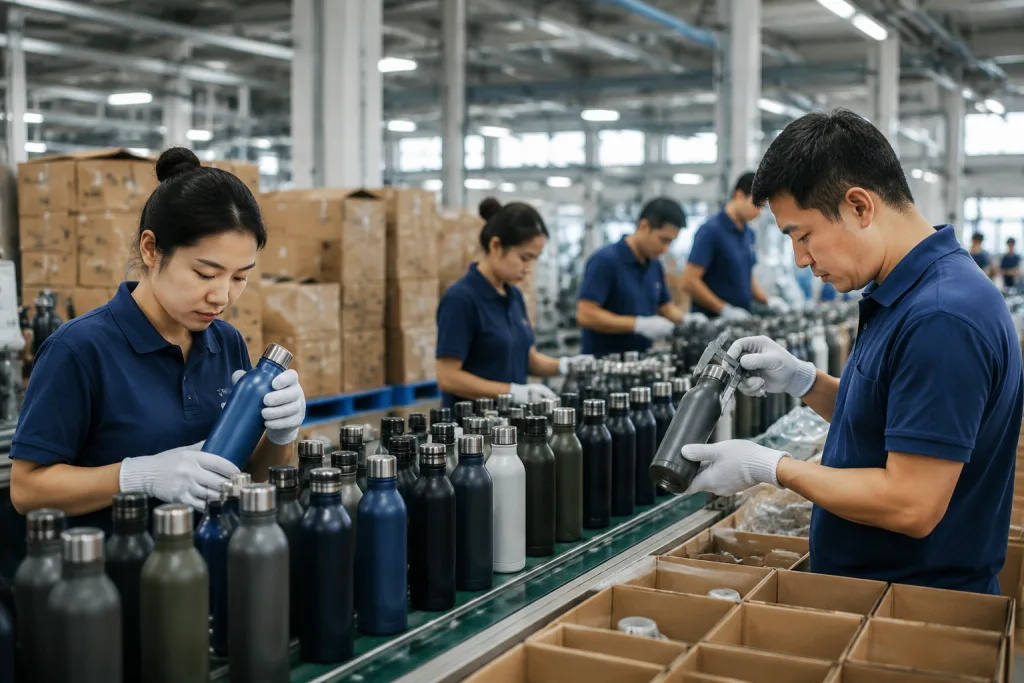
If you buy for an outdoor retail chain or a promotional thermos program, the cheapest bottle is the wrong question to ask. You need the right construction, finish, logo method, packaging, compliance level, and delivery plan before your artwork and PO lock you into a bad call. We’ve seen this go sideways when a buyer approved matte powder coating, then flagged carton rub marks after 18 days on the line. Our Hangzhou, Zhejiang team produces up to 420,000 stainless vacuum units per month, so we know which bulk thermos choices save money and which ones just move the cost to rework, claims, or air freight.
Start With The Real Use Case
I’ll rewrite this section in-place, keep the HTML exactly as-is, and tighten the copy so it reads like a factory sales engineer wrote it.Before you ask any thermos manufacturer for a price, lock the use case first. A 500 ml corporate gift, a 750 ml hiking bottle, and a 1.2 L campsite flask should not share the same cap, coating, or carton. We’ve seen buyers mix those up on one PO, then blame the sample when the retail sell-through goes sideways after 90 days.
For outdoor retailers, start with capacity and carry format. The strongest movers are usually 500 ml, 750 ml, and 1,000 ml. A 500 ml customizable thermos works for commuters and day hikers. A 750 ml wholesale vacuum flask gives better shelf value without pushing weight too far. A 1,000 ml flask needs a stronger handle or loop lid because a full bottle can hit 1.3 kg, and the line will flag that fast.
For promotional brands, the math changes. You are buying a customized thermos against a campaign budget, not a retail shelf. Decoration area, unit price, and gift box look matter more than chasing the last degree of heat retention. A promotional thermos at USD 3.60 FOB is fine if it passes leak testing and the coating survives a basic 1 m scratch check.
Use these decision filters before requesting quotes:
- Retail outdoor range: 304 stainless steel, 0.45-0.55 mm body wall, powder coating, retail box, barcode, AQL inspection.
- Corporate gifting: 304 stainless steel, stock mold, laser logo or silk screen, color box, 500-2,000 pcs per design.
- Premium campaign: 316 inner wall, copper lining, custom cap, debossed box, higher MOQ and tooling cost.
A good thermos factory in China should push you to answer these questions early. If a thermos vendor only says “yes, we can make it” and never asks about market, channel, or testing level, that is not engineering support. QC pulled the sample, the buyer flagged it, and everyone loses a week.
Choose Steel And Insulation Sensibly
I’ll rewrite the section in place, keep the HTML exactly as-is, and tighten the sales-engineer voice with concrete shop-floor detail.Most buyer arguments about stainless thermos quality start with steel grade. The practical answer is straightforward: 304 stainless steel is the default for most wholesale vacuum flask programs. It is food-safe, resists corrosion for water, coffee, tea, and sports drinks, and clears EU and North American programs when backed by LFGB, FDA, or migration test reports.
316 stainless steel makes sense when chloride resistance matters, such as coastal outdoor sets, marine promos, or a premium retail line. It is not a miracle upgrade. Raw material cost usually rises 12-18%, and most end users will never feel the difference. If the budget is fixed, we’d spend the money on a better lid, a cleaner powder coat, or tighter inspection; that is the move that cuts complaints. On the line, QC pulled a 316 sample with a lid leak after 3,000 open-close cycles, and the buyer flagged the cap, not the steel.
For insulation, ask your thermos supplier for measured data, not sales words. A standard 500 ml double-wall vacuum flask should hold water above 60°C for 6-8 hours when tested from 95°C in a 20°C room. Bigger 750 ml and 1,000 ml bottles usually hold heat better because the liquid volume is higher versus surface area. Copper lining can lift retention, but a bad vacuum weld wipes that out fast; we’ve seen that go sideways on a 12,000-piece order where the bottom weld left a faint ring after the first thermal test.
Important construction points include:
- Inner and outer wall thickness: usually 0.4-0.6 mm for 304 stainless steel bodies.
- Vacuum weld quality: weak welds cause insulation failure and visible bottom defects.
- Lid sealing: silicone gasket hardness and thread design affect leakage more than the body material.
- Mouth diameter: 45-55 mm works for ice cubes but can shave a bit off heat retention.
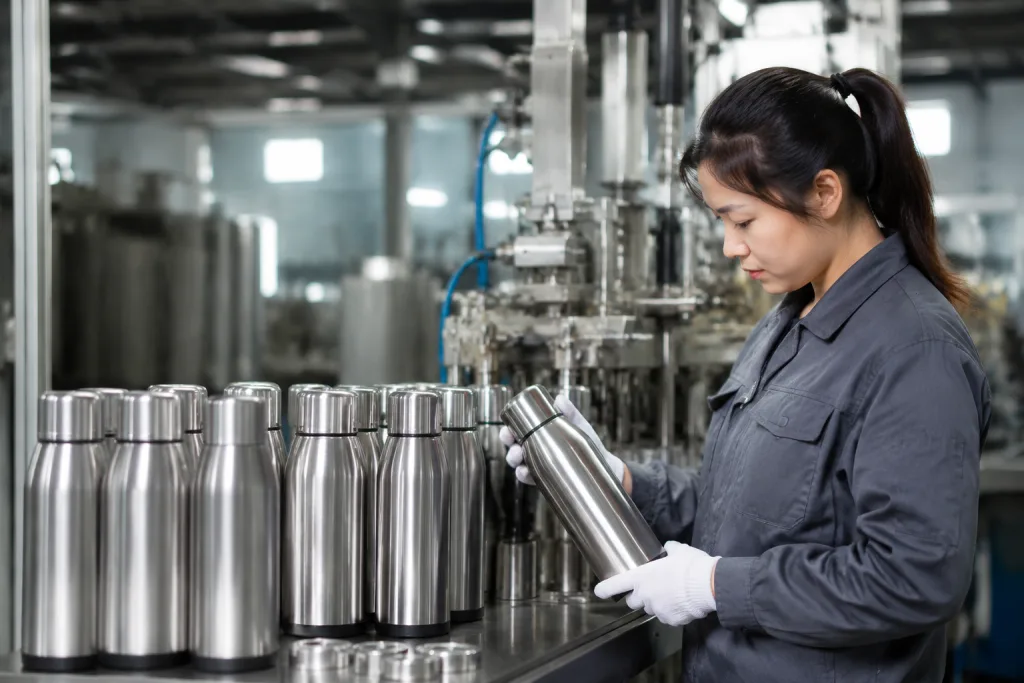
Our Zhejiang production line runs vacuum decay checks and hot-water retention sampling during production. For thermos bulk orders, we still push a final AQL inspection, with at least AQL 2.5 for major defects and AQL 4.0 for minor appearance defects. The math does not work if you skip that step and hope the carton labels were typed right; one PO here came in with a 550 ml model marked as 500 ml, and that typo almost missed the packing line.
Decoration Drives More Cost Than Expected
I’ll rewrite the section in place, keep the HTML exactly as-is, and tune the prose to sound like a factory-side sales engineer.Buyers often treat logo work as a minor line item. On a custom thermos order, it changes the MOQ, lead time, scrap rate, and how the flask lands on the shelf. Same 18/8 stainless body, different result. One order looks like a giveaway; another feels like a proper outdoor flask, and the decoration method decides that fast.
Laser engraving is the safest pick for a distributor thermos program because it stays clean after washing and does not fade. We run it most often on powder-coated shells and brushed stainless steel. The cost usually sits at USD 0.10-0.35 per unit, depending on logo size and engraving time. For 500 pcs to 2,000 pcs, setup stays simple, and QC pulled the sample with no ink adhesion issue to chase.
Silk screen printing fits when the buyer wants bright color or a larger promo logo. We use it often on thermos campaigns, but Pantone control and adhesion testing matter. A one-color print may add USD 0.08-0.18 per unit, while multi-color artwork needs more screens and more inspection at the line. Curved bodies cut registration accuracy, so a tapered flask will not match a flat catalog page.
Powder coating is where the quote starts moving. A stock color from the thermos supplier may keep MOQ at 500 pcs. A custom Pantone powder coating usually needs 1,000 pcs per color, and sometimes 2,000 pcs if the finish is matte, speckled, gradient, or rubberized. The math does not work any other way. Custom coating also adds 7-12 days because the paint supplier must match the shade and the factory must run adhesion and boiling water checks.
If you need retail packaging, approve it with the logo. A proper manufacturers thermos quotation should split bottle cost, decoration cost, gift box cost, master carton, barcode label, and any FNSKU or Amazon carton label. One buyer once sent a PO with the box code missing a digit, and that stalled packing for a full day. Bundled pricing looks neat, but it makes supplier thermos offers harder to compare honestly.
MOQ, Tooling, And Price Reality
I’ll rewrite this section in a more grounded factory-sales voice, keep the HTML exactly intact, and preserve the numbers while making the pricing and MOQ language sound like we’ve actually run these jobs.The lowest thermos quote usually comes with a catch: 0.4 mm steel, a plain PP lid, thin coating, no drop test, or a lead time that falls apart once the buyer sends artwork. We see this on the line all the time. For outdoor retail and promo jobs, the better move is to read the price ladder first, then cut the right features without wrecking the flask.
For a standard 500 ml wholesale vacuum flask from a China thermos manufacturer, FOB pricing usually lands in these bands: USD 3.20-4.20 for a stock color with laser logo, USD 4.10-5.40 for custom powder coating and printed box, and USD 5.50-7.20 for a premium lid, copper lining, upgraded coating, and heavier retail packaging. Last month QC pulled a sample at 92°C after 6 hours, and the buyer still pushed back on the lid cost. Fair pushback, but the math does not work if you want all the upgrades at entry-level pricing.
MOQ depends on what is custom. Stock body, stock color, and laser logo can start at 500 pcs. A custom thermos color is usually 1,000 pcs per color. A new lid mold can run USD 2,000-6,000 in tooling and needs 25-35 days for mold opening. A fully new body shape may cost USD 8,000-18,000 in tooling and needs pilot testing before mass production, or you end up chasing shrinkage and cap fit issues later.
You also need to separate sampling time from production time. A normal sample with logo takes 7-10 days if the bottle exists. Pre-production samples with custom coating and packaging may take 15-20 days. Mass production is usually 35-55 days after deposit and final artwork approval. One PO typo on a carton mark can add two days by itself, so before Q4 we build in 10-15 days of schedule buffer.
For a first order, use an existing mold and customize color, logo, and box. Save new tooling for the second order after sell-through data proves the shape.
That is the right call. We have seen new molds turn into dead stock when the first order looked good on paper but the sell-through never showed up.
Compliance Is A Purchase Requirement
A supplier thermos order that cannot pass your market requirements is not cheap; it is blocked inventory. We ask for compliance papers before deposit, then match the report against the exact order BOM: 304 stainless inner wall, PP lid, silicone seal, powder coating code, and printed logo ink. Check this early. Last year QC pulled a 500 ml sample where the report showed bare stainless, but the PO had matte black coating; the buyer flagged it, and the shipment sat 12 days while the coating test was repeated.
For EU retail, common requirements include LFGB food contact testing, REACH screening for coatings and plastic parts, and packaging heavy metal limits. For North America, buyers often request FDA food contact declarations, California Proposition 65 review where relevant, and ASTM or CPSIA checks if the bottle is designed for children. A kids bottle is not the same compliance category as an adult outdoor flask. We run separate material files for child lids because one small straw part at 6.8 mm can change the choking-risk discussion with the customer’s compliance team.
Factory audits also matter, but this is the wrong question to ask if you treat the certificate as a shipment guarantee. BSCI, Sedex, or ISO 9001 certification will not promise perfect goods; it shows whether the thermos factory keeps labor records, corrective-action files, batch traceability, and inspection sheets that can be checked when something goes wrong. For larger distributor thermos orders, your customer may ask for audit documents before they approve the vendor code. We have seen a vendor setup delayed 9 working days because the audit PDF name did not match the legal factory name on the PO.
Quality control should be written into the PO. We recommend defining these points before the line starts, not after cartons are sealed:
- Leak test: 100% water leak test at the factory before packing, with lids tightened by torque wrench to the agreed setting.
- Vacuum performance: hot water retention sampling from each production lot, usually checked with 95°C water and a digital probe after the agreed hour mark.
- Coating adhesion: cross-hatch tape test and boiling water check for coated bodies, with QC recording grid photos before release.
- AQL: AQL 2.5 major, 4.0 minor, with critical defects not accepted.
- Carton drop test: required for e-commerce and warehouse distribution, especially when one master carton is over 12 kg.
Our Hangzhou, Zhejiang quality team keeps inspection photos, batch records, and retained samples for repeat orders. That traceability matters when a thermos distributor needs to prove whether a complaint came from production, transport damage, or consumer misuse. We keep one retained sample per color for standard wholesale runs, and it saves arguments when a buyer sends a blurry photo of a dented base 47 days after delivery.
Packaging And Logistics Affect Margin
Packaging is not just a box around the flask. It changes landed cost, warehouse damage, shelf presentation, and e-commerce chargebacks. A promo order may only need a white box or kraft box, often 300 gsm with a simple black SKU sticker. An outdoor retailer usually asks for printed retail packaging with barcode placement, warning text, country of origin, and multilingual care instructions; last month QC pulled the sample because the PO said “dishwasher safe” while the artwork said “hand wash only.”
For bulk thermos shipments, we run one bottle in a polybag or paper wrap, one color box, then 24 pcs per master carton. A 500 ml stainless flask carton may measure around 48 x 36 x 28 cm and weigh 9-12 kg depending on wall thickness and packaging. Too heavy? Damage climbs. If the carton board is too weak, ocean freight compression crushes retail boxes; our carton drop tester has caught 3-layer board failing at the corner after a 76 cm drop.
Ask your thermos suppliers to quote FOB Ningbo or FOB Shanghai clearly. Zhejiang factories often ship through Ningbo port, and that suits buyers using a consolidation warehouse in East China. For North America, ocean freight can take 25-40 days port to port, plus customs and inland trucking. For Europe, expect roughly 30-45 days depending on destination and routing. Air freight works for 200-500 urgent units, but the math doesn't work on standard 500 ml bottles when freight is higher than the flask cost; we’ve had buyers flag this after seeing the DHL chargeable weight on a 12 kg carton.
If you sell through online channels, confirm FNSKU labels, master carton labels, suffocation warnings for polybags, and drop-test packaging before production. Retrofitting labels in a China warehouse costs money and delays dispatch, often 2-3 days for 1,000 cartons if the warehouse has to open and reseal each master carton. For a thermos custom project with several colors, carton marking must match SKU, color, barcode, and purchase order exactly; one typo such as “navy” versus “blue” can stop receiving at the buyer’s 3PL.
The practical decision is whether your product is a giveaway, a retail SKU, or an e-commerce unit. This is the wrong place to chase the cheapest line item. Each channel needs different packaging strength and product information, and the line has to know that before mass production starts. Paying USD 0.20 more for correct packaging can save far more than that in repacking, returns, or retailer penalties.
How To Compare Factory Quotes
I’ll rewrite the section in-place, keeping the HTML tags and structure unchanged while making the prose sound like a seasoned factory sales engineer.When you compare thermos manufacturers, do not line up only the final unit price. Build one quote sheet and send the same spec to every thermos vendor: 500 ml or 750 ml, 304 stainless or 316, body wall thickness in mm, lid material, gasket material, coating type, logo size, box type, testing, MOQ, sample cost, lead time, payment terms, and FOB port.
A solid manufacturer thermos quote should show what is included and what is left out. If the price leaves out compliance testing, export carton upgrades, artwork changes, or third-party inspection support, that is fine, but you need that written down before approval. We have seen buyers lose margin on this after the retail price is fixed. The math does not work.
For a first cooperation, ask for production photos from similar orders, not just catalog renders. Request one physical sample and one retained sample agreement. If the order is 3,000 pcs or more, get the pre-production sample signed off before mass production starts. For orders above 10,000 pcs, we run an inline check when 20-30% of goods are finished, especially if the coating or packaging is new. QC pulled the sample once and found a 1.5 mm lid gap that a render would never show.
Watch communication quality too. A good thermos supplier in China will push back on unclear artwork, flag low-contrast logo colors, explain lead time risk, and send carton dimensions before you ask twice. A weak supplier says yes fast and fixes problems slow. That is the wrong question to ask if you care about repeat business.
The best choice is rarely the lowest price or the highest quote. It is the factory thermos partner that holds the agreed spec through sampling, production, inspection, and shipping. We ship plenty of orders where the buyer changed the PO typo after sample approval, and the line still had to match the original 1,000 pcs spec. For outdoor retailers and promotional brands, that consistency is what turns one customized thermos order into a repeat wholesale program.
Send Your Flask Brief For A Factory Quote
Share capacity, logo, color, market, MOQ, and packaging needs. We will return a practical Zhejiang factory quotation with lead time.
Frequently asked questions
What is a realistic MOQ for a wholesale vacuum flask order?
For an existing stainless steel body, 500 pcs is realistic if you use a stock color and laser engraving. For custom powder coating, plan on 1,000 pcs per color because the coating line and paint matching need enough volume to run efficiently. If you want a new lid, new body shape, or special finish, MOQ may rise to 2,000-5,000 pcs. For promotional thermos projects under 500 pcs, you can still source from China, but you will usually be limited to stock bottles and simple logo decoration. The unit price will also be higher because setup, export packing, and document work are spread across fewer units.
Should I choose 304 or 316 stainless steel for a custom thermos?
Choose 304 stainless steel for most outdoor retail, corporate gift, and distributor thermos programs. It is the normal food-contact material for vacuum flasks and performs well with water, coffee, tea, and common cold drinks. Choose 316 stainless steel when your product story requires higher corrosion resistance, such as marine, fishing, coastal outdoor, or premium positioning. Expect roughly 12-18% higher material cost for 316. If your budget is limited, do not upgrade steel while ignoring the lid, gasket, coating, and AQL inspection. Most real customer complaints come from leakage, scratches, dents, or poor logo quality, not from 304 stainless steel failing in normal use.
How long does custom thermos production take in China?
For a stock mold with logo decoration, samples usually take 7-10 days. If you need custom powder coating, printed packaging, and a pre-production sample, allow 15-20 days before mass production approval. Normal production lead time is 35-55 days after deposit, final artwork, and sample approval. New tooling adds 25-35 days for a lid mold and longer for a new body shape. Shipping is separate: ocean freight to North America often takes 25-40 days port to port, while Europe is commonly 30-45 days. Before Q4 and major China holidays, add at least 10-15 days of buffer.
Which logo method is best for a promotional thermos?
Laser engraving is the safest method when you need durability, a clean look, and a moderate order size. It works very well on powder-coated stainless bottles and usually adds about USD 0.10-0.35 per unit depending on logo size. Silk screen printing is better for colorful campaign logos, but it needs adhesion testing and careful Pantone control. Heat transfer can create full-color graphics, but it has higher setup needs and should be tested for abrasion. For most promotional thermos orders of 500-3,000 pcs, we recommend laser for premium gifts and one- or two-color silk screen for budget campaigns where color accuracy is important.
What quality tests should I require from thermos suppliers?
At minimum, require 100% leak testing, hot water retention sampling, visual inspection, and carton packing checks. For coated bottles, add cross-hatch adhesion testing, boiling water exposure, and basic abrasion checks. For food-contact compliance, ask for LFGB or FDA-related documentation depending on your market, plus REACH review for coatings if selling in Europe. For shipment inspection, write AQL 2.5 for major defects and AQL 4.0 for minor defects into the purchase order. Critical defects such as leakage, unsafe sharp edges, wrong material, mold contamination, or incorrect logo should be zero tolerance. Keep approved samples and compare them against mass production before shipment.