Key Takeaways
- A normal wholesale vacuum bottle USA order starts at 3,000-5,000 units, with 35-45 days lead time after sample approval.
- 304 stainless steel is standard; for heavier-duty thermos bulk, ask for 18/8 inner and outer walls with 0.4-0.5 mm wall thickness.
- FOB China pricing for a basic custom thermos often lands around USD 3.20-6.80 per unit, depending on lid, coating, and decoration.
- For shipping to the USA, insist on lid torque, vacuum retention, drop test, and AQL 2.5 inspection before carton-out.
You are not buying a “thermos.” You are buying a thermal hold time, a surface finish, and a failure rate. For outdoor retailers and promo brands in the USA, the mistake starts when a vacuum bottle gets treated like a plain commodity. A 500 ml bottle can look clean in a sample photo and still miss your ship date, your margin, or your logo spec.
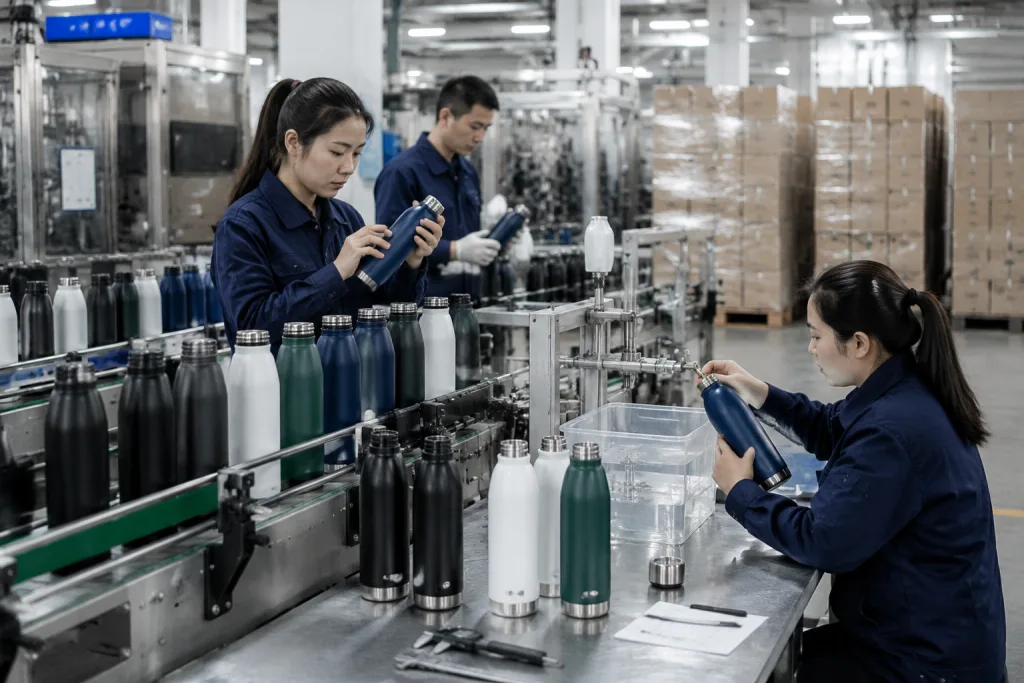
At BottleForge in Hangzhou, Zhejiang, we see the same order pattern every week: a buyer needs bulk thermos production, wants custom logo work, and has a hard ship date. The right move on a wholesale vacuum bottle USA order is simple—define the use case first, lock the spec second, then QC the order like it matters. Because it does. We’ve seen a 5,000-unit run go fine when the buyer signs off on the 304 stainless, the lid test, and the artwork before the line starts.
Start with the retail use case
I’ll keep the HTML exactly as-is and rewrite only the prose to sound like a factory-side sales engineer, with more concrete retail details and less AI phrasing.The first question is not “What size bottle do you make?” It is “Where will this sell, and who is carrying it home?” A 500 ml custom thermos for trail shops is a different buy from a 750 ml promo thermos for a giveaway table. Miss the use case, and you pick the wrong lid, coating, or carton count. We’ve seen that go sideways on the line more than once.
For outdoor retail, a double-wall stainless thermos with a screw lid or push-button lid sells better when it feels solid in the hand. For promotions, the logo panel and print cost matter more than fancy hardware. At our Hangzhou factory, we split every quote into function, decoration, and shipping carton setup before we price it. Simple, but it saves rounds of back-and-forth. One buyer once sent a PO with “750ml” in the spec and “500 ml” in the carton note—the math did not work. If you are building a bulk thermos program, get three numbers upfront: target retail price, required heat retention at 6 hours, and how many times the logo must survive washing.
Practical buyer note: a 500 ml model with a 304 inner wall and powder coat usually weighs 280-360 g. A 750 ml version can move to 380-460 g. QC pulled a sample at 412 g last week, and that extra weight changed freight, carton loading, and the shelf feel.
Lock the stainless thermos spec
I’ll rewrite the section in-place, keep the HTML structure intact, and make the wording sound like a factory-side sales engineer, not generic copy.Once the use case is clear, lock the spec on paper. A custom thermos order gets expensive fast when the buyer says “stainless” and stops there. State the grade, wall thickness, lid style, finish, and test requirement. For a wholesale vacuum bottle USA program, we usually start with 304 stainless steel inside and outside, then choose 0.4 mm or 0.5 mm wall thickness based on target price and hand-feel. If the buyer wants a stiffer body, 0.5 mm is the better pick. The caliper on the line tells the truth.
Vacuum performance needs a written target too. For standard promotional thermos lines, 6-12 hours hot and 12-24 hours cold is the normal ask, while premium vacuum bottle models run beyond that. We do not quote a number without a test method. Ask for a hot-fill test at 95°C, room-temperature ambient, and a retention check at 2, 6, and 12 hours. QC pulled the sample last Friday with a probe thermometer, and that curve is what settles the argument. Guessing on hold time is the wrong question to ask.
Decide early whether the bottle ships as a bulk thermos item or a retail-ready custom thermos item. Retail-ready means individual box, barcode label, and sometimes FNSKU if the USA channel is Amazon. Bulk-only packaging cuts unit cost, but it pushes the packing work back to your side. We have seen buyers ignore that and then get burned on warehouse labor. On one PO, the buyer flagged a barcode typo after packing started, and the reprint cost more than the foam insert.
- 304 stainless steel is the default for most orders.
- 0.4-0.5 mm wall thickness is the usual balance of cost and durability.
- Powder coating adds grip and a cleaner finish, but it adds process time on the line.
- Laser engraving is usually cleaner than silkscreen for a long-life custom logo.
Ask for the right sample
I’ll rewrite the section in a more field-tested sales tone, keep the HTML intact, and make the sample advice sound like it came from the shop floor.A sample is not a finished order. It only proves the spec can be built. For a custom thermos or customizable thermos program, ask for a pre-production sample with your actual logo, lid color, surface finish, and carton format. We had one buyer approve a blank white unit, then flag the final cartons because the logo sat 4 mm too low. That mistake costs time.
When we sample in Zhejiang, QC checks lid alignment, vacuum seal quality, coating coverage at the shoulder and base, and whether the print survives a simple abrasion pass with a Scotch-Brite pad. For a promotional thermos, logo clarity beats extra insulation. For an outdoor retailer, grip and condensation control matter more. Test it with gloves on. A thermos custom program that looks clean in photos can still feel awkward on a cold trail, and that is the wrong place to find out.
“Approve the sample only after you have touched it, filled it, closed it, and left it upside down for a leak check.”
If you are comparing a thermos customized matte body with a glossy finish, choose with the shelf in mind. Matte powder coat hides fingerprints and scratches better, but it can shift the color under store lighting. We run into this all the time. The buyer sees a different shade at 10 p.m. in a warehouse aisle than we do under the booth lights, and the math does not work if you skip that check.

Price the order like a buyer
I’ll rewrite the section in place, keep the HTML exactly as-is, and tighten the sales tone so it reads like a factory-side pricing note.Most wholesale vacuum bottle USA buyers ask for a price first and the spec later. That is backwards, but we see it all the time. Price the order by configuration. A plain 500 ml bottle with a basic lid and one-color print does not price the same as a customized thermos with color powder coat, laser logo, gift box, and drop-test packaging. On FOB China terms, a straight 3,000-5,000 unit order usually sits around USD 3.20-4.50 per unit. Add a better lid, upgraded coating, or retail box, and you move into USD 5.50-6.80 or higher.
A thermos supplier should break the quote line by line. Body cost. Lid cost. Decoration cost. Packaging cost. Testing cost, if the buyer wants it. That is the clean way to see where the money goes, and it is the right way to push back when someone asks for a single flat number. We run this every week on the line with calipers and a carton gauge. If you are buying from thermos suppliers in China, ask for a price break at 5,000 and 10,000 units. At BottleForge, our standard stainless drinkware line runs about 80,000 units per month, so we can keep the schedule steady if the PO is clean. If you send a PO with one typo on carton size, QC will flag it before packing. The real cost is often in packaging and shipping dimensions, not only in steel.
Do not ignore carton efficiency. A tighter inner box and a better master carton can cut freight enough to cover a better cap. We have seen the math work on a 42 x 42 x 28 cm carton and fall apart on a bulky one. That matters for outdoor retailers shipping mixed assortments and for promo brands trying to stay under a landed-cost target.
QC the production line properly
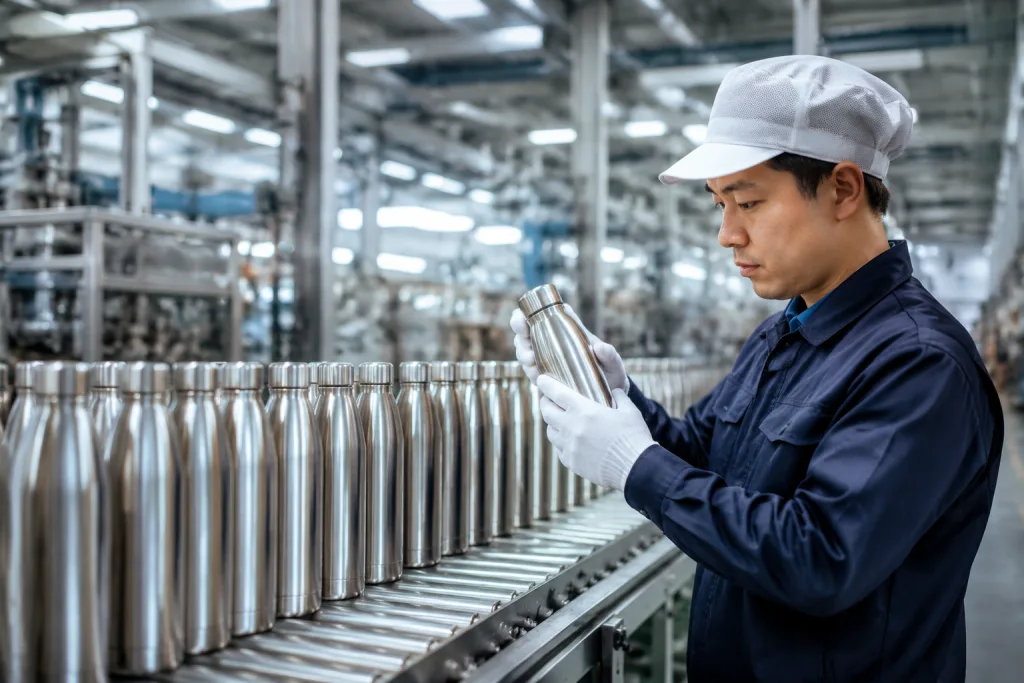
I’ll rewrite the section in-place, keep the HTML exactly as-is, and make the prose sound like a factory-side export sales engineer wrote it.This is where a lot of distributor thermos programs go sideways. The factory says the order is running, the buyer assumes someone is watching it, and the line keeps moving without a real check on the control points. We inspect before production, during filling, and again before packing-out. For a thermos manufacturers order, the key checks are weld quality, vacuum performance, print alignment, lid fit, and carton count. One missed lid spec can sink the whole batch.
Use AQL 2.5 for general inspection unless your program has a tighter target. For hot and cold retention, pull random samples from the line, not just the first tray off the machine. We check for leaks after 30 minutes upside down and again after one thermal cycle. On coated bodies, rub the base and shoulder with a glove; that is where the weak finish shows first. For custom logo work, match the artwork to the approved file, especially on curved bottles with small text. The buyer flagged it once because a 1.5 mm shift turned a clean logo into scrap.
Typical QC checklist:
- Vacuum retention and leak test
- Lid open/close torque
- Decoration registration and color match
- Carton drop test and transit corner crush check
- Finished carton count and master carton label accuracy
Do not accept “looks good” as a QC report. We have seen that line of thinking fail on a 12,000-piece PO because the carton tally was off by 48 units. A thermos factory in Zhejiang or elsewhere in China should hand over a simple pass/fail sheet with samples, defect photos, and carton totals. That is normal export work, not a favor.
Plan shipping and compliance early
I’ll rewrite just this section, keep the HTML tags intact, and tighten the prose so it reads like a factory-side export note.A stainless thermos program for the USA is not finished when production ends. It is finished when the cartons clear your warehouse and the goods match the channel spec. For retail, we run UPC labels and shelf-ready cartons. For Amazon, the buyer will flag FNSKU labels, carton marks, and box count. For corporate promotions, split shipping and branded insert cards matter more than shelf display.
Lead time is usually 35-45 days after sample approval and deposit for a standard order. Add special packaging or hit peak season, and the clock moves. Sea freight from China to the US West Coast usually adds 18-28 days, and East Coast routing runs longer. We’ve seen a launch slip by 14 days and kill the margin on a Q4 program faster than a 5% material increase. The math doesn’t work.
Compliance comes first, not last. Ask for REACH-related material statements where needed, and if your channel asks for it, request material declarations plus basic migration or safety documents that match the SKU. QC pulled the sample on one lot because the ink on the outer carton was off by 2 mm, and that saved us a headache later. A real thermos manufacturer should hand that over cleanly. If they cannot, you are not buying a commercial program; you are buying a risk.
Send your thermos spec for a real quote
We’ll turn your buyer brief into a clean stainless thermos order with clear MOQ, pricing, QC checkpoints, and lead time.
Frequently asked questions
What MOQ should I expect for wholesale vacuum bottle USA orders?
A practical MOQ is usually 3,000 units for a standard stainless thermos with one logo method and one finish. If you want multiple colors, retail boxes, or mixed lid styles, the MOQ often rises to 5,000 units. For very simple bulk thermos orders, some factories can do 1,000-2,000 pieces, but pricing usually becomes less attractive. In Zhejiang, the cleanest export orders are usually 3,000-10,000 units because that matches efficient line setup and carton planning. If you need a promotional thermos program with a tight deadline, keep the spec simple and the carton count fixed.
How do I compare custom thermos quotes fairly?
Compare them on the same spec sheet, not on the headline price. A true apples-to-apples quote should show stainless grade, wall thickness, lid type, coating, decoration method, inner box, master carton size, and testing. A quote at USD 3.60 may look cheaper than USD 4.10, but if the lower price excludes packaging or uses a thinner wall, your landed cost may be higher. Ask the thermos supplier to separate body, lid, print, and carton. For wholesale vacuum bottle USA buying, that is the fastest way to identify what is actually driving cost.
Which decoration method is best for a thermos customized with a logo?
For a durable retail piece, laser engraving is usually the cleanest choice. It holds up well and looks premium on brushed or powder-coated stainless steel. Silkscreen works well for larger logos and stronger brand color, especially on promotional thermos runs, but it can wear faster under heavy use. If your design has small text, laser is safer. If your art relies on exact Pantone color, silkscreen may be better. For thermos bulk orders, ask for a printed proof on the actual body curve, not only on a flat sample sheet.
How long does production take in China?
A standard factory thermos order usually takes 35-45 days after sample approval and deposit. That assumes the mold or tooling is ready, the coating is standard, and the order quantity is in the normal range. If you need custom packaging, special lids, or a very busy season slot, add 7-15 days. From our Hangzhou, Zhejiang operation, we plan around real line capacity, not guesswork. If your launch date is fixed, place the order early enough to absorb sample revisions and freight timing.
What QC steps should I require before shipment?
Require leak testing, vacuum retention checks, decoration inspection, lid torque checks, and carton count verification. Use AQL 2.5 for general acceptance unless your customer demands tighter control. For a wholesale vacuum bottle USA shipment, I also recommend a simple drop test on packed cartons and a temperature retention test on random samples. If the thermos manufacturers team cannot show pass/fail photos and defect counts, that is a warning sign. A good thermos factory should treat QC as part of the export process, not as optional paperwork.