Key Takeaways
- A 500ml stainless vacuum bottle usually lands around USD 2.80–5.60 FOB with MOQ 1,000 pcs, depending on lid, coating, and print.
- Double-wall 304 stainless steel with a 0.4–0.5 mm inner wall is the safer default for a UK wholesale order.
- For hot drinks, a good 500ml bottle should hold 60°C+ after 12 hours and 45°C+ after 24 hours in a controlled test.
- Laser engraving starts around USD 0.10–0.30 per position; full-color print or coating changes the unit price and lead time fast.
If you are sourcing a wholesale vacuum bottle uk order, the real question is not “which bottle looks good?” It is which spec sheet protects your margin, cuts complaint rates, and still gives you something that moves in the UK market. Outdoor retailers ask about heat retention, lid seal life, and carton drop test results. Promo buyers look at print area, landed unit cost, and whether the bottle still looks clean after a 1,000-piece giveaway run. We run a 24-hour leak test on the line for a reason.
The mistake we see most is buyers sending artwork before they lock in steel grade, wall structure, and closure style. That is the wrong order. A factory in Zhejiang can make a nice-looking thermos fast; the issue is whether it fits your channel and your paperwork. For a custom thermos, start with the basics: performance target, decoration method, UK compliance file, and MOQ that matches your sell-through. QC pulled one sample with a lid torque issue at 0.8 N·m last week, and that sort of miss turns into returns if you rush the spec.
Start with the use case
I’ll rewrite the section in-place, keep the HTML structure untouched, and make the prose sound like a factory sales engineer wrote it.Before you compare samples, lock the use case. A bulk thermos for hiking retail is not the same product as a promotional thermos for a winter campaign. Outdoor buyers usually ask for a 500ml to 750ml body, a leak-proof lid, and a finish that will not show scuffs after 2 weeks in a backpack. Promotional buyers push for a lower entry price, a wider print area, and a carton spec that survives fulfillment without crushed corners.
If the bottle is for UK retail, you need shelf appeal and heat retention. For giveaways, imprint durability and landed cost come first. A decent factory thermos in 304 stainless can price well, but only if you do not overbuild the lid or the gift box. We have seen buyers cut 8% to 15% by taking a standard PP lid instead of a push-button assembly with extra parts. The math works. At 3,000 units or 10,000 units, that gap shows up fast on the PO.
Ask three blunt questions: how long must it stay hot, what is the unit cost ceiling, and who handles it after it leaves the warehouse? That is the first filter. One buyer sent us a PO with “wholesale vacuum bottle uk” typed as “vacuum botle,” and QC still caught the spec mismatch before the line ran. Factories in Zhejiang that quote cleanly ask these same questions first, then they talk artwork.
Choose the right steel build
I’ll rewrite the section in place, keep the HTML intact, and tighten the language so it sounds like a buyer-facing sales engineer.The first call on a customized thermos is the steel build. For wholesale work, 304 stainless is the safe baseline. We run it on a lot of UK orders because it gives solid corrosion resistance, acceptable cost, and fewer buyer headaches at the sample stage. If you move the outer shell to 201 stainless, the unit price drops, but that is only worth it when the target is tight and the brand is not trying to look premium. For outdoor retail, 304 inside and outside is the cleaner answer.
Wall thickness is where a lot of quotes go sideways. On our line, a 0.4 to 0.5 mm inner wall and a 0.35 to 0.45 mm outer wall gives stable performance without turning the bottle into a brick. A 500ml bottle usually lands around 260 to 320 g, depending on the lid and base. The buyer flagged a dent issue on one PO, and the root cause was a 0.3 mm outer wall. Too thin hurts the vacuum and the shell. Too thick just adds freight cost.
Trade-off to remember:
- 304/304 construction: better for retail confidence and fewer complaint emails.
- 304/201 construction: lower cost, but you need a clear sales story when the buyer asks why.
- Single-color powder coat: tough finish for branding, but it adds one more curing step.
For a serious manufacturer thermos order, ask for vacuum leak checks and thermal testing on every batch. QC pulled the sample, and we still check sealing with AQL 2.5 for visual defects plus tighter control on the lid seal. If a supplier cannot explain how they test the vacuum, the math does not work—you are buying a quote, not a partner.
Decide on lid and insulation
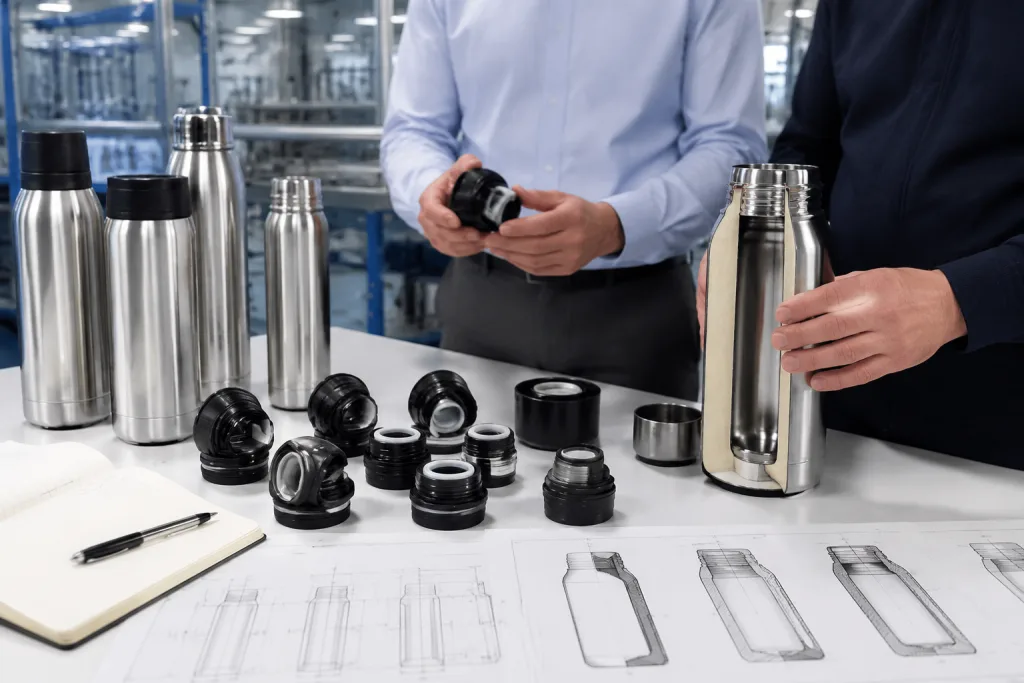
I’ll rewrite the section in-place, keeping the HTML structure intact and tightening the sales-engineer voice. Then I’ll do a quick pass for the banned filler words and any awkward phrasing.Lid choice is where a lot of wholesale orders go wrong. The body can be solid and the bottle still gets returned because the cap leaks, knocks loose in transit, or feels bad in hand. For a thermos manufacturer, the lid is not a side part; it carries the performance promise. If your buyer is an outdoor retailer, a screw-top or insulated cup lid is the safer call. If your buyer is a promotional distributor, a leak-resistant PP lid usually wins on cost. We have seen a buyer push for the cheapest cap, then QC pulled the sample and found a 2 mm gasket mismatch at the thread.
Double-wall vacuum insulation is standard, but the vacuum spec still matters. A good 500ml bottle should hit about 60°C after 12 hours and 45°C after 24 hours, tested with 95°C fill water at room temperature. Cold retention should stay above 10°C after 24 hours in normal use. These are not magic numbers. They are the numbers that hold up in the line.
Check the neck size as well. Wide mouths are easier to clean and take ice, but they give up a bit of heat retention and splash more when the buyer opens them fast. Narrow mouths hold temperature better, but they feel less flexible at retail. For a thermos custom program, I usually pick the mouth by channel first, not by the mold the factory likes best. That is the wrong question to ask if you want fewer complaints. A smart thermos distributor order is the one where the lid fits the shelf, the user, and the carton drop test.
If the bottle needs to clear UK market checks, ask for REACH-compliant materials and food-contact declarations up front. If you also sell into North America, line up the paperwork before sample approval so you do not pay for the same test twice. We ship a lot of these. One PO typo on the material code can add 12 days, and nobody wants that.
Branding that survives use
I’ll rewrite the section in place, keep the HTML tags untouched, and tighten the copy so it sounds like a factory-side sales engineer wrote it.Your decoration method should match the channel, not just the artwork. A customizable thermos for retail can take laser engraving, screen print, UV print, or wrap coating. For promo orders, we usually push the fastest method with the lowest setup fee. Laser engraving is the safest long-term branding on stainless steel because it does not chip. On our line, it adds about USD 0.10 to 0.30 per location, depending on logo size and curve coverage.
Screen print works when you need a bold logo and a lower unit price on bigger quantities. One-color print is straightforward; full-color jobs bring registration issues and more scrap. If you want a thermos customizable finish with a premium shelf feel, powder coating plus laser logo is the combo we ship most often. The buyer flagged one sample for looking “cheap” on a 300 mm retail shelf, and that was the wrong question to ask—the math was off because the package finish did the selling.
Practical rule: if the bottle will get tossed into bags, washed hard, or sold through outdoor stores, stay away from decoration that depends on a thin ink layer. A custom thermos only stays sharp after 30 dish cycles if the customer hand-washes it or the print system is built for abuse. QC pulled a sample last month with edge lift after the 18th cycle, so we ask for abrasion testing up front when the brand promise depends on it.
We produce standard and promo runs in Zhejiang, and the cleanest orders are the ones where the buyer chooses decoration by use case first. One PO came through with a typo on the logo position and cost us a day at the transfer station. Pick the method early, or you end up paying for a pretty sample that dies in the market.
MOQ, pricing, and lead times
I’ll rewrite the prose in place, keep the HTML structure untouched, and make it read like a factory-side sales note with tighter pricing detail.For a real wholesale vacuum bottle uk program, the numbers decide the deal. On a standard 500ml stainless bottle, we usually run MOQ at 1,000 pcs per color or per logo version. If the buyer wants a custom lid, a new carry loop, or a shaped body, MOQ moves to 3,000 pcs or 5,000 pcs fast. We saw one PO typo turn a 1,000 pcs order into 100 pcs on paper; the buyer flagged it before QC booked the line. For a new retail test, start with a stock mold and spend on print, not tooling. That is the right call.
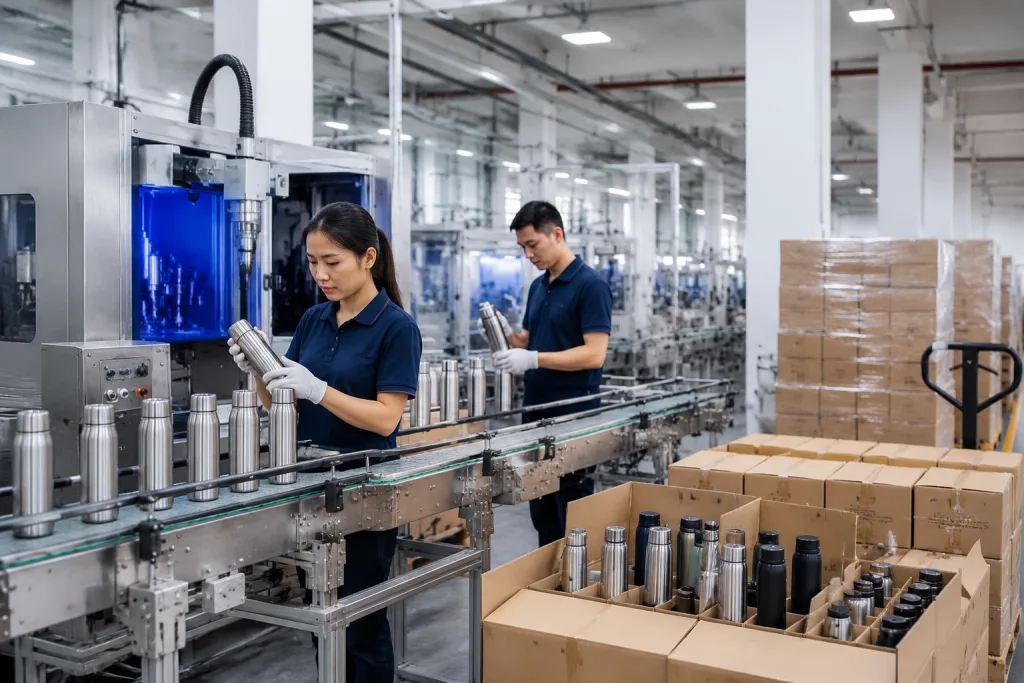
FOB China for a common 500ml double-wall 304 bottle usually lands at USD 2.80 to 5.60, depending on finish, cap structure, and print method. A plain packed unit sits near the low end; a powder-coated bottle with laser logo and a gift box climbs to the top. On our Hangzhou line, normal lead time is 25 to 35 days after sample approval and deposit, and we track that against the filling machine schedule and carton slotting. If tooling or special packaging is added, plan on 45 days or more. The math does not move the other way.
UK shipping changes the picture. For seasonal retail, build in time for sea freight, customs, and the warehouse booking slot. Air freight works for 500 to 1,000 sample-sale units, but for proper wholesale volume, sea freight is the cleaner answer. We’ve seen buyers chase a low unit price, then miss the season by 12 days against the ship cut-off and lose the margin anyway.
Useful checkpoint: ask the thermos supplier for a pro forma invoice that breaks out product cost, decoration, inner carton, master carton, and freight assumption. Put that against the sample sheet and the carton measurment on the desk. That is the fastest way to see whether the quote is solid or just wishful.

Check compliance and QC
I’ll rewrite the section in place, keep the HTML structure intact, and tighten the language so it sounds like a real factory-side sales engineer.Compliance is not filing-cabinet work; it is what gets your bottles through customs and onto the shelf. For UK and EU stainless drinkware, ask for food-contact declarations, REACH-related material statements where they apply, and a plain list of inks and coatings. For private-label retail, we also ship carton labels, batch traceability, and country-of-origin marking. If a supplier cannot produce those on the first round, the order is already shaky.
QC has to sit inside the order, not after the buyer flags a leak. A good thermos supplier will run pre-production samples, in-line checks, and final inspection before shipment. For a normal batch, AQL 2.5 works for cosmetic defects; leakage and thermal retention need a tighter call. We ask for photos of the vacuum-test or pressure-test rig, not just a nice PDF. If they cannot show a real line check, they are not the thermos factory you want for repeat work.
Packaging needs the same discipline. A bottle can pass leak test and still arrive dented if the carton spec is weak. We have seen 18 kg master cartons fail stacking while a 5-layer box held up cleanly. For export from China, I want an inner box with a fitted insert and a master carton that survives warehouse handling. If your SKU goes to Amazon or a distributor, add barcode labels and pallet specs early; FNSKU belongs in the PO, not in a last-minute email.
In practice, the best thermos suppliers in China ask for your target market before they quote. That is the right question, because the math does not work any other way. A UK retail order and a Middle East promo order do not carry the same paperwork or carton spec, and we have seen that go sideways fast.
Get a quote for your UK thermos order
Send your target size, logo method, and MOQ. We’ll price the right stainless vacuum bottle for your channel, not just the cheapest one.
Frequently asked questions
What is a realistic MOQ for wholesale vacuum bottle UK orders?
For a standard stainless vacuum bottle, 1,000 pcs is the most common MOQ. If you want a custom lid, special coating, or molded shape, expect 3,000 pcs or more. For a simple logo on a stock mold, some China factories can quote 500 pcs, but the unit price usually rises by 15% to 25%. For outdoor retailers and promo brands, 1,000 pcs is the better starting point because it keeps sampling, freight, and carton costs under control.
How much should a custom thermos cost FOB China?
A basic 500ml double-wall 304 stainless bottle often costs USD 2.80 to 5.60 FOB China. Laser logo adds about USD 0.10 to 0.30 per position. Powder coating, gift box packaging, and upgraded lids can push the price higher. If a quote looks far below USD 2.50, check the steel grade, wall thickness, and whether the supplier is hiding packaging or inspection costs. A real factory thermos quote should break those items out clearly.
What insulation performance should I request?
For a quality wholesale vacuum bottle UK order, ask for a test based on 95°C fill water at room temperature. A practical target is 60°C or above after 12 hours and 45°C or above after 24 hours for a 500ml bottle. Cold retention should often stay below 10°C after 24 hours. If a supplier gives only marketing language and no test conditions, ask again. A serious manufacturer thermos supplier will state the method, not just the result.
Is 304 stainless enough for UK retail?
Yes, 304 stainless is the standard choice for the inner wall and usually for the outer wall too. It gives good corrosion resistance and customer confidence without the cost of premium grades. For lower-cost promotional thermos programs, some buyers use 304 inside and 201 outside to reduce cost, but that is a trade-off. If your brand sits in outdoor retail, 304/304 is the safer choice. It reduces complaint risk and helps your distributor thermos line hold its value on shelf.
Can you customize packaging for distributors and Amazon sellers?
Yes. A thermos distributor program often needs barcode labels, master carton marks, and retailer-ready inner boxes. If you sell through Amazon, you may need FNSKU labels and carton dimensions that meet inbound rules. We usually recommend confirming carton pack-out, drop-test expectations, and pallet count before production starts. That avoids repacking costs later. For China export orders, packaging changes can add 3 to 7 days to lead time, but they save much more time during fulfillment.