Water Bottle Wholesale Supplier Production Scalability Planning for United States Buyers
Vincent Xi, Editorial Author, BottleForge Industrial (author profile)
United States B2B buyers should not convert a water bottle sample approval into a wholesale blanket until production scalability planning is in the award file. That file should include a dated monthly output statement by material, written peak-season reservation rules, a production-line map for stainless steel, plastic, and glass, an expansion trigger with qualification time, and a QC handoff that links the golden sample, pre-production (PP) sample, and mass-production standard. Those records decide whether water bottle wholesale supply can hold ship dates, print quality, cartonization, and food-contact files when United States retail or e-commerce demand spikes.
Treat production scalability planning as a gated procurement control, not a supplier slogan. A public wholesale-supplier evaluation guide tells buyers to request monthly output, peak-season planning, production-line organization, and expansion capability because those items affect delivery reliability as order volumes increase (Yeway Drinkware wholesale supplier guide).
This page applies those public supplier-evaluation and large-order practices to a United States RFQ sequence for water bottle wholesale supply. It does not claim factory visits, laboratory tests, awards, certifications, or customer outcomes, and it does not report first-person production experience. Exact commercial numbers below are example planning values to verify in a supplier quote, a dated capacity letter, a carton specification, and a freight/customs pack as of the purchase-order date.
Production scalability planning for water bottle wholesale supply
Production scalability planning for water bottle wholesale supply is the documented control set that keeps quality, labeling, and ship dates intact when volume moves from approval samples to repeating United States purchase orders. Define scale in finished units, SKU count, print methods, and in-store or distribution-center (DC) dates. Then test whether forming, finishing, QC, and packing can absorb that load without an unapproved process change.
Use trade-offs as decision inputs. Dedicated stainless-steel forming and vacuum-weld cells can reduce mix-related process drift for vacuum bottles, but they can also reduce mix flexibility if the same month still needs plastic or glass SKUs—require the supplier to state which cells are dedicated versus shared. Shared finishing lines can lower a quoted unit cost and still raise changeover risk for print registration, powder-coat color, and lid torque. Extra work-in-process or finished goods near the factory can protect a United States peak window, yet they increase carrying cost and obsolescence if artwork or lid colors change. Air freight can sometimes rescue a missed ocean slot for a launch SKU; it rarely salvages a full wholesale program once cartons, pallets, and Importer Security Filing (ISF) data are already wrong.
Set one working first-lot size in the RFQ and keep it consistent through packing trials and the award memo. A practical first wholesale lot after an approved PP sample is 25,000 finished bottles (example planning quantity; scope: the RFQ-defined SKU set; as-of: the named production week on the quote; assumption to verify in the supplier quote). Use that lot to prove cartonization, packed-carton drop performance, and United States-mark application at rate—not only at a sample bench. If the supplier cannot show how that lot sits inside booked versus open capacity for the named ship month, the program is not yet scalable.
Capacity, production lines, and expansion capability
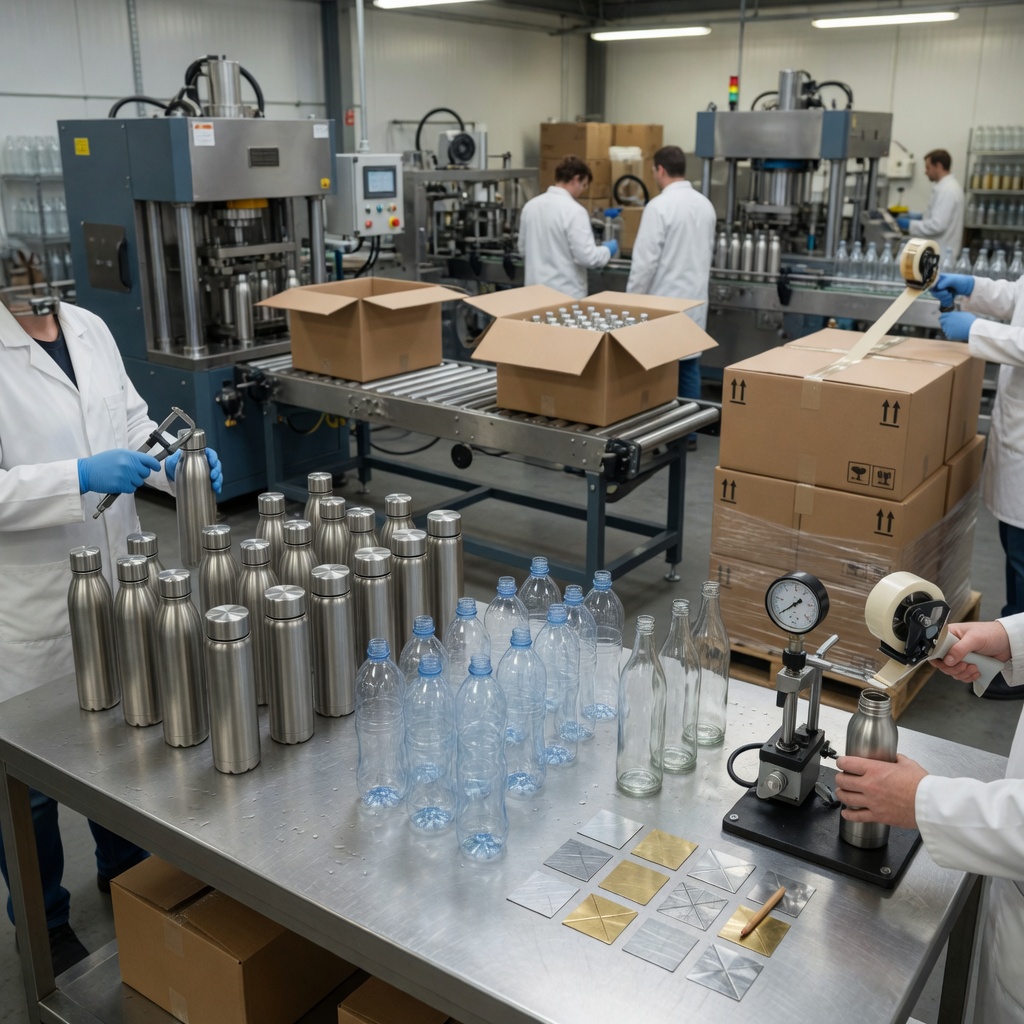
Ask for capacity in units per month by product family, not a single headline number. Stainless-steel vacuum bottles, injection-molded plastic bottles, and glass bottles do not share the same bottleneck. A factory build-out discussion stresses defining product direction first so specialized lines, finishing, QC, and packaging infrastructure can be planned rather than improvised. That source describes hydraulic stretching and vacuum welding equipment as stainless-capability drivers and custom molds / private-label tooling as OEM/ODM enablers; those same assets create changeover and spare-tool constraints that must appear on the capacity calendar (Diller factory build-out overview). The Diller page is a third-party build-out narrative, not a BottleForge factory record and not a first-person claim by Vincent Xi.
Request the following in writing:
- Monthly rated output and demonstrated output for the last 90 days (unit: finished units per month; scope: by material and by print/finish process; as-of: the capacity-letter date; request as documented evidence, not a verbal figure).
- Number of forming, welding, coating, printing, assembly, and packing lines, plus which lines are shared.
- Booked versus open slots for the next two peak windows relevant to United States retail (commonly late-summer back-to-school and Q4—confirm against the buyer’s actual calendar; as-of: the capacity-letter date).
- Expansion capability: additional shifts, extra molds, subcontract finishing, or a second campus—and the lead time to qualify each option, including PP and food-contact file updates.
Example planning control: if a supplier states 80,000 stainless-steel units per month (unit: finished stainless-steel bottles per month; scope: the quoted stainless family only; as-of: the dated capacity letter; assumption—confirm in that letter), a 120,000-unit United States wholesale purchase order in a single ship month (example calculation: 1.5 × 80,000 units; same unit and stainless scope; as-of: the named ship month on the RFQ) is a scalability test, not a routine release. Options include a staggered two-drop schedule, a second qualified line, or a reduced SKU mix. Do not accept a verbal claim that a shift can be added. Require the shift’s labor plan, QC headcount, and whether coating or print remains the true bottleneck.
Peak-season planning is a reservation problem. Request a written peak calendar at least 12 weeks before the United States in-store or DC-required date (example planning lead; unit: calendar weeks; scope: origin production slotting through the named United States receipt date; assumption to verify in the RFQ). The calendar should show reserved capacity for existing programs versus open capacity, mold-change freezes, and origin shutdown overlays (including Chinese New Year where it affects the factory calendar) that change ocean-origin readiness. Scalability fails when volume is accepted against theoretical annual capacity that is already sold in the peak month.
Quality consistency from samples to large wholesale runs
Scaling is where hidden process substitutions appear: different weld fixtures, thinner cartons, unapproved ink lots, or alternate lid-gasket suppliers. Freeze the golden sample, PP sample, and mass-production standard as three linked records with the same drawing revision, material certificates, and print standard.
Specify hold points that still operate at wholesale rate:
- Incoming: steel coil or resin lot, lid components, silicone, and print ink/coating lots.
- In-process: wall thickness, vacuum decay or leak test, weld cosmetics, coating adhesion, print registration, and lid torque.
- Outgoing: a buyer-specified acceptable quality limit (AQL) by defect class, scan checks of United States-required marks, and carton drop or compression as packed for the nominated United States lane. AQL here is an RFQ sampling control to define and verify; it is not a claim that any factory holds a named quality certification.
Tighter AQL and 100% leak testing reduce brand risk on vacuum bottles but add cycle time. If the factory only leak-tests samples, mass-run vacuum failure can surface after United States receipt. Require the test method, equipment, sampling plan, and whether the same fixtures used on PP will run on the wholesale lot. Capability shown at 5,000 finished bottles (example quantity; scope: one process routing; as-of: the PP or pilot-run date) does not prove capability at 50,000 finished bottles (example quantity; same unit; scope: the mass-production routing, including any second print line or subcontract coater) if a second print line or a subcontract coater is introduced without re-qualification.
For United States programs, food-contact and chemical documentation must scale with production lots, not only with the first sample. Importer-of-record files typically need consistent material declarations, test reports tied to the actual production lots, and artwork that already includes required marks. Do not treat a laboratory report on a development sample as sufficient for the 25,000-finished-bottle first lot (example planning lot; as-of: the mass-release date on the PO).
Inventory, packaging automation, and demand systems that support scale
Large wholesale water bottle programs fail as often in the warehouse as on the forming line. A public large-order operations article describes an order-management system for tracking and automation, real-time inventory to prevent shortages, first-in-first-out (FIFO) warehouse discipline, automated packaging for scale, and demand-forecast inputs so bulk fulfillment stays on calendar (Harris large-order management overview). Those items are buyer-verification targets from that source, not audited BottleForge warehouse metrics.
Specify:
- SKU-level inventory visibility (finished goods, printed shells, lids, gift boxes) with FIFO or first-expired-first-out (FEFO) rules for dated coatings and inks.
- Whether packing is manual or automated, and at what order size automation becomes the default. Ask for the supplier’s break-even volume; an example threshold to test in the quote is 10,000 finished bottles per SKU per release (scope: packing method only; as-of: the quote date; assumption—verify).
- Carton specifications: bottles per inner pack, inners per master carton, master dimensions, packed weight, and whether a 40-foot high-cube container cubes out or weighs out. Empty water bottles often cube out first. Request bottles per carton and cartons per 40-foot high-cube so landed unit count can be calculated (example cube method; container type: 40-foot high-cube; as-of: the carton-drawing revision on the PO; verify utilization against the actual carton drawing).
- Forecast cadence: a rolling 13-week or 26-week volume signal (example horizons; unit: calendar weeks; scope: the United States program SKUs; as-of: each forecast freeze date), freeze windows, and who owns forecast error. Demand forecasting only helps if the buyer’s United States sell-in data actually feeds the factory slotting calendar.
Automated packing and a robust order-management system can reduce labor variance and missing-piece cartons at wholesale scale, but they require stable carton designs and barcode rules. Frequent United States private-label artwork changes punish automation. If seasonal wraps will change, specify a manual-pack exception path with extra QC, not an unstated line diversion.
United States labeling, landed-cost, and delivery controls
Keep the product and RFQ decision primary: United States rules are constraints on the same production scalability planning pack, not a separate country guide. The importer of record must confirm, as of the purchase-order date and with licensed counsel or a customs broker:
- Food-contact status for wetted materials and any coatings or inks that can contact the beverage, with lot-traceable support (confirm applicable United States Food and Drug Administration requirements with counsel; this article is not a legal opinion and does not assert that a named factory is certified).
- Country-of-origin marking and any other required consumer or B2B marks on the bottle, hangtag, and master carton.
- California Proposition 65 or other state warning logic if the SKU will ship into those United States channels (confirm with counsel; do not copy a prior artwork file without a current legal review).
- Harmonized Tariff Schedule (HTS) classification, duty, merchandise processing, harbor maintenance, and any additional origin-based measures that apply to the actual factory origin. Do not copy a duty percentage from a prior year into the RFQ; rates and origin rules move.
- Importer Security Filing (ISF/10+2) and ocean documentation aligned to the Incoterms on the PO.
Landed-cost scalability is a calendar problem. A factory that can form bottles but cannot apply correct United States marks at packing speed will miss the DC appointment even if the vessel sails. Request a packaging bill of materials that already includes United States-compliant labels, UPC/GTIN if required by the retailer, and carton marks that survive ocean humidity.
Delivery planning should name the United States gateway and inland mode (example only: a West Coast port plus rail to an inland DC versus an all-water East Coast routing—verify against the actual PO; as-of: the freight quote date). Split shipments can protect a launch SKU but can break pallet and carton continuity for retail routing guides. Specify whether the first 25,000-finished-bottle wholesale lot (example planning quantity; as-of: the first mass ship week) may ship in one 40-foot high-cube container or must split, and who pays detention if packing is late.
Buyer decision table for production scalability planning
Use the table to compare suppliers on the same water bottle wholesale supply task. Every row is a specify / verify / approve control for United States B2B buyers.
| Decision factor | Specify in the RFQ | How to verify | Red flag | Scalability implication for United States wholesale |
|---|---|---|---|---|
| Monthly capacity by material | Units/month stainless, plastic, glass; booked vs open for named months | Dated capacity letter plus last-90-day output (as-of the letter date) | One blended plant-capacity number | Peak United States POs collide with other programs |
| Production lines | Line count by process; which lines are shared | Line map and changeover times | No weld/print bottleneck named | Quality or lead time breaks at mix |
| Expansion trigger | Extra shift, mold, or campus; qualification days | Written lead time including PP re-run | Overtime promised with no labor/QC plan | Slot appears only after the United States in-store date |
| Peak-season buffer | Reserved vs open slots; freeze calendar | Peak calendar at least 12 weeks ahead (example lead to verify) | Accepting volume against annual average | Missed Q4 or back-to-school window |
| Sample-to-mass QC | Golden / PP / mass production linked to the same drawing and lots | Control plan, AQL sampling plan, leak/vacuum method | Laboratory report only on a development sample | Defects appear after United States receipt |
| Packaging at rate | Carton drawing, bottles/carton, cartons/40-foot high-cube | Trial pack of the named first wholesale lot | Sample gift box only, no master carton | Cube and routing-guide failure |
| Inventory / order system | FIFO, SKU visibility, forecast freeze | System description plus shortage history | Spreadsheet-only work-in-process | Shortages on lids or print lots |
| United States marks and files | Country of origin, food-contact support, retailer barcode rules | Artwork proof plus lot-tied documents | Labels deferred until after packing | Customs or retailer rejection |
| Landed-cost pack | Incoterms, HTS to be confirmed by a United States broker, origin | Broker/forwarder quote on the actual SKU as of PO date | Factory-quoted lump sum without HTS | Margin and date risk on repeat POs |
RFQ checklist for water bottle wholesale supplier production scalability planning
Every item below should appear in the RFQ or the award memo so the United States buyer can specify, compare, verify, approve, or order.
- State the primary SKU set (material, capacity in ml, lid type, print method) and the first wholesale lot size; use 25,000 finished bottles as an example planning lot only if it matches the buyer’s real PO, then require the supplier to place that lot on a named production week.
- Require a dated monthly capacity statement by material and process, showing booked versus open units for the next six months (example horizon; unit: calendar months; as-of: the capacity-letter date—extend if the United States program is seasonal).
- Require a line map: forming, welding or molding, coating, printing, assembly, leak/vacuum test, and packing, including shared lines and changeover hours.
- Require peak-season rules: reservation policy, mold-change freeze, and shutdown overlay, issued at least 12 weeks before the United States DC or in-store date (example planning lead to verify).
- Require expansion options with qualification time, including whether a second print line or subcontract coater needs a new PP sample and a new food-contact file.
- Freeze golden sample, PP, and mass-production standards to one drawing revision; list the instruments and sampling plan that will run at wholesale rate.
- Specify leak/vacuum, adhesion, torque, and AQL by defect class for the mass lot—not only for samples. Treat AQL as a contractual sampling plan, not as evidence of a certification document.
- Require carton drawings, bottles per carton, carton weight, and cartons per 40-foot high-cube so landed unit count can be calculated (example cube method; verify against the carton-drawing revision).
- Require an order-management and inventory description: real-time SKU visibility, FIFO, and how forecast updates change the slotting calendar (Harris large-order management overview).
- Require United States-facing artwork and marks: country of origin, food-contact claims only if substantiated, retailer barcode rules, and master-carton marks, applied at packing speed.
- Require the importer-of-record pack: material declarations, lot-tied tests, HTS to be confirmed by a licensed United States customs broker, Incoterms, and ISF responsibility.
- Require a written recovery path if the first wholesale lot fails QC or misses the vessel: extra line time, air-eligible spare quantity (define a small example, such as 2,000 finished bottles, only if the buyer actually needs it; scope: launch-SKU spare only; as-of: the recovery annex on the PO), or a split ocean schedule—each with cost and date impact.
- Require named commercial contacts for capacity, QC, and shipping who can answer within a stated business-day service window during United States peak weeks.
- Make award contingent on a complete, signed capacity-and-control pack; do not convert a sample PO into an open wholesale blanket without those documents.
How this article was derived
Source context 1 is a wholesale water bottle supplier-selection guide that instructs buyers to request monthly output, peak-season planning, line organization, and expansion capability as delivery-reliability controls (Yeway Drinkware wholesale supplier guide). Source context 2 is a factory build-out discussion that ties product direction to specialized stainless, plastic, and glass lines and to infrastructure for manufacturing, finishing, QC, and packaging, including forming and welding equipment and custom-mold OEM/ODM paths (Diller factory build-out overview). Source context 3 is a large-order operations article covering order-management systems, real-time inventory, FIFO warehousing, automated packaging, and demand forecasting for bulk fulfillment (Harris large-order management overview).
Methodology: buyer questions on monthly capacity, line count, sample-to-mass QC, inventory, packaging automation, and forecasting were mapped only to practices those public guides actually describe. United States labeling, HTS, ISF, and food-contact items are framed as importer-of-record verification steps, not as findings copied from those three drinkware pages. Research-source evidence supports only the editorial practices cited above; it is not keyword-demand evidence and is not used to estimate search volume, CPC, difficulty, traffic, or ranking. Numeric planning values (25,000-unit first lot, 80,000 units/month capacity illustration, 120,000-unit single-month PO test, 10,000-unit automation threshold, 12-week peak calendar, 5,000- versus 50,000-unit capability contrast, 2,000-unit air-spare example, 40-foot high-cube cube method, 13-week or 26-week forecast horizon, last-90-day output window, six-month booked-versus-open horizon) are explicit example assumptions for RFQ sizing, not measured factory statistics. Editorial byline: Vincent Xi, Editorial Author; no first-person factory-visit or lab-test claim is made.
Limitations and what to verify
Capacities, equipment, order-system maturity, and packing methods vary by factory and change with season and tool ownership. This article is not a factory audit, not a certification, and not a customs, Food and Drug Administration, or Proposition 65 legal opinion. Verify every number against a supplier capacity letter, process control plan, carton drawing, and a United States broker/forwarder quote tied to the actual HTS classification, origin, and Incoterms on the purchase-order date. Do not infer that BottleForge Industrial or any cited publisher holds a named certification, customer result, or production volume that is not in a current document you hold.
Editorial author: Vincent Xi, Editorial Author, BottleForge Industrial (https://bottleforge.com/authors/vincent-xi/).
Discuss Your Requirements
Review our manufacturing capabilities, then share your specifications for a supplier-fit review.