Water Bottle Wholesale Supplier Business Continuity Planning for Canada
Vincent Xi, Editorial Author, BottleForge Industrial (author profile).
```json {"@context":"https://schema.org","@type":"Article","headline":"Water Bottle Wholesale Supplier Business Continuity Planning for Canada","author":{"@type":"Person","name":"Vincent Xi","jobTitle":"Editorial Author","url":"https://bottleforge.com/authors/vincent-xi/"}} ```
Answer first for Canadian buyers: do not award a water bottle wholesale supplier on unit price until business continuity planning is a scored RFQ exhibit. Freeze the SKU, name the backup line or plant, state buffer days and location (origin and/or Canada), attach a pallet drawing, and write emergency MOQ, clock-start, and quality gates into the purchase documents before the first production lot.
If the program depends on wholesale supply of reusable water bottles, the nominated plant, tooling, packaging line, and outbound lane still have to deliver that SKU when a furnace, coater, lid mill, port, or carrier fails. Backup capacity, inventory policy, and time-bound emergency procedures belong in the contract, not in a brochure. Score water bottle wholesale supplier business continuity planning as its own exhibit: named backup production or dual tooling, finished-goods or component cover in days, pre-agreed emergency MOQs and clocks, and quality gates that stay in force during a surge.
This briefing is an editorial comparison aid published by BottleForge Industrial and attributed to Vincent Xi, Editorial Author. Experience basis: the named author’s published Editorial Author role on the BottleForge Industrial author profile only. This page does not describe personal factory visits, laboratory tests, awards, certifications, or named customer outcomes.
Why business continuity planning belongs in the water bottle wholesale RFQ
Wholesale water-bottle programs usually break at a single point: one mold or liner vendor, one coating line, one export CFS, or a warehouse with no stated cover. Repeat-order drinkware sourcing guidance still matters—production stability, leak and insulation checks, packaging control, and the scheduling value of long-term partnerships in busy seasons (Yeway drinkware wholesale sourcing guide). Those habits keep a normal calendar honest. They do not prove the supplier can re-sequence another line, release safety stock, or cut an emergency PO when body material, lids, coating, cartons, or ocean space disappear.
Filled-water emergency logistics are a different product class, but they show how mobilisation is specified: inventory in known places, pallet discipline, and a published window. As published on the Water Direct page (scope: UK filled bottled-water emergency network, not reusable water-bottle manufacturing and not a Canadian wholesale supply quote; as-of: publication date not independently clocked in this briefing), one operator describes a bottled water bank with 24/7 access (unit: hours of stated access) across 42 UK locations (unit: sites) and response times of 4–24 hours (unit: hours) (Water Direct on bulk bottled water for emergencies). Use that design as a question list: SKU-specific window, stock locations, and release authority—not as a transferable SLA.
Cube is the other continuity variable. As published on the Government Procurement page (scope: US filled-water disaster-recovery configuration, not empty or vacuum-insulated water bottles and not a Canada duty or brokerage quote; as-of: publication date not independently clocked in this briefing), one bulk-supply write-up cites GSA Advantage truckloads of 40,320 bottles (unit: filled bottles) of 16.9 oz filled water (unit: fluid ounces per bottle) per 53-foot trailer (unit: trailer length), shrink-wrapped for shipment (Government Procurement on bulk supply chains in disaster recovery). Reusable bottles will not match that count. Require bottles-per-inner, inners-per-carton, cartons-per-pallet, pallet height, and pallets-per-container—or per 53-foot trailer if that is the Canadian over-the-road lane—then test whether the emergency quantity still fits a legal, stackable pack-out.
Buffers, dual plants, and emergency freight: what to score
Continuity is a cost-and-risk split across water bottle wholesale supply, not a slogan. Three levers decide the award:
- Finished-goods or component buffer. Measure cover in days of forecast demand at a named site. A 14-day origin buffer (unit: calendar days of forecast demand; scope: example assumption for an origin warehouse; as-of: not a measured factory figure; source: example calculation/assumption to verify in the supplier quote and in the 3PL contract) may absorb a coating stoppage and will not cover a multi-week ocean disruption into Canada. Stock in a Canadian DC shortens last-mile response and raises carrying cost, colour obsolescence risk, and lot-traceability load.
- Dual production versus dual tooling. A second qualified plant, or a sister line already running the same BOM, lid, and print process, cuts single-site risk. Duplicate tools at one site cost less than a second plant and still fail if utilities, labour, or the park are the constraint. Collect first-article evidence on the backup path before the emergency: vacuum insulation if the SKU claims it, leak test, print adhesion, and carton drop. Record where each mold lives and whether a duplicate already sits at the backup site.
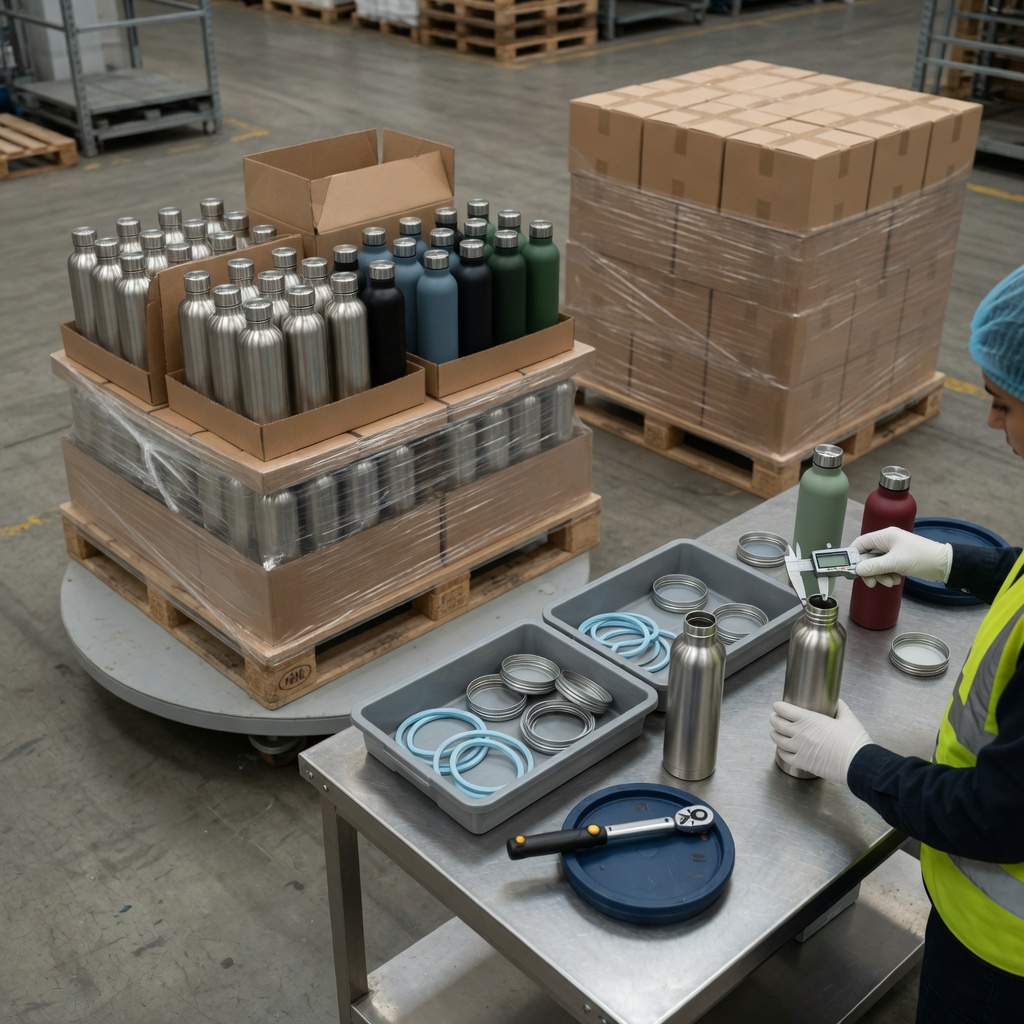
- Expedited freight versus pack-out redesign. Premium air or trucking can buy calendar days after a miss. It cannot replace a down mold. The filled-water 40,320-count / 53-foot trailer figure above is not reusable-bottle density and not a Canada duty model. Example calculation to verify in the quote (not a price, not a measured factory rate): if an insulated bottle packs 24 bottles per carton and 40 cartons per pallet, 10 pallets are 9,600 bottles (unit: bottles; scope: illustration only). If emergency demand is 20,000 bottles (unit: bottles; scope: example RFQ surge; source: assumption to verify in the supplier quote), more than two loads are required if 10 pallets is one load—confirm against the supplier’s current pallet drawing.
Origin inventory is usually cheaper per unit than dual plants and slower to reposition into Canada. Dual plants cost more in tooling and quality maintenance. Premium freight is a short-fuse overlay, not a substitute for business continuity planning. Score all three in one matrix so unit price cannot hide a single-point failure.
Continuity evidence that can sit on the purchase order
Ask for artefacts, not adjectives.
- Named backup capacity. Plant ID or line ID, qualified process (body, lid assembly, print, insulation if applicable), and maximum weekly output on that path for this SKU family. “Other factories exist” is not evidence.
- Inventory policy. SKU or component, quantity, location, ownership (supplier, buyer, or 3PL), rotation rule, and after-hours release authority. The UK filled-water bank cited above publishes a location list and a 4–24 hour window as its mobilisation design (unit, scope, and as-of as first cited); a drinkware supplier should be able to state an analogous window for packed bottles or for components, even if the number is different (Water Direct).
- Dual sourcing of critical inputs. Body material, lid/gasket, powder or paint, carton, and print film. Single-source lids are a common hidden failure on custom bottles.
- Tooling custody. Cavity/mold ID, storage site, duplicate-tool status at the backup plant, and who may authorise a move during an outage.
- Surge quality plan. Leak, insulation, and torque tests do not pause on an emergency run. The wholesale drinkware guide treats vacuum insulation, leak testing, logo, and packaging as core QC (Yeway). Put sampling size and hold/release authority in the quality exhibit so a continuity event cannot waive defects.
- Logistics pack-out. Stretch-wrapped, corner-boarded pallets and a defined trailer or container load plan, as the disaster-recovery truckload write-up emphasises (Government Procurement). For water bottles, add inner protection against scuff and dent on powder-coated or printed walls. Ban mixed-SKU pallets on surge shipments unless the drawing allows it.
- Communication cadence. Escalation tree, time to first written status, and the language of the purchase documents for Canadian stakeholders. That is a contract exhibit, not a chat habit.
A current ISO certificate, a marketing “resilience” page, or an unrelated bottled-water SLA does not prove a drinkware plant can reroute this SKU. If a standard or certificate is offered, verify that it is current, scoped to the producing site, and separate from BottleForge Industrial’s editorial practice on this page. This article does not claim any certification for BottleForge Industrial or for any unnamed factory.
Canada ship-to, Incoterms, and pack-out locks
Canada is the sales market this RFQ should serve. Keep the product and continuity decision primary; do not turn the file into a general import manual.
Lock the following in the RFQ body:
- Ship-to and buffer geography. Origin warehouse, Canadian DC, or split. Who pays storage, and who owns shrinkage.
- Incoterms® rule and named place. Continuity cost sits with whoever controls main carriage and insurance. An ex-works production plan still leaves Canadian inbound risk with the buyer.
- Label and artwork pack. Attach the print-ready files the Canadian program will actually ship, plus change control. This briefing does not assert a labelling statute. Require those files to be printed, and quarantine obsolete cartons after an emergency reprint so mixed artwork cannot enter the Canadian pipeline.
- Pallet and truck constraints for Canadian lanes. Footprint, max height, stack rating, and whether 53-foot trailer math or ocean-container math governs. Treat the filled-water trailer example only as proof that load plans are empirical, not as empty-bottle cube (Government Procurement).
- Emergency quantity versus standing forecast. Restating standard lead time is not a continuity clause. State surge quantity, calendar window, and whether sampling increases.
- Alternate outbound node. Named CFS, gateway, or carrier if the primary export path is blocked—asked as a supplier document, not as a published Canadian transit time here.
Duties, brokerage, and fuel belong in the commercial exhibit as buyer-owned estimates unless the quote is delivered. This page does not publish duty rates or freight tariffs.
Buyer decision table: score continuity before unit price
Every row is a specification, comparison, verification, approval, or order action.
| Decision factor | Weak posture (do not award on price alone) | Continuity-ready posture | What the Canadian buyer verifies | RFQ / PO action |
|---|---|---|---|---|
| Documented business continuity planning | Verbal assurance; generic HQ policy | Site-level plan covering this SKU family, backup line, order desk, and logistics | Dated plan, owner, last test or tabletop, and gap list | Make the plan an exhibit; require notice of material change |
| Backup production | “Other factories exist” | Named line or plant already qualified on the BOM, lid, and print | First-article pack, backup-line evidence, capacity in units/week | Dual-source clause with qualified backup ID |
| Tooling / molds | Primary cavities only; location unknown | Duplicate tools or documented move plan with owner | Mold ID, site, duplicate yes/no | No silent tool transfer; list IDs on the PO |
| Inventory buffer | No stated cover | Days of cover by SKU or critical component, location, rotation | Stock-report format, cycle count, ownership | Min/max and release authority in the contract |
| Dual input sourcing | Single lid or carton mill | Second qualified lid/gasket and carton source | AVL with part numbers | No-single-source rule for lids and cartons |
| Emergency lead time | “Best effort” | Clock-start definition, hours/days to ship emergency MOQ | Written window; treat the UK filled-water 4–24 hour range only as an analogue, not a drinkware promise (Water Direct) | Liquidated schedule or service credit, if commercially agreed |
| Pack-out for surge | Mixed cartons, no pallet drawing | Frozen pallet recipe; stretch wrap and edge protection | Bottles/carton, cartons/pallet, pallets/container or trailer | Attach pallet drawing to PO |
| Quality during surge | Waived inspections | Same leak/insulation/print checks, sampling size stated | Procedure ID and hold desk | Quality exhibit remains in force |
| Canada delivery path | Origin only; buyer discovers the lane later | Named Incoterm, optional Canada buffer, broker roles | Who files entry; who owns dwell | Incoterm + ship-to in the header |
| Communication | Sales desk dark outside ordinary hours | Named escalation, written status cadence | Test the tree in a pre-award drill | Name and phone in the exhibit |
| Priority in peak season | New logos jump the queue | Contracted capacity reservation | Written reservation vs. forecast | Capacity hold for the Canadian program |
Long-term partnership language in drinkware sourcing is consistent with priority production in busy seasons (Yeway), but priority has to be written as reserved capacity, not inferred from relationship length.
RFQ checklist for water bottle wholesale supply continuity
Use this list to specify, compare, verify, approve, or order. Each item should produce an artefact or a quote line.
- SKU freeze. Body material, capacity, lid/gasket, colour, print method, and carton recipe. Continuity cannot be quoted on an open design.
- Forecast and emergency quantity. Standing weekly/monthly volume plus the surge quantity and the calendar days in which that surge must ship.
- Business continuity planning exhibit. Site plan covering production, utilities, order desk, subcontract print, and outbound logistics for this family.
- Backup line or plant ID with proof the backup already ran this BOM, or a dated qualification plan that holds award until complete.
- Tooling custody. Mold/cavity IDs, storage site, duplicate at backup plant, and move authorisation.
- Buffer policy. Days of cover, location (origin and/or Canada), ownership, and after-hours release contact.
- AVL for lids, gaskets, powder/film, and cartons, with at least one alternate for each single-point part.
- QC that survives surge. Leak test; vacuum/insulation test if the SKU claims insulation; torque; print adhesion; carton drop; sampling size; hold authority.
- Pallet and load plan. Units per carton, cartons per pallet, max height, wrap spec. Ask for pallets per 40-foot container and per 53-foot trailer if over-the-road trucking into Canada is in scope. Do not import the filled-water trailer count as an empty-bottle count (Government Procurement).
- Clock-start for emergency orders. Receipt channel, cut-off, and hours or days to ship the emergency MOQ. Treat published filled-water response times as a benchmark question, not a drinkware default (Water Direct).
- Incoterms, named place, and Canada ship-to. Who books, who insures, who files entry, where title passes.
- Artwork files. Attach the exact print pack; state whether emergency reprints may use a simplified one-colour mark; quarantine obsolete leftovers.
- Lot traceability and recall desk. Carton and pallet marks; hours to produce a shipment list for Canadian consignees.
- Peak-season capacity hold. Reserved units by month; what happens if the hold is not called.
- Sub-tier notice. Hours allowed to notify if a lid mill, coater, or CFS fails.
- Alternate outbound node. Named CFS, gateway, or carrier if the primary lane is blocked.
- Pre-award drill. One tabletop: dummy emergency PO and timed written acknowledgement.
- Change control. No silent substitution of lid, gasket, steel grade, or carton board during a continuity event.
- Commercial overlay. Whether emergency freight is prepaid and billed, and whether unit price changes after a stated overtime threshold—terms to negotiate, not market averages.
- Acceptance and on-hold product. Where rejected surge production is stored so it cannot mix into the Canadian pipeline.
Approve only when the decision-table rows and items 1–20 have owners, dates, and documents. Order against the frozen pallet drawing and the qualified backup ID, not against a catalogue photo.
How this briefing was assembled and what still must be verified
Source context 1. Public emergency write-up on filled bottled water: mobilisation network of 42 UK locations, 4–24 hour response, and 24/7 access, as published for a UK filled-water product. Those figures are as published on the cited page; the publication date is not independently clocked in this briefing. They are not reusable-bottle manufacturing rates and not Canadian duty or brokerage quotes (Water Direct).
Source context 2. Public disaster-recovery write-up on filled-water truckload density: 40,320 bottles of 16.9 oz filled water per 53-foot trailer, shrink-wrapped pallets, as published for a US disaster-recovery configuration. Same as-of limitation: publication date not independently clocked in this briefing. Not an empty-bottle cube and not a Canada landed-cost model (Government Procurement).
Source context 3. A B2B drinkware sourcing guide describes production stability, vacuum-insulation and leak QC, packaging control, and the scheduling value of long-term wholesale relationships during busy seasons (Yeway). That is process guidance for water bottle wholesale supply, not a continuity certificate and not a capacity number.
Methodology / how the data was derived. Editorial comparison only: extract stated quantities, time windows, and QC themes from the cited pages; keep filled emergency-water logistics separate from empty/reusable water-bottle manufacturing; convert those themes into RFQ artefacts a Canadian buyer can score. No factory audit, no lab test, and no BottleForge production, inventory, or transit-time claim was added. Trailer-to-unit illustrations that use a buyer’s own pack-out are labelled as example calculations to verify in the supplier quote.
Limitations / what to verify. Treat every number as as-published on the source URL until the supplier restates it for the contracted SKU. The 42-location / 4–24 hour and 40,320-unit / 53-foot figures are not Canada landed-cost data, not BottleForge capabilities, and not interchangeable with insulated-bottle cube. The 14-day buffer, 24 bottles/carton, 40 cartons/pallet, 9,600 bottles/10 pallets, and 20,000-bottle surge figures are example calculations or assumptions to verify in the supplier quote. Artwork, customs classification, and carrier transit times must come from the buyer’s attached print pack, broker, and quote. If a supplier offers ISO or other management-system documents, verify currency, site scope, and expiry; this page does not imply certification. Do not award on relationship length or on emergency-water case studies from other product classes.
Editorial attribution: Vincent Xi, Editorial Author, BottleForge Industrial — https://bottleforge.com/authors/vincent-xi/.
Discuss Your Requirements
Review our manufacturing capabilities, then share your specifications for a supplier-fit review.