Tumbler Wholesale Supplier Production Scalability Planning for Europe
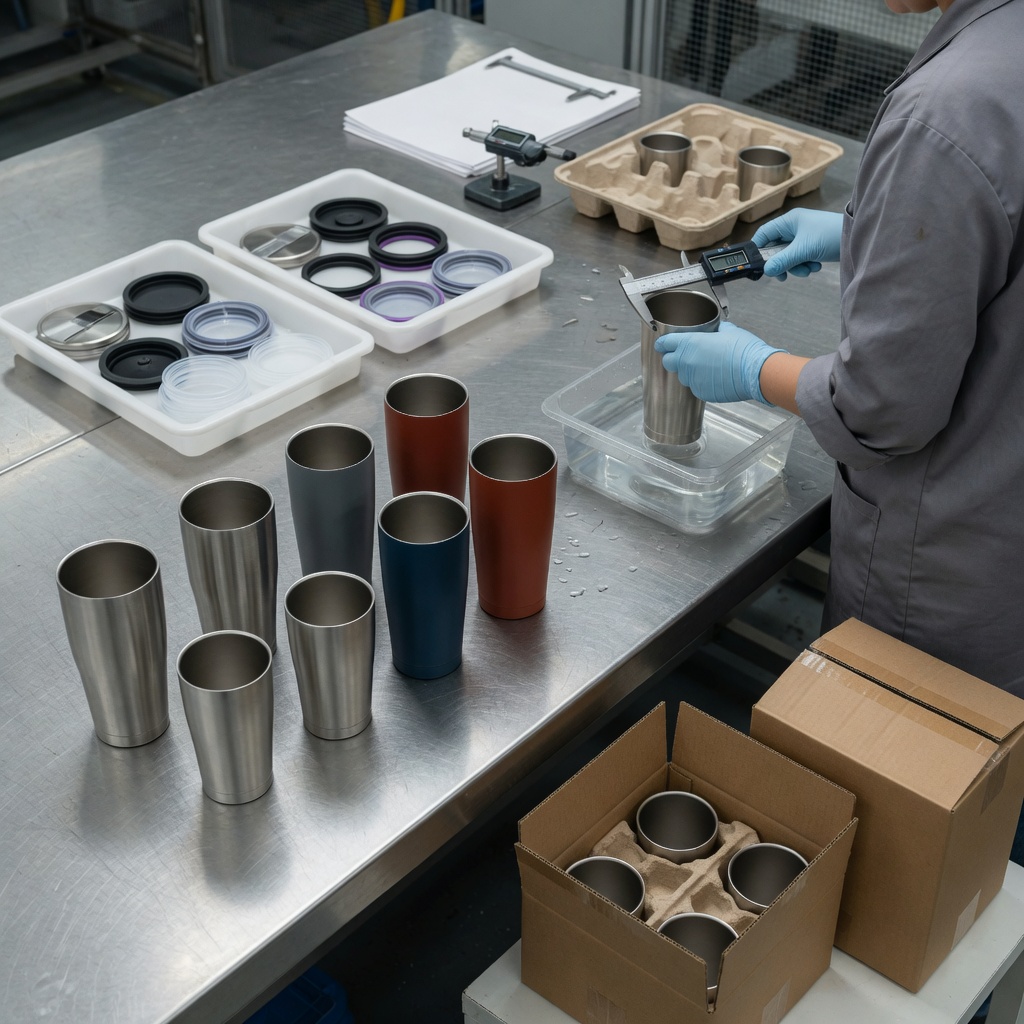
Direct answer. Tumbler wholesale supplier production scalability planning for Europe is the pre-award comparison of written factory capacity for tumbler wholesale supply against a frozen article and a named first-delivery country. Freeze four artifacts: a modular SKU architecture, a volume-break table, a dated weekly factory slot, and destination-specific food-contact files. Compare those artifacts across suppliers. A trial quote is not evidence that cycle time, defect allowance, and the ship window will hold at scale for a named EU member state, a named EEA country, or the UK.
Byline: Vincent Xi, Editorial Author, BottleForge Industrial. Author profile. This page is research-based procurement editorial for European B2B buyers of tumbler wholesale supply. It does not claim personal factory visits, laboratory tests, awards, certifications, or named-customer results. First-hand manufacturing or testing claims are omitted because they are not part of the approved public author basis.
Decision path. Specify the frozen article and first-delivery country. Compare weekly output, changeover loss, volume breaks, and document packs. Verify samples from the production tool plus files that match the bill of materials. Approve a slot letter and mix-freeze date. Order only on a purchase order that names the first-delivery country.
Evidence snapshot (source-tagged; re-verify in the RFQ).
- Order-size band: 500 to 50,000 finished tumbler units per order — published claim on the Haers tumbler wholesale-price page; unit: finished tumbler units per order; scope: that factory page’s stated flexible-line range; as-of date not extractable from the supplied excerpt. Not a BottleForge capacity, price, or calendar promise (Haers tumbler wholesale price article).
- Origin planning calendar: start at least four months before the ship-ready need date to cover mold work, samples, and shipping — same Haers page; unit: months; scope: origin mold, sample, and shipping work, not EU, EEA, or UK clearance; as-of date not extractable from the supplied excerpt.
- Process spine: seven named stages — forming, vacuum processing, coating, assembly, inspection, packing, and multi-SKU coordination — listed on the Golmate custom tumbler manufacturer page; undated excerpt; use as an audit checklist, not as a control plan attached to your order (Golmate custom tumbler manufacturer page).
A distributor-oriented OEM article describes scaling through one core mold, multiple colors, shared lid components, flexible decoration, unified cartons, and longer material agreements rather than redesigning every SKU (Insulflask OEM insulated tumbler scaling article). Copy that architecture into RFQ language. Do not treat the article as proof that any unnamed factory already runs it.
Production scalability planning for tumbler wholesale supply
When a European importer evaluates a tumbler wholesale supplier, production scalability planning matches the forecast to bottlenecks that can be named on paper: body tools, vacuum equipment, coating queues, lid inventory, inspection sampling, and packed-carton output. Insulated tumbler output is not a straight line. The RFQ should force a yes-or-no on three factory-physics questions: is a new colorway only a coating changeover; does a new diameter need a new body-forming tool and vacuum fixture; can a new lid stall assembly even when bodies are in stock.
Wholesale programs fail in two predictable ways. Merchandising sells a wide SKU set against a line that has only run a narrow set. Or the 500-unit trial (Haers published lower band; unit: finished tumbler units per order; as-of date not extractable from the supplied excerpt; re-verify) is treated as proof that a much larger fill will keep the same cycle time. Scalability means the approved article can be repeated at a stated weekly output, a stated defect allowance, and a stated changeover loss, through a named production window, to a named European place under a named Incoterm.
Ask for three calendars, each in working days or weeks:
- Specification and sample freeze (factory physics; not Europe-specific).
- Mass-production slot including coating and assembly (factory physics; not Europe-specific).
- Origin handling plus main-leg transit to the first-delivery country (the only calendar that is route-specific to Europe).
Write weekly units, not a single lead-time slogan. Name the destination market on every RFQ line: EU member state, EEA country, UK, or another named European country. Do not print “Europe” alone on the purchase order.
Modular OEM architecture: molds, shared lids, decoration, and cartons
The Insulflask OEM guidance frames modular expansion as the efficient path: one core mold, multiple color options, shared lid components across SKUs, flexible logo printing methods, unified carton structures, and long-term material sourcing agreements. Keep slow assets (body dies, vacuum jigs, lid tools) stable while variety moves into color, print, and sleeve. That is a checklist for the offer, not a certificate that any unnamed factory already runs this model.
Specify these trade-offs in the RFQ:
- Body tool versus merchandising SKU. Different capacities (state each in millilitres, ml) are separate forming tools if diameter and height differ. Confirm whether tools already exist, who pays for new tools, who holds title, and whether the quoted sample is from the production tool.
- Lid commonality. Shared lids reduce safety stock and assembly changeover. Unique lids can support a higher wholesale price but multiply gaskets, sliders, and leak-test fixtures. The bill of materials must flag every unique lid and seal.
- Decoration method. Screen, transfer, laser, and UV have different minima and color-change times. Flexible printing can support short campaign runs; it does not replace a frozen print-area drawing.
- Carton unity. Common inner trays and outer cartons let mixed-SKU pallets fill without a packaging redesign. Require outer dimensions, packed weight (kg), units per carton, cartons per pallet, and stack height as measured data on the offer.
- Material agreements. Stainless coil, lid polymer, and coating chemistry drive both food-contact files and color stability. A volume plan without named grades is not scalable.
MOQ bands, volume breaks, and changeover trade-offs
Use the Haers order-size band and origin calendar in the evidence snapshot as RFQ starting points, not as BottleForge terms. Re-verify both as current commercial offers. Scope for the quantity range: finished tumbler units per order as claimed by that factory page. Unit for the calendar claim: months before the ship-ready need date, covering mold, samples, and shipping—not EU, EEA, or UK clearance.
- Trial quantity versus scale quantity. A 500-unit test (Haers published lower band; finished tumbler units per order; undated excerpt; re-verify) can check leak, coating, and print. It will not expose furnace or vacuum queues. A 50,000-unit drop (Haers published upper band; finished tumbler units per order; undated excerpt; re-verify) amortizes setup and metal yield loss but concentrates stock risk in the importer’s warehouse in the named European country.
- Volume-break table. “Cheaper at scale” is not a number. Example calculation/assumption to verify in the supplier quote, not a benchmark: net price, setup charge, and production days at 500, 3,000, 10,000, and 30,000 units of one frozen body and lid, one color, one decoration. If the factory cannot quote those four points, it cannot support production scalability planning.
- Changeover tax. Example assumption to verify in the quote, not a measured result: an order that totals 20,000 units may be twenty 1,000-unit color runs. Require hours or shifts lost per color and per lid swap.
- Cash versus slot. Booking about four months out (cited Haers hypothesis; unit: months; scope: mold, samples, and shipping; as-of date not extractable) trades forecast error for capacity. Record postpone, cancel, and deposit terms against the reserved week.
None of the cited pages publish a euro unit price, freight, or duty. Any landed-cost worksheet for Europe is an example calculation until the quote lists Incoterm charges, main freight, insurance, duty, and VAT treatment for the importer of record.
Process controls to evaluate: forming through multi-SKU packing
Golmate’s page (undated excerpt) describes repeatable stainless tumbler production across capacities, lid structures, handles, and finishes, using the seven-stage spine in the evidence snapshot. Use that spine as an audit list, not as a certificate of BottleForge or of any unnamed factory. A process list on a manufacturer page is not a current control plan attached to your order.
- Forming. Ask for a rim/sidewall/base thickness map on the golden sample and mill certificates for the agreed stainless grade. Specify the grade and capacity (ml); do not assume either.
- Vacuum processing. Insulation is a process result. Name the test method, apparatus, and acceptance limit in the RFQ. Do not copy a marketing hour-claim without those three fields.
- Coating. Freeze the color standard (Pantone or a physical plaque), adhesion checks, and recoat rules. Require documented changeover hours per color.
- Assembly. Lids and silicone gaskets create leak paths. Ban food-contact polymer changes without a new declaration of compliance.
- Inspection. Name the sampling plan (AQL or equivalent) and whether third-party inspection may hold the shipment.
- Packing. Unified cartons, agreed drop-test assumptions, and label fields for the destination country.
- Multi-SKU coordination. Ask how colors and lids are sequenced inside one purchase order and how mixed-lid cartons are prevented.
Convert “consistent materials” and “controlled production” into artifacts: specifications, a control plan, batch traceability, packed-carton photos per SKU, and a named planner who owns the ship window to the named European place.
Factory slots and first-delivery calendars for Europe
The four-month start cited for mold, samples, and shipping is a planning hypothesis from the Haers page (undated excerpt; unit: months; scope: origin mold/sample/shipping work, not destination clearance). Tumbler wholesale supply into Europe then adds steps those factory pages do not price: export documents, ocean or rail main-leg, destination handling, and optional VAT or warehouse treatment in a named country. Confirm those steps with the importer of record; this page is not tax or customs advice.
Do not apply one rule to all of Europe:
- EU member states share a customs union. Release in one member state does not finish retail or extended producer responsibility (EPR) duties in another. Food-contact rules are largely EU-level; packaging EPR, consumer-facing language, and warehouse VAT are national.
- EEA (Norway, Iceland, Liechtenstein) applies much of the EU goods framework, but import formalities, VAT, and EPR stay national. Do not file an EU-only document set as if it were automatically complete for an EEA importer.
- United Kingdom is outside the EU and EEA. Food-contact and chemicals files are separate. Dual-channel wholesale needs two evidence packs or an explicitly dual-agreed article, plus separate EORI/VAT identities.
- Other European countries (Switzerland, for example) are not EU members. Name them if they are in scope. Do not assume EU documents suffice.
Do not assume a single European peak month. If hospitality or retail has a named intake week, reserve the factory slot to that week. Coat and vacuum capacity fills on the factory calendar, not on the buyer’s internal deadline. Reserve a slot as units per week with a freeze date after which SKU-mix changes are re-quoted. Example assumption to verify in the quote: show sample loops, mass-production working days, and a separately quoted main-leg to the named port or warehouse as three lines—do not invent transit days in this article. If a recovery quantity is required, ask for air versus ocean as separate quoted lines for a stated unit count; do not assume air can replace a 50,000-unit program (Haers published upper band; finished tumbler units per order; undated excerpt) at an acceptable landed cost.
Example named places to confirm in the offer, not assumed routing: origin port FOB versus DAP a warehouse serving Rotterdam, Antwerp, Hamburg, or Gdansk (EU ports) or Felixstowe (UK). Do not treat a UK port booking as an EU customs entry, or the reverse.
Food-contact, chemicals, and packaging files: EU, EEA, and UK
This section is an RFQ evidence list, not a complete legal opinion and not a claim that BottleForge or any cited factory is certified. A regulation’s legal requirement is not the same thing as a factory’s internal QC checklist. Use current official texts and the importer’s counsel; legal instruments are amended.
- Food contact (EU). Goods placed on the EU market must meet the food-contact framework in Regulation (EC) No 1935/2004. Plastic lids, seals, and some coatings may also fall under plastics Regulation (EU) No 10/2011 when they are plastic food-contact materials. Request a declaration of compliance for the finished tumbler as used (interior, coating, lid, gasket) and supporting test reports from a laboratory the buyer accepts.
- Chemicals. EU REACH (EC 1907/2006) and UK REACH are different systems. Ask for SVHC communication where it applies. Do not file an EU REACH statement as a UK REACH statement.
- EEA. Confirm with the importer which EU-form documents are accepted and which national extras apply.
- UK. Specify the UK as its own destination. A passive insulated tumbler is not automatically a CE- or UKCA-marked category; do not invent marks unless a directive actually applies to an added feature.
- Packaging EPR. Schemes are country-specific (Germany’s packaging registration is not France’s). Name the first-destination country and collect material and weight data for the importer of record. Unified cartons help the warehouse; they do not replace national filings.
Do not imply certification without a current document attached to the order. Put the destination market on every purchase-order line. If one program serves both an EU member state and the UK, require two evidence packs or a written dual-market article definition.
Buyer decision table for tumbler production scalability planning
| Decision factor | Specify in the RFQ | Scalability signal to compare | Verify or approve before order | Europe-market note |
|---|---|---|---|---|
| Core body tool | Capacity (ml), stainless grade, thickness map, tool owner | Existing tool vs new tool; shared diameter family | Tooling title clause; sample from the production tool | Tool lead time sits inside the cited four-month hypothesis; it is not EU-specific |
| Lid and gasket set | Geometry, polymer grade, leak-test method | Shared lid across SKUs vs unique lid | Golden-sample freeze; no-substitution clause | Plastic lids drive EU 10/2011-type evidence when applicable; keep a UK file separate |
| Color and coating | Color standard, coating type, max SKUs per PO | Documented changeover hours per color | ΔE tolerance and rework rule | Extra colors after freeze can miss the named EU/EEA/UK window |
| Decoration | Print-area drawing, method, ink or laser spec | Method that supports short campaign runs without new jigs | Adhesion check on the decorated article if a durability claim is made | Consumer-facing language is national; freeze translations |
| Order band | Units per SKU and per PO | Written prices at 500 / 3,000 / 10,000 / 30,000 units (example bands to verify) | Signed volume-break table with validity dates | State the EU, EEA, or UK warehouse that will hold stock |
| Factory slot | Units per week, start week, freeze date | Named weekly capacity, not “open capacity” | Slot letter with postpone/penalty terms | Align to the buyer’s named destination intake week, not only origin holidays |
| Process control | Forming, vacuum, coating, assembly, inspection, packing, multi-SKU | Control plan plus sequencing SOP | Hold points and AQL (or equivalent) | Origin inspection does not rewrite Incoterm liability into Europe |
| Food-contact file | DoC plus test reports for the finished article | Reports that match the production BOM | Buyer legal review for EU vs UK vs EEA | Do not reuse an EU file as a UK file without review |
| Pack-out | Carton ID, units per carton, pallet pattern, label fields | Unified structure across SKUs | Measured packed-carton data; agreed drop assumptions | EPR data is for the importer in the first-destination country |
| Logistics | Incoterms, named European place, document set | Critical path split: factory days vs main-leg days | Draft transport fields; SKU-accurate packing list | EU customs union is not UK customs; EEA entry is not “EU” |
RFQ checklist for production scalability planning
Every item should appear in the written offer so you can specify, compare, verify, approve, or order.
- Destination market line. EU member state, EEA country, UK, or another named European country.
- Article freeze. Body capacity (ml), stainless grade, drawings, lid BOM, coating, decoration file, packed-carton spec, each with a revision date.
- Sample ladder. Golden sample, pre-production sample from the production tool, and first-article from the reserved slot, each with accept/reject rules.
- Modular architecture. Which SKUs share the body tool, which share the lid, which are unique; tool title and amortization if a new tool is required.
- Volume-break table. Net price, production days, and setup at 500, 3,000, 10,000, and 30,000 units (example bands to verify) for the frozen article, with quote validity dates.
- Capacity slot. Weekly output in finished tumbler units, start week, coating/decoration queue, freeze date for mix changes, postpone and cancel terms.
- Changeover data. Hours or shifts lost per color and per lid swap; maximum SKUs allowed inside one production week.
- Critical path. Sample loops, any mold work, mass production, origin inspection, ship-ready date. Confirm or replace the cited four-month hypothesis with dated working-day counts.
- Incoterms and named place. Example places to verify: FOB origin port, or DAP a named warehouse serving Rotterdam, Antwerp, Hamburg, or Gdansk (EU) or Felixstowe (UK). Split factory days from main-leg days.
- Food-contact pack. Declaration of compliance and test reports for interior, coating, and lid/gasket under the destination regime (EU 1935/2004 framework and applicable plastics measures; separate UK pack if UK-bound). State the language the importer’s broker accepts.
- Chemicals pack. EU REACH versus UK REACH as applicable; SVHC communication if required. Do not cross-file the two systems.
- Packaging EPR data. Component weights and materials for the importer’s filing in the first-destination country.
- QC plan. Sampling standard, leak-test method, coating and decoration checks, third-party hold yes/no, hold points before ship.
- Multi-SKU control. Sequencing, carton labels that prevent mixed lids, packed-carton photos per SKU before ship.
- Material traceability. Mill certificates and batch codes on the packing list; no-substitution clause for lid polymer, coating, and steel grade.
- Broker-ready documents. Invoice, packing list, and DoC that match SKU codes, quantities, and the named destination.
- Repeat-order clause. Reorder lead time, price-validity window, and a quality gate from the first landing in the destination market before a scaled follow-on purchase order.
How this guidance was derived, and what to verify
Source contexts. Insulflask’s OEM article is a distributor product-line guide for modular insulated tumblers (core mold, shared lids, decoration flexibility, unified cartons, material agreements). Golmate’s product-type page is a manufacturer capability narrative listing seven process stages and multi-SKU coordination. Haers’ article is factory-facing wholesale-price advice that includes the 500–50,000 unit range (finished tumbler units per order as claimed), a qualitative cost-threshold remark, and a four-month procurement start (months covering mold, samples, and shipping). All three are public marketing or education pages, not independent audits and not BottleForge production records.
Method. This editorial synthesizes those pages with the named EU and UK legal instruments for food-contact materials and chemicals, then recasts them as RFQ fields a European buyer can specify, compare, verify, approve, or order. Example quantity bands and example ports are labeled for verification in the supplier quote. No unpublished test, customer name, or factory capacity is used.
Limits. The supplied excerpts have no reliable publication date or laboratory report numbers. Whether any factory still accepts 500–50,000 units, still quotes a four-month path, or still shares lids across SKUs must be confirmed in writing. Europe is not one customs or EPR regime: EU, EEA, UK, and other European countries are not interchangeable on the purchase order. Legal texts are amended; use the current Official Journal or UK official publication and the importer’s counsel. This article does not certify BottleForge or any cited supplier, does not publish a price, and does not report a tested lead time.
Editorial attribution: Vincent Xi, Editorial Author, BottleForge Industrial. Profile: https://bottleforge.com/authors/vincent-xi/. First-hand manufacturing or testing claims are omitted because they are not part of the approved public author basis.
Discuss Your Requirements
Review our manufacturing capabilities, then share your specifications for a supplier-fit review.