Tumbler Wholesale Supplier Minimum Order Quantity for United States Buyers
By Vincent Xi, Editorial Author
For a United States B2B buyer, a tumbler wholesale supplier minimum order quantity is usable only when the supplier states exactly what must reach the threshold. A headline MOQ can conceal separate minimums for the body model, capacity, color, artwork, decoration process, packaging version, component, or shipment. The RFQ must expose each applicable layer.
Compare suppliers against one frozen tumbler specification and SKU allocation. Evaluate the resulting inventory commitment and landed cost per accepted sellable unit, not just the smallest published quantity or lowest product price. Before award, require a completed MOQ matrix, itemized costs, specification exceptions, labeling evidence, delivery milestones, inspection terms, change controls, and remedies for nonconforming goods. Use the practical RFQ checklist below as a mandatory supplier return schedule.
The cited commercial pages provide supplier-published examples and sourcing context. They do not establish current BottleForge minimums, prices, specifications, inventory, lead times, compliance status, or certifications.
United States Tumbler Minimum Order Quantity: Define the Quote Scope
Use a separate RFQ row for every sellable SKU. The supplier should mark each field with a stated threshold or not applicable; a blank field is unresolved, not zero.
| MOQ scope | Question the supplier must answer | Procurement effect |
|---|---|---|
| Total purchase order | Can unlike SKUs be combined to reach the aggregate minimum? | Establishes whether the headline quantity has any practical value across the planned assortment |
| Model and capacity | Does each body, capacity, lid, straw, or handle configuration require a separate batch? | Exposes configuration-level inventory commitments |
| Color and finish | Does each coating color, texture, or finish have its own minimum or batch increment? | Identifies excess color inventory and unfinished-material exposure |
| Artwork and decoration | Is the minimum applied by artwork file, print position, decoration process, or setup? | Identifies additional setup charges and artwork-specific inventory |
| Components | Are lids, straws, gaskets, handles, inserts, or replacement parts subject to separate purchase quantities? | Reveals residual component liability |
| Packaging | Is there a separate minimum for each unit box, insert, label, carton, or channel-specific packout? | Prevents product and packaging quantities from being treated as interchangeable |
| Shipment | Must the full quantity ship together, or can production and delivery be split? | Clarifies storage, title, risk, payment, and remaining-inventory obligations |
| Reorder | Does the reorder threshold differ, and how are retained tooling, materials, and packaging handled? | Prevents the opening-order MOQ from being assumed to apply to later orders |
Attach the supplier-completed matrix to the purchase order. It should show permitted SKU combinations, minimum batch increments, price effects, residual-material ownership, overrun or underrun rules, and every exception to the requested allocation.
What the Supplied Sources Support
These source statements are useful as RFQ prompts, not as market benchmarks or substitute quotations.
| Source and date context | Source-supported data | Proper RFQ use | Unsupported inference to avoid |
|---|---|---|---|
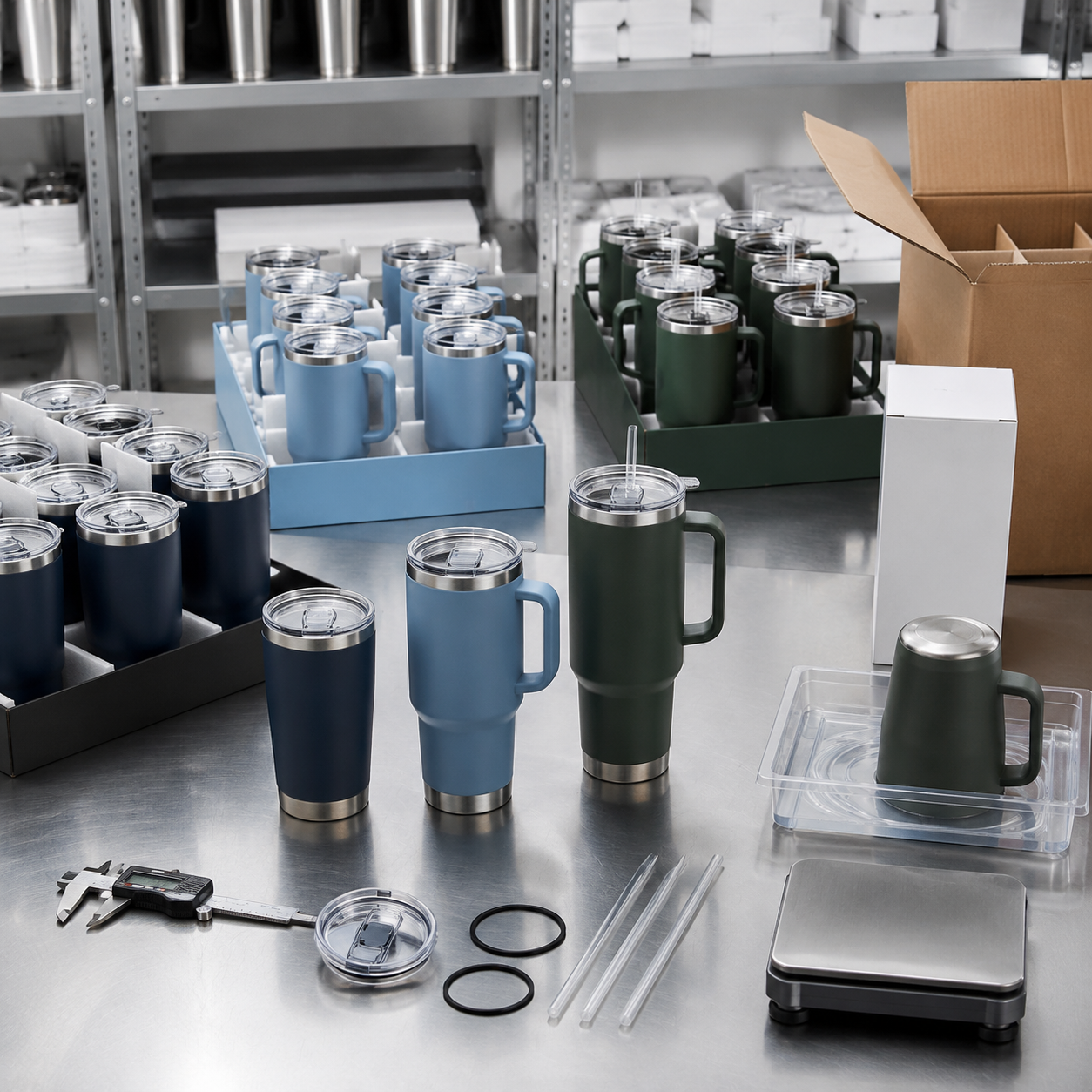
| JOOYO tumbler sourcing article; the page displays a publication date of June 19, 2026 | The page presents nominal 20-ounce commuter, nominal 30-ounce handled, and nominal 40-ounce handled-straw tumbler formats. The units and scope are the source page's stated format examples. | Ask whether capacity, body, lid, straw, and handle changes create separate model or component minimums. | Do not infer measured capacity, dimensions, current availability, performance, price, or another supplier's MOQ. The displayed publication date is not a current quote date. |
| TheBottleChina tumbler category; the supplied page is undated, so no current as-of date is available | The page states that its standard custom OEM/ODM minimum starts at 300 pieces per design and that selected models may start at 100 pieces per design. These quantities apply only to the source page's stated offer scope. | Require the bidder to identify whether its own threshold applies per design, selected model, total order, or another allocation level. | Do not treat either quantity as an industry norm, a BottleForge term, mixed-SKU permission, or a current quotation. |
| TheBottleChina tumbler category; the supplied page is undated, so no current as-of date is available | The page states a production window of 25 to 35 days per wholesale vacuum-flask order after sample approval and deposit receipt. The source does not identify whether those days are calendar or business days. | Ask each bidder to define its timing trigger, day basis, product scope, and included production stages. | Do not convert the source statement into tumbler-specific destination delivery, current capacity, transit, inspection, corrective-work, or customs-clearance timing. |
| Yeway wholesale sourcing article; no numerical benchmark is adopted here | The article provides nonnumerical context about aligning customization, packaging, supply planning, and the buyer's business model. | Test whether the product MOQ creates separate artwork, decoration, component, or packaging commitments. | Do not infer a current tumbler MOQ, specification, price, or delivery term. |
| EverichHydro supplier-selection article; no numerical benchmark is adopted here | The article identifies product price, shipping, setup, and customization charges as cost-comparison categories. | Request those categories as separate quote fields. | Do not treat the categories as a complete landed-cost calculation or evidence of applicable United States import charges. |
Freeze the Tumbler Specification Before Comparing Minimum Order Quantity
Every MOQ tier must price the same revision-controlled product and packout. A lower threshold is not comparable if it changes construction, components, decoration, testing, or packaging.
| Control area | Required quote fields | MOQ decision use |
|---|---|---|
| Product identity | Supplier model, body configuration, lid, straw, gasket, handle, and proposed substitutions | Confirms which configurations share or split a minimum |
| Capacity | Nominal unit in fluid ounces or milliliters, usable or brimful basis, fill method, test-liquid condition, and tolerance | Prevents different capacity definitions from being compared as one model |
| Dimensions and mass | Finished height, body and base diameter, opening dimensions, empty mass, measurement points, unit system, and tolerances | Ties the quantity tier to a measurable physical product |
| Materials | Supplier-declared material for each component, coating, ink, adhesive, and other specified construction details | Identifies material or component changes that may alter the minimum or evidence scope |
| Closure and fit | Assembly orientation, closure engagement, gasket placement, straw fit, test setup, sample selection, and pass criteria | Establishes the approved configuration before volume commitment |
| Performance | Any leak, temperature-retention, adhesion, abrasion, or other claim, including equipment, conditioning, duration, ambient conditions, result, and failure disposition | Keeps performance claims tied to a defined method and quoted revision |
| Decoration | Artwork revision, color reference, process, measured size, location, orientation, appearance limits, and durability method | Exposes artwork- and process-specific minimums |
| Packout | Protective material, unit package, insert, carton configuration, carton dimensions and mass, and pallet requirements | Identifies packaging inventory that may remain after the product order |
| Quality plan | Lot definition, sample selection, defect categories, acceptance rule, records, reinspection, and corrective action | Defines how accepted sellable units will be determined |
Terms such as standard quality or food grade are not measurable acceptance criteria by themselves. If a supplier names a standard, require the exact title, edition, relevant scope, and evidence. The evidence register should distinguish an applicable legal requirement identified by the buyer's qualified reviewer, a contractual buyer requirement, and the supplier's own practice. Do not describe a product, supplier, or facility as certified without a current document whose stated scope covers the quoted model, construction, and relevant site.
United States Labeling Evidence Before MOQ Release
Packaging can create its own minimum and become unusable if label content changes after production. Hold packaging commitment until the buyer's designated compliance owner has approved the revision-controlled files.
No United States government or regulator source is included in the supplied citations. This article therefore does not determine which marking, warning, instruction, test, or document is legally required for a specific order. Applicability should be confirmed for the exact product, claims, origin, importer structure, and sales channel by the buyer's qualified compliance adviser, customs broker, retailer, marketplace contact, or laboratory, as appropriate.
| Control | Supplier submission | Buyer verification |
|---|---|---|
| Product and component identity | Model- and revision-linked declaration for the body, lid, straw, gasket, handle, coating, ink, and adhesive | Confirm that the declared scope matches the components ordered |
| Reports and certificates | Complete document showing issuer, issue date, model, material, color where relevant, test scope, result, and limitations | Record scope gaps and obtain a current document where required; do not extend coverage by assumption |
| Import and origin proposal | Proposed product, unit-package, and carton markings | Obtain qualified confirmation of applicable content, placement, permanence, and responsible-party details |
| Claims, warnings, and care | Proposed claim, warning, instruction, and care language | Approve only wording supported for the intended United States sale |
| Barcode and channel labels | Buyer-controlled data file and supplier proof | Confirm data accuracy, ownership, placement, legibility, scan result, and channel acceptance |
| Packout proof | Preproduction proof and packed reference sample tied to the packaging revision | Approve before the supplier commits to the packaging minimum |
| Change control | Written notice of any proposed material, source, process, artwork, label, or package change | Require written buyer approval before implementation |
Freeze the approved artwork, label files, revision identifiers, and packout reference in the purchase order. A generic facility document or report for another model does not close a product-specific evidence gap.
Compare MOQ by Landed Cost per Accepted Tumbler
Use the same specification, SKU allocation, currency, quote date, delivery point, and cost boundary for every tier:
Landed cost per accepted sellable unit = (goods + setup + tooling allocation + samples + packaging + inspection and reinspection + origin handling + freight + insurance + buyer-verified import charges + brokerage + destination handling and delivery + expected rework or replacement cost) / accepted sellable units
Request each charge separately. Record quote validity, payment timing, exclusions, freight basis, named delivery place, and the quantity basis for ordered, produced, shipped, invoiced, inspected, accepted, rejected, and replacement units. The buyer's customs broker or another qualified party should verify classification, origin treatment, and applicable import charges for the exact order.
Illustrative RFQ calculation only: Every value below is a hypothetical assumption, not supplier pricing or market data. Replace each input with a dated supplier quote and buyer-verified logistics and import data before making a purchase decision.
| Input | Example assumption to verify |
|---|---|
| Quantity | 1,200 ordered units per order and 1,200 accepted sellable units per order |
| Product and standard packaging | US$6.40 per ordered unit |
| Artwork setup | US$180 per order |
| Samples | US$120 per project |
| Freight, applicable import charges, brokerage, and destination delivery | US$2,760 per shipment |
| Independent inspection | US$420 per production lot |
Under those example assumptions, goods cost is US$7,680 per order. Total landed cost is US$11,160 per order, or US$9.30 per accepted sellable unit. The example assumes no rejected units, storage, financing, markdown, rework, or replacement cost.
Run the calculation separately for each quoted tier. Add the buyer's approved assumptions for residual components, excess packaging, storage, financing, markdown exposure, obsolescence, and reorder timing. Hold a comparison if a tier changes the specification or omits a cost category.
Tie Delivery Scope to the Quoted Tumbler MOQ
A published production window is not a destination-delivery commitment. Require the supplier to separate each milestone and name the event that starts and completes it.
| Milestone | Required RFQ response |
|---|---|
| Sample readiness | Sample type, cost, dispatch event, approval process, and differences from production |
| Production trigger | Required payment, approved sample, artwork, label, packaging, and other dependencies |
| Materials and packaging | Availability, buyer-supplied dependencies, separate timing, and packaging approval status |
| Production completion | Supplier-controlled target, capacity assumptions, day basis, and completion event |
| Inspection | Readiness notice, booking access, records, failure disposition, corrective action, and reinspection timing |
| Cargo handoff | Cargo-ready event, export handling, shipping mode, required documents, delivery term, named place, and responsible party |
| Transit and clearance | Routing assumption, carrier estimate, document responsibility, and customs dependencies |
| Destination delivery | Named destination, appointment or unloading responsibility, delivery evidence, and excluded charges |
Obtain current timing for the controlled tumbler specification. Confirm whether materials, packaging, inspection, corrective work, transit, clearance, and destination delivery are included or excluded.
For split deliveries, require written terms for storage charges, title and risk, release notice, remaining-inventory liability, insurance, final shipping deadline, and any price or packaging effect. The supplier should also state whether the MOQ refers to a production batch, invoice, shipment, or total contracted quantity.
Practical Tumbler RFQ Checklist and Award Rule
Send this checklist with the controlled specification and require the supplier to complete every item. Treat an unchecked item, blank field, or unsupported response as unresolved rather than accepted.
- [ ] Quote identity completed: Supplier legal entity, manufacturing location, payment recipient, quote date, currency, validity, payment milestones, and exclusions are stated.
- [ ] Controlled specification acknowledged: Product, component, finish, decoration, and packout revision identifiers are listed, with every supplier exception disclosed.
- [ ] SKU allocation completed: Model, capacity, lid, straw, gasket, handle, color, artwork, package, requested quantity, and applicable MOQ rule are entered for each sellable SKU.
- [ ] MOQ matrix completed: Minimums are stated by total order, model, component, color, artwork, decoration process, package, shipment, and reorder, with permitted combinations identified.
- [ ] Quantity rules completed: Treatment of ordered, produced, shipped, invoiced, inspected, accepted, rejected, replacement, overrun, and underrun units is defined.
- [ ] Evidence register attached: Each claim or requirement is linked to the issuer, document title, issue date or version, model and material scope, relevant pages, result, limitation, and unresolved gap.
- [ ] United States review package attached: Proposed markings, claims, warnings, care instructions, barcode and channel labels, material declarations, and scope-matched reports are included for buyer review.
- [ ] Cost schedule itemized: Goods, setup, tooling, samples, packaging, inspection, origin charges, freight, insurance, import charges, brokerage, and destination delivery are separately stated or marked
not applicable. - [ ] Landed-cost basis defined: Delivery term, named place, cost exclusions, ordered-unit basis, and accepted-sellable-unit basis are stated for each quoted quantity tier.
- [ ] Milestone schedule completed: Start trigger, materials, packaging, production, inspection, cargo handoff, transit, clearance, and named-place delivery assumptions are listed.
- [ ] Inspection controls accepted: Lot definition, inspection access, sample selection, defect categories, acceptance rule, records, failure disposition, and reinspection responsibility are confirmed.
- [ ] Change controls accepted: No material, source, process, artwork, label, component, or packaging change may be implemented without written buyer approval.
- [ ] Remedies accepted: Rework, replacement, credit, rejection, short shipment, corrective action, and related cost responsibility are defined.
- [ ] Purchase-order attachments acknowledged: The supplier confirms that the final specification, SKU allocation, MOQ matrix, approved proofs, evidence register, delivery schedule, and quality plan form part of the order.
Pass a quote only when the supplier prices the frozen specification, defines every applicable MOQ layer, supplies the required evidence, itemizes the agreed landed-cost boundary, and accepts the delivery, inspection, change-control, and remedy terms. Hold a quote with a blank, inconsistent, expired, unsupported, or out-of-scope material field. Decline when the supplier will not define the MOQ basis, disclose exceptions, permit agreed inspection, control changes, or acknowledge the purchase-order attachments.
Among quotes that pass, select the tier that fits the buyer's documented forecast, cash limit, inventory tolerance, and delivery requirement. The appropriate tier is not automatically the lowest minimum order quantity or product price.
Evidence Method, Limitations, and Verification
Methodology: The evidence review was limited to the supplied webpages. Numerical statements were retained only with their stated unit, offer scope, source, and available page-date context. The JOOYO page supplied its displayed publication date and nominal capacity-format examples. The undated TheBottleChina page supplied its own MOQ and production-window statements. The Yeway and EverichHydro articles supplied nonnumerical RFQ context for customization, packaging, supply planning, and cost categories. Supplier-published statements were not averaged, extrapolated, or relabeled as market benchmarks. The specification, labeling, cost, delivery, checklist, and contract tables are buyer-defined RFQ controls, not claims about a supplier's current capability.
Limitations and verification: The commercial pages can change, and no common retrieval date was supplied. No current supplier quotation, physical sample, purchase contract, component declaration, scope-matched certificate, test report, freight booking, customs entry, or inspection record was available for independent validation. No cited United States regulator source establishes legal applicability for a proposed product or label. Before commitment, verify the exact model and revision, allocation-level MOQ, component and packaging availability, quote validity, currency, tooling, evidence scope, labeling, import treatment, test methods, production timing, delivery assumptions, inspection rights, and remedies. Replace every illustrative calculation input with quoted and buyer-verified data.
Experience note: BottleForge Industrial's author profile identifies Vincent Xi as an Editorial Author. The approved profile provides no basis for a first-person claim about factory visits, product testing, manufacturing, purchasing, client work, or customer outcomes, so no such experience claim is made.
Discuss Your Requirements
Review our manufacturing capabilities, then share your specifications for a supplier-fit review.