Tumbler Sourcing Sample Approval for Procurement in Europe
By Vincent Xi, Editorial Author
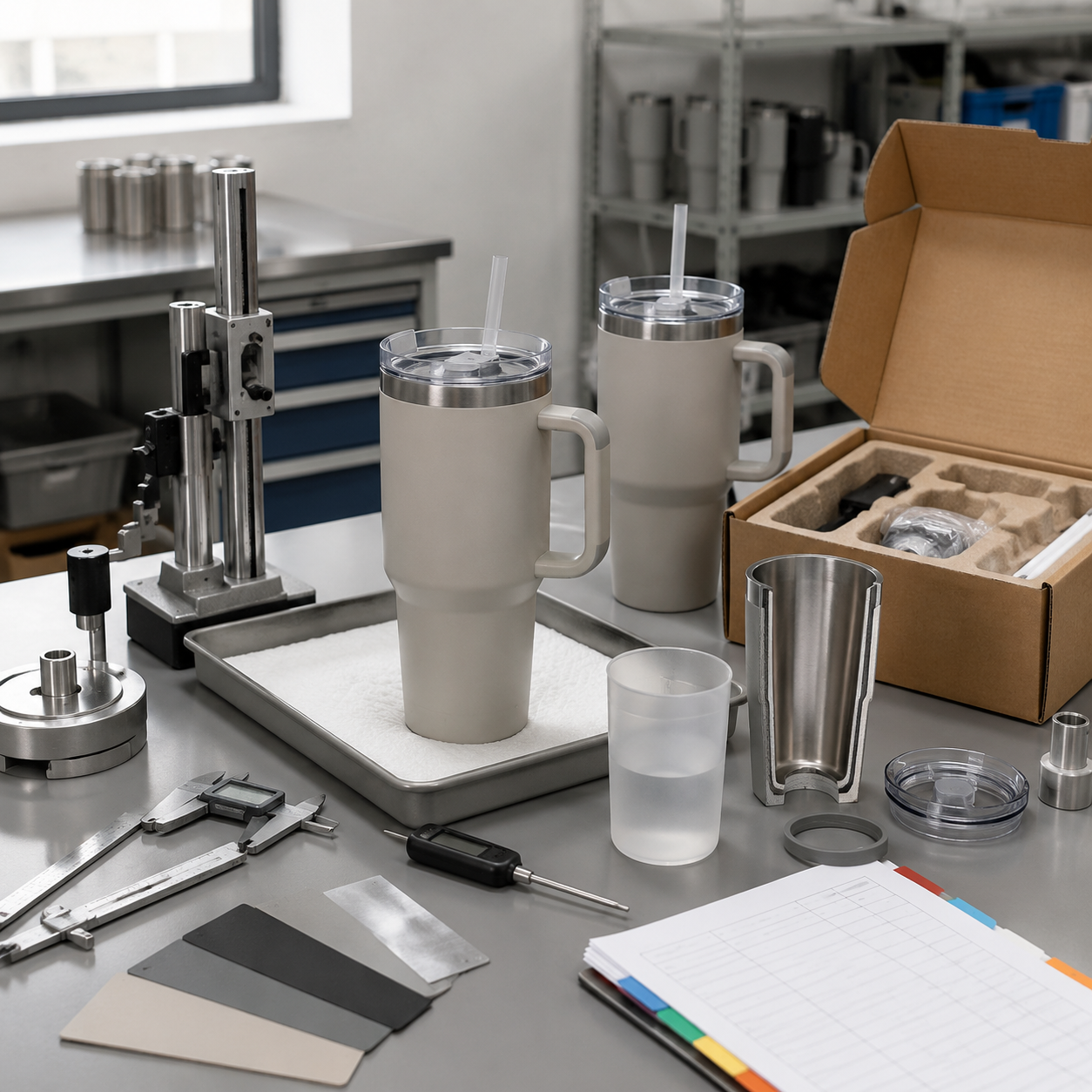
For tumbler procurement in Europe, sample approval is the release decision between a controlled RFQ and bulk production. A physical sample is not sufficient on its own. The approved unit should be traceable to the same model code, quote, drawing, bill of materials, artwork, test records, packaging specification, and destination evidence intended for the purchase order.
Europe should not appear as a single compliance line in the approval record. Create separate review lines for intended EU destinations, non-EU EEA destinations, the UK, and any country-specific requirement. A supplier statement describing a tumbler as Europe-compliant should remain unaccepted until the responsible importer or adviser has reviewed the exact product, component scope, documents, and destination.
Use approved, conditionally approved, or rejected as controlled procurement outcomes. These are buyer-defined release statuses, not regulatory findings or certification categories.
Tumbler Sample Approval Decision for Europe
The decision should state whether bulk production may proceed and identify the exact revision covered by that decision.
| Outcome | Decision rule | Required record | Bulk status |
|---|---|---|---|
| Approve | Mandatory RFQ criteria pass, required evidence is linked to the submitted revision, and accepted deviations have been incorporated into controlled purchase documents | Approval form, sample identifier, controlled file references, results, destination-review status, and retention instruction | May proceed under the approved specification and commercial terms |
| Conditionally approve | A defined issue remains open, but the required correction, owner, closure evidence, and resampling decision have been recorded | Deviation record, affected requirement, required proof, due point, and release condition | Blocked until closure evidence is accepted or the purchase documents are formally amended |
| Reject | The sample differs from the RFQ, fails an agreed test, lacks traceability, or cannot support the intended destination review | Failed criterion, observed result, corrective request, and resubmission scope | Blocked |
A catalogue unit can support an early review of shape or handling. It should not become the final control sample unless its disclosed materials, construction, components, finish, decoration, and packaging represent the quoted bulk configuration.
Keep release blocked when a mandatory RFQ item has any of these gaps:
- The sample identifier does not connect to the current quote, drawing, bill of materials, or artwork.
- Differences between the sample and planned bulk production have not been disclosed.
- A test record omits the method, conditions, unit, sample identifier, date, result, or issuing party.
- A declaration or report cannot be linked to the relevant body, lid, gasket, straw, coating, ink, or adhesive.
- A deviation has no owner, closure evidence, or stated effect on production.
- Packaging is a placeholder rather than the requested production-intent packout.
- Destination evidence has not been reviewed by the responsible importer, laboratory, or adviser.
Freeze the Sample Approval Baseline in the RFQ
Send candidate suppliers the same controlled baseline. Define the intended European sales channel and tumbler use, then state the capacity definition, body profile, handle or grip arrangement, lid system, removable components, finish, decoration area, and production-intent packout.
A wholesale drinkware article notes that packaging, branding, and product priorities vary with the buyer's business model. That context supports defining the channel and packout before sampling, but it does not establish a suitable tumbler configuration for a particular order (wholesale drinkware source).
Require the supplier to classify each unit as a catalogue reference, appearance sample, functional sample, or production-intent sample. These are procurement labels for the RFQ, not externally defined certification categories. The RFQ should state which sample stage is eligible for final approval.
Each submitted unit should be linked to:
- Buyer model code and RFQ revision.
- Supplier quote and model reference.
- Drawing and bill of materials revision.
- Body, lid, gasket, straw, valve, and accessory configuration where applicable.
- Finish, colour reference, decoration process, and artwork revision.
- Sample production date and production site stated by the supplier.
- Packaging specification revision.
- Declared differences involving tooling, material, component source, process, subcontractor, production site, or packaging.
Ask the supplier to return the controlled specification with every requirement confirmed, corrected, or marked as an exception. Treat a blank response as unresolved rather than as acceptance.
Verify Commercial Inputs Before Sample Approval
The cited commercial figures have different product scopes, page-date contexts, and schedule triggers. They are supplier statements rather than European market benchmarks. Verify each figure in a current, dated quote for the requested tumbler revision.
| Cited figure | Unit, scope, date context, and source | Procurement use |
|---|---|---|
| Minimum of 300 pieces per colour | Unit: pieces per colour. Scope: powder coating for the wine-tumbler configuration described on the supplier page. Date context: the page displays 11 June 2026. Source: wine-tumbler supplier page | Request the current MOQ by approved SKU, colour, finish, and decoration. Do not apply this supplier figure to another configuration. |
| Lead time of 18-22 calendar days | Unit: calendar days. Scope: the powder-coated wine-tumbler configuration described on the supplier page, with timing stated to begin at artwork approval. Date context: the page displays 11 June 2026. Source: wine-tumbler supplier page | Make the quote identify whether timing starts at artwork approval, sample approval, payment, material confirmation, or another event. |
| Typical order range of 500-5,000 pieces per SKU | Unit: pieces per SKU. Scope: the stainless-kitchenware supplier's stated typical order range, not a quote for the tumbler under review. Date context: no publication or update date was provided in the reviewed source context. Source: stainless-kitchenware supplier page | Treat the range as an undated supplier statement and obtain a current MOQ for the exact tumbler, finish, colour, and decoration. |
| Production window of 30-60 calendar days | Unit: calendar days. Scope: the stainless-kitchenware supplier's stated production window after sample sign-off. Date context: no publication or update date was provided in the reviewed source context. Source: stainless-kitchenware supplier page | Define sample sign-off, exclusions, correction handling, and the event that makes the bulk schedule binding. |
Do not average or combine these figures. Their suppliers, product scopes, and timing triggers differ.
The sample quotation should itemise:
- Quantity by body, lid, finish, colour, and artwork variant.
- Sample fee, tooling fee, decoration setup, testing charge, and courier cost.
- Whether sample or tooling payments are credited against the bulk order.
- Sample lead-time trigger and treatment of buyer or supplier corrections.
- MOQ by exact SKU, colour, finish, and decoration.
- Bulk lead-time trigger, exclusions, and change-control effect.
- Quote validity and assumptions about materials, components, and packaging.
- Cost and schedule effects of replacement samples or additional evidence.
Build the Tumbler Sample Approval Matrix
The approval matrix should connect every mandatory RFQ requirement to supplier evidence, an observable check, a decision, and a bulk control. A blank field remains an open procurement issue.
| Decision area | Buyer controls in the RFQ | Supplier returns with the sample | Approval and bulk transfer |
|---|---|---|---|
| Destination and revision | Intended EU destination, non-EU EEA destination, UK market, or country-specific review; buyer model; revision | Labelled sample and destination-indexed document register | Limit approval to the named model, revision, and destination scope |
| Sample provenance | Required sample stage, stated production site, and permitted differences from bulk | Sample identifier, production date, site statement, and deviation declaration | Confirm that the unit is production-intent before final approval |
| Geometry | Drawing-defined measurement points, nominal dimensions and tolerances in mm, product condition, and instrument requirements | Physical sample and dimension record with measured values in mm | Reuse the same definitions and tolerances during bulk inspection |
| Capacity | Usable-fill or brimful definition, fill reference, target and tolerance in mL, liquid condition, and measurement method | Capacity result linked to the sample identifier | Transfer the approved definition, method, and tolerance to the bulk specification |
| Components and materials | Required body, lid, gasket, straw, valve, accessories, and component-level evidence | Bill of materials, assembled sample, declarations, and relevant reports | Prohibit unapproved material or component substitutions |
| Workmanship | Rim, seam, base, handle, lid engagement, and buyer-defined defect limits | Assembled sample and disclosed exceptions | Convert accepted workmanship limits into inspectable bulk criteria |
| Leakage and lid operation | Fill condition, assembly method, orientation, dwell time in min, operating sequence, and permitted result | Completed method record and tested sample | Repeat the agreed method on retained or production samples where required |
| Thermal performance | Starting condition, fill line, ambient condition, probe location, elapsed time in min, and buyer-set threshold in deg C | Raw readings and a record linked to the sample | Use the same protocol for production verification where the RFQ requires it |
| Finish and decoration | Process, colour reference, texture, gloss or colour method, artwork revision, dimensions in mm, and position | Production-process finish and decorated sample with declared process | Retain a protected reference and transfer measurable limits to bulk inspection |
| Packaging | Unit protection, insert, accessory placement, closure, carton arrangement, and handling method | Complete production-intent packout | Freeze the packout and its acceptance criteria |
| Destination evidence | Required review status by destination and applicable component | Register showing issuer, date, model relationship, and scope | Responsible importer or reviewer confirms relevance before release |
| Deviations and changes | Controlled materials, components, tooling, processes, sites, subcontractors, and packaging | Written exceptions and acknowledgement of controlled items | Require disclosure and approval before any production change |
Conditional approval should identify the accepted element, required correction, responsible party, closure record, and whether a corrected physical sample is mandatory. An untracked message or verbal commitment is not a release record.
Define Measurable Tests Before Sample Approval
Write test methods into the RFQ before comparing samples. Targets and tolerances should be buyer-set fields for the quoted tumbler and intended use, not defaults inferred from commercial articles.
| Test area | Controlled method fields | Result fields | Buyer-defined pass rule |
|---|---|---|---|
| Dimensions | Drawing point, product condition, instrument, resolution in mm, and measurement orientation | Observed value and deviation from nominal in mm | Every mandatory point remains within its stated tolerance |
| Capacity | Usable-fill or brimful definition, liquid condition, fill reference, and measurement method | Observed volume in mL, or measured liquid mass in g with the conversion basis recorded | Result remains within the RFQ target and tolerance |
| Leakage | Liquid condition, fill quantity in mL, lid and gasket assembly, orientation, dwell time in min, and test surface | Leakage location and observed amount, with mass in g where a mass-difference method is selected | No result exceeds the written leakage limit |
| Thermal performance | Starting liquid temperature in deg C, ambient temperature in deg C, fill line, probe position, lid state, and elapsed time in min | Raw readings in deg C and calculated change | Recorded change remains within the buyer-set threshold |
| Lid operation | Assembly sequence, opening and closing method, cycle count, and selected force or torque method | Observed fit, force in N, or torque in N m where instrumented measurement is required | Fit, retention, venting, and repeated operation meet the written criteria |
| Finish and colour | Approved reference, viewing conditions, and instrumental method where selected | Visual decision, gloss in GU, or instrumental colour difference where applicable | Result remains within the approved comparison method and limit |
| Decoration | Artwork revision, process, target dimensions and offsets in mm, wear procedure, and inspection conditions | Measured size and position in mm plus post-test observations | Placement and durability meet the controlled artwork criteria |
| Packaging | Complete packout, package dimensions in mm, gross mass in kg, handling sequence, and inspection points | Product movement, abrasion, component displacement, deformation, or breakage | No outcome exceeds the written damage or movement limits |
Every test record should identify the sample, method revision, equipment, conditions, date, result, and issuing party. Where instruments are used, record their identifiers and the resolution or calibration status required by the buyer.
Appearance alone does not establish alloy identity, coating chemistry, or migration performance. Those decisions require suitable component-level evidence and destination-specific review.
For capacity, keep usable-fill and brimful definitions separate. For leakage, replace an undefined claim such as leakproof with a controlled fill, assembly, orientation, duration, and acceptance limit. For thermal testing, preserve the raw starting, ambient, and final readings so results obtained under different conditions are not treated as comparable.
Control Finish, Artwork, and Packaging at Sample Approval
Approve colour and finish against a defined reference under controlled viewing or instrument conditions. Record the process stated by the supplier, substrate preparation, texture, comparison method, and coating boundaries. Store the retained reference so handling or exposure does not undermine later comparison.
Decoration approval should use the intended production process. A digital artwork file can control content and orientation, but it does not establish the physical result. Check the artwork revision, dimensions, position relative to the handle or seam, edge quality, and outcome of the agreed adhesion or wear procedure.
A commercial custom-tumbler article presents brand consistency and structured supplier communication as procurement priorities. This supports revision-controlled artwork and written feedback, but it does not prove that a supplier's process meets the buyer's specification (custom-tumbler procurement source).
Packaging approval should use the actual approved tumbler finish, lid, removable components, and accessories. Record product orientation, accessory placement, surface-contact points, protection, inserts, and closures. Market-facing copy, warnings, and labels remain subject to review for each intended European destination.
Separate Sample Approval Evidence for EU, EEA, UK, and Country Rules
The cited source set contains commercial articles rather than official statutory text. Use those articles as sourcing context only. They cannot establish legal applicability or prove that a submitted tumbler complies.
| Destination scope | Sample approval action | Evidence boundary |
|---|---|---|
| EU | List each intended EU destination and ask the responsible importer or regulatory reviewer to record the current legal basis, applicable components, required evidence, and country-specific actions | The undated stainless-kitchenware supplier article refers to Regulation (EC) No 1935/2004 in EU food-contact context (source). Its scope is the article's general EU food-contact discussion; the reviewed source context provides no publication date. This secondary reference is not proof of compliance and should be checked against current official text for the exact tumbler. |
| Non-EU EEA destination | Maintain a separate destination line and request written review of current applicability, local implementation, and document needs | Do not close this line solely because a supplier file is labelled for the EU. Record the review conclusion and source used by the responsible reviewer. |
| UK | Maintain a UK-specific register for the exact tumbler and ask the responsible importer or adviser to identify the current legal basis and accepted evidence | Review any document reused from an EU file independently for UK scope. Its presence alone does not establish a UK conclusion. |
| Germany-specific review | Record Germany separately when applicable and define the exact evidence request | The same undated commercial source names LFGB in Germany-related sourcing context (source). This supports requesting qualified Germany-specific review, not an LFGB certification claim or a Europe-wide requirement. |
| Other country-specific review | Record the country, responsible reviewer, requested evidence, and decision | Do not infer one country's document, warning, or language decision from another destination without supported review. |
For each declaration or report, request the document date, issuer, material, test conditions, report scope, and relationship to the submitted model. Identify whether it covers the body, lid, gasket, straw, coating, ink, or adhesive where applicable. The responsible importer, laboratory, or legal adviser should determine whether the evidence is current and relevant.
Buyer-defined leakage, thermal, colour, decoration, and packaging tests are procurement controls unless a current destination review identifies a separate legal or standards-based requirement. Keep supplier management-system documents separate from model-specific product evidence, and do not describe either as certification without a current document supporting that status and scope.
Transfer Sample Approval into Bulk Controls
The signed approval record should identify the sample, quote, drawing, bill of materials, artwork, finish, packaging specification, test records, destination-review status, and accepted deviations. Buyer and supplier should each retain a traceable control sample with agreed storage instructions.
Purchase documents should require written disclosure before changes to material source, component design, tooling, production site, subcontractor, finish process, decoration, or packaging. Visual similarity should not override the controlled bill of materials or approved process.
The cited stainless-kitchenware sourcing article describes independent pre-shipment inspection before balance payment and sampling against an agreed AQL plan as commercial safeguards in that supplier's sourcing context (source). The article does not establish either practice as a legal requirement or automatic contract term. When an AQL plan is used, the purchase documents should define the inspection scope, defect classes, acceptance criteria, reporting, reinspection, and remedies.
Bulk inspection should use the approved drawing, test methods, workmanship criteria, packaging specification, and retained sample. If an approved sample contains a deviation, state whether it was accepted only for sampling or transferred into the bulk specification. Keep production release blocked while any mandatory condition remains unresolved unless the controlled specification and purchase order are formally amended.
Practical RFQ Checklist for Tumbler Sample Approval
Attach this checklist to the RFQ and require the supplier to complete every applicable item against the submitted sample. Treat a blank response as open, record exceptions as deviations, and keep bulk release blocked until every mandatory line is resolved.
- [ ] Product identity: Record the buyer model, supplier model, sample identifier, RFQ revision, and intended EU, non-EU EEA, UK, or country-specific destination scope.
- [ ] Sample status: Identify the unit as catalogue, appearance, functional, or production-intent and disclose every difference from planned bulk production.
- [ ] Controlled files: Link the current quote, drawing, bill of materials, artwork, finish reference, packaging specification, and test-method revisions.
- [ ] Construction: Confirm the body, lid, gasket, straw, valve, handle, accessories, materials, finish, decoration process, and stated production site.
- [ ] Measurable checks: Define the method, conditions, units, equipment, target, tolerance, and pass rule for each required dimension, capacity, leakage, thermal, lid, finish, decoration, and packaging check.
- [ ] Recorded results: Enter observed values, raw readings, test date, equipment details, sample relationship, issuing party, and pass or fail status.
- [ ] Destination evidence: Index each declaration or report by issuer, date, component scope, model relationship, destination relevance, and responsible-reviewer status.
- [ ] Commercial terms: Confirm the sample charges, credits, MOQ by exact variant, quote validity, correction costs, and the triggers for sample and bulk lead times.
- [ ] Deviations and changes: Record the affected requirement, observed difference, owner, closure evidence, resampling decision, and any restriction on bulk production.
- [ ] Approval and transfer: Mark the sample approved, conditionally approved, or rejected; identify the authorised decision makers; set control-sample retention; and transfer accepted criteria into the purchase order and bulk inspection documents.
Evidence Method and Limitations
The sources were reviewed at claim level. Each retained commercial figure was recorded with its stated unit, product scope, schedule trigger, available page-date context, and citation. Figures with different scopes or triggers were not averaged, converted into market assumptions, or used to predict a supplier's current terms.
The approval method was derived by mapping each RFQ requirement to supplier evidence, an observable sample check, a controlled decision status, and a corresponding bulk control. Measurement units are record fields rather than preset acceptance thresholds. The buyer should set tolerances and pass criteria for the quoted tumbler and intended use.
| Source context | Retained use | Excluded inference |
|---|---|---|
| Wholesale drinkware article | Business-model-dependent packaging, branding, and product priorities | No universal tumbler configuration, test result, commercial term, or compliance conclusion |
| Wine-tumbler supplier page | The page-dated powder-coating MOQ and lead-time statements in the commercial-input table | No European market benchmark, current quote, or promise for another configuration |
| Stainless-kitchenware supplier page | The undated order and production statements, food-contact references, and inspection-practice discussion | No proof of model compliance, certification, legal applicability, or agreed purchase term |
| Custom-tumbler procurement article | Brand consistency and structured supplier communication as reasons for revision control | No proof of decoration quality, supplier capability, or procurement outcome |
These commercial sources are not official statutes, independent market datasets, accredited laboratory reports, or current quotations for the tumbler being approved. Before release, verify commercial terms in a dated supplier quote; confirm that the sample represents the quoted production site, materials, components, processes, and packaging; authenticate model-specific documents; confirm relevant laboratory scope; and obtain destination-specific review from the responsible importer, laboratory, or legal adviser. Verify the current edition, territorial applicability, and product relevance of any regulation, test method, AQL plan, or standardised reference before recording compliance or certification.
Discuss Your Requirements
Review our manufacturing capabilities, then share your specifications for a supplier-fit review.