Flask Sourcing Business Continuity Planning for Thermos Flask Procurement in Malaysia
By Vincent Xi, Editorial Author https://bottleforge.com/authors/vincent-xi/
Malaysian B2B buyers who treat thermos flasks as operational supplies should complete flask sourcing business continuity planning before the next award, not after a stock-out. The procurement sequence is to lock essential thermos flask SKUs and a recovery time objective (RTO) in days of cover from warehouse records; require the incumbent vendor’s documented business continuity plan; qualify at least one alternate backup source before a mill, logistics, or quality disruption; then choose dual-sourcing, strategic buffer stock, or a hybrid by comparing dated RFQ landed costs with the internal cost of a stock-out. Dual-sourcing and buffer stock are the two primary levers. Neither is free, and neither works unless specification, incoming inspection, and an independent lead-time path are locked in the same file as price.
Do not award until four dated artefacts sit in the file: the vendor’s written BCP; a written emergency-volume commitment; a first-article or sample inspection record for any backup SKU; and the date plus a one-paragraph non-confidential outcome of the vendor’s last BCP test. A vacuum-insulated stainless-steel flask with a defined capacity, lid style, and food-contact material is not always instantly interchangeable. This article does not describe any manufacturer’s production capacity, prices, tests, or certifications, and it does not restate Malaysian import or labelling law.
Mapping essential thermos flask SKUs and recovery time objectives
Published laboratory continuity guidance states that specialised supplies that are difficult to obtain or available from limited vendors must be identified, that an alternate backup vendor should be named for essential must-have items, and that buyers should have a conversation with suppliers about their business continuity plan and how they intend to maintain deliveries after a disaster. University of Washington EHS, Guide to Business Continuity and Recovery Planning for Laboratories and Research Facilities
The same mapping discipline applies to thermos flasks used as operational supplies. Start with a SKU register of items operations cannot function without beyond a stated number of days. Record capacity, body material, vacuum construction, lid and seal type, any required colour or marking, current on-hand quantity, and open purchase orders. Then set an RTO in days of cover.
As an example calculation to verify against warehouse records as of the RFQ date (not a surveyed industry average and not taken from the cited sources): a site that issues 90 units of 500 ml thermos flasks per month and holds 45 units on the shelf has 15 days of cover before any safety factor, because 45 units ÷ (90 units per month ÷ 30 days per month) = 15 days. Confirm actual issue quantity, the day-count used in the conversion, seasonality, and on-hand quantity with operations. A second example data point, again to be replaced by live figures: if the documented production-plus-inland-transit lead time on the primary vendor’s last quotation was 50 days as of that quotation’s date (example assumption to replace with the dated RFQ lead-time statement; not a published standard), the buyer needs either cover longer than 50 days or a qualified backup whose quoted lead time is independent of the same mill or port.
Document the supplier conversation. Request the vendor’s current BCP document, the date of its last internal test, how finished-goods inventory is held, and the named recovery path for deliveries. Record the date of the discussion and the documents received. If the vendor cannot produce a written plan, treat that as a qualification gap rather than a verbal assurance.
Dual-sourcing versus buffer stock for thermos flask business continuity planning in Malaysia
A procurement-glossary description of a business continuity plan in procurement identifies critical suppliers and materials, defines alternative sourcing options, implements dual-sourcing for critical materials, establishes strategic buffer stock for key components, and uses flexible supply contracts with emergency clauses. That description also includes regular testing via risk-scenario planning as part of keeping the plan effective. Those points are glossary guidance, not a statute or a certification. Tacto, Business Continuity Plan (BCP): Definition and application in procurement
For thermos flask awards in Malaysia, put the trade-offs in the recommendation with RFQ figures, not in marketing language. Apply this path to the live numbers:
- If the RTO is shorter than the primary quoted lead time and the warehouse cannot hold enough cover, dual-source or use a hybrid. A single-source buffer that cannot be stored will not meet the RTO.
- If warehouse capacity exists and the specification is stable, compare the holding cost of buffer stock with the unit-price delta of a second source. Choose the lower incremental landed cost that still meets the RTO.
- If a lid, capacity, marking, or material change is likely before the buffer would be consumed, prefer a pre-qualified backup on a framework agreement over a large slow-moving stockpile, to reduce obsolescence risk.
- If the backup shares the same mill, lid line, or port as the primary, do not treat the arrangement as independent dual-sourcing. Require evidence that the recovery path is not correlated.
Dual-sourcing splits volume across two qualified sources. An illustrative 70/30 split of an annual 1,800-unit thermos flask requirement equals 1,260 units and 540 units (example calculation only; a 60/40 split of the same 1,800 units equals 1,080 units and 720 units). Confirm actual volumes, minimum order quantities, tooling or artwork charges, and price deltas in competing quotations dated with the RFQ. Benefit: a second source can continue deliveries if the primary vessel mill, lid line, or logistics lane fails. Cost: possible higher unit price on the smaller share, extra incoming-inspection effort, and more complex inventory coding.
Buffer stock buys calendar time. An example 45-day buffer for the same illustrative 1,800-unit annual usage equals 1,800 units ÷ 365 days × 45 days ≈ 222 units before any safety factor (example calculation; verify consumption, seasonality, and warehouse condition with the site as of the RFQ date). Cost: working capital, storage space, and the risk that a later spec change (new lid, new capacity, new marking) renders part of the buffer obsolete.
A hybrid often balances cash and risk: a modest buffer plus a pre-qualified backup on a framework agreement that contains an emergency-release clause. The contract should state the trigger (missed delivery window, quality hold, or declared force majeure), the maximum volume the backup must honour, and whether price is frozen at the last agreed rate or follows a documented escalation formula. Malaysian buyers should quantify the incremental landed cost of the chosen mix and compare it with the internal cost of a stock-out (replacement bottled water, delayed field work, or lost shifts). Those figures come from operations and the supplier quotes, not from this article.
The arrangement remains valid only if tested. Schedule a tabletop or actual call-off test on a stated calendar interval (for example once per year—set the interval in the buyer’s own BCP rather than treating this frequency as a published standard), record the date, the volume released, and the observed lead time, and update the RTO if the test fails.
Risk controls that block award until evidence is filed
Treat continuity as a file of dated evidence, not a verbal assurance. The following controls are buyer-side award gates applying the cited mapping, dual-source, buffer, and alternate-source guidance; they are not claimed as clauses of a named product standard:
- Specification lock: the backup SKU must match the buyer’s capacity, body material, vacuum construction, lid and seal, and marking before volume is split.
- Independence lock: mill, lid line, warehouse, and port correlation must be stated in writing; a second purchase order on the same constrained path is not dual-sourcing.
- Quality lock: incoming inspection limits (dimensions, fill capacity, vacuum or leak method, lid fit, visual defects) apply to every source and to stored buffer lots.
- Volume lock: emergency quantity, notice period, and price treatment must be written before an outage, not negotiated during one.
- Test lock: a dated BCP-test note from the vendor, plus the buyer’s own call-off or tabletop result, must sit in the same pack as the quotation.
- Document lock: if material certificates, food-contact declarations, or any claimed certificate are required by the buyer, file the current documents; this article never implies that a vendor holds them.
Do not recommend award if any of those locks is missing, even when the unit price is lower.
Qualifying an alternate backup vendor for thermos flasks
Lab-supply continuity guidance describes identification of critical suppliers and the establishment of contingency plans and alternative sources in case of supply-chain disruption. Zageno, Business Continuity Planning Cheat Sheet for Labs
Qualification of a backup thermos flask vendor should be as rigorous as the primary, even when the volume share is smaller. Minimum evidence to place in the file:
- Material certificates for the stainless grade and food-contact declarations for the exact construction offered. The buyer names the required standard; this article does not assert that any party holds a particular certificate.
- The vacuum-integrity or leak-test method the vendor uses and recent lot results against the buyer’s stated acceptance limits.
- A dated production-capacity and current-lead-time statement, plus a separately dated emergency or expedite lead time if offered.
- The vendor’s own documented BCP, covering alternate raw-material sources, finished-goods warehousing, and how deliveries would continue after a named disruption.
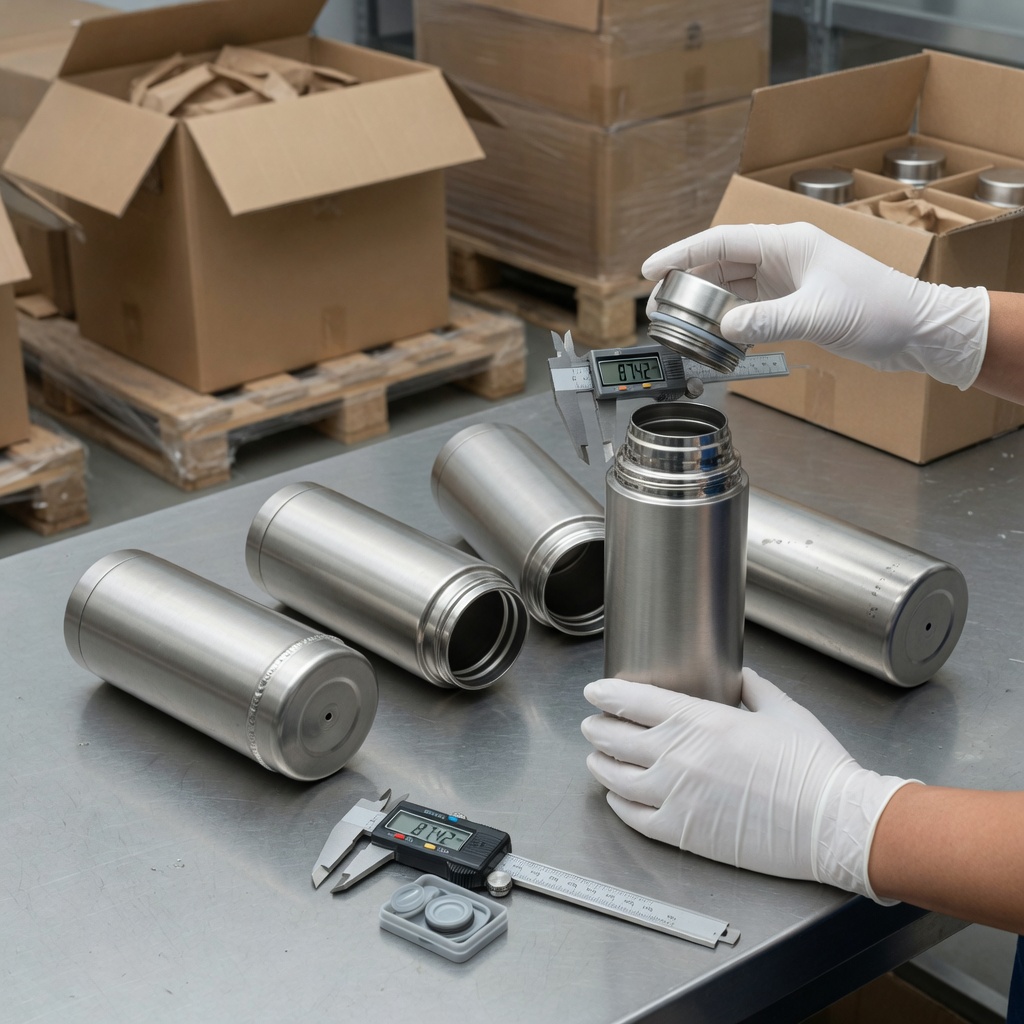
- A sample or first-article lot of the exact SKU for dimensional, capacity, lid-fit, and visual inspection against the buyer’s drawing or specification, with the inspection date recorded.
Do not treat a catalogue page or a verbal promise as qualification. Set a re-qualification interval (for example after a material or process change, or at a stated number of months) and name the owner of that review.
Decision table: continuity options for thermos flask procurement
Complete every cell with data from the live RFQ responses and internal usage records before an award is recommended. Do not copy the example figures from this article into the award file.
| Decision factor | Dual-source (split volume) | Strategic buffer stock | Hybrid (buffer + framework backup) | What the buyer must verify before award |
|---|---|---|---|---|
| Recovery time objective (days of cover) | Backup can ship independently of the primary disruption | On-hand quantity divided by verified daily usage | Buffer covers a short delay; backup covers a longer outage | Actual daily or weekly usage as of RFQ date; current on-hand and in-transit quantities |
| Incremental unit cost | Price delta on the smaller share plus extra tooling or artwork | Holding cost (capital plus warehouse) | Combination of both | Landed-cost quotations including freight, duty, and any emergency surcharge, dated with the RFQ |
| Minimum order quantity and flexibility | Backup MOQ may be higher than the primary | Replenishment MOQ from the primary | Framework must allow emergency call-off below normal MOQ | MOQ, price breaks, and call-off terms in writing |
| Quality and specification lock | Second source must pass the same incoming inspection | Stored lots must remain within spec until used | Both sources and stored lots | Incoming inspection plan, sample retention, and spec-revision control |
| Contractual trigger | Dual contracts or a dual purchase-order schedule | Reorder point and maximum stock level | Emergency clause, volume cap, and price formula | Legal review of force-majeure and emergency clauses |
| Malaysian logistics and documentation | Independent origin or port reduces correlated delay | Storage location and condition of the buffer | Both | Current lead time, Incoterms named by the buyer, and any import or labelling documents the vendor must supply as of the RFQ date |
| Testing and review frequency | Re-quote and sample on the buyer’s stated interval | Cycle count and obsolescence review | Scenario test of the call-off | Named owner and calendar date for the next test |
Practical RFQ checklist for flask sourcing business continuity planning
Attach the following as a mandatory schedule to the thermos flask RFQ. Each item is an action the buyer or the vendor must complete so the award can be specified, compared, verified, approved, and ordered. Record answers in a comparison sheet dated with the RFQ close date, with columns for vendor name, SKU, unit price, Incoterms, standard lead time, emergency lead time, MOQ, BCP document date, last BCP-test date, emergency-volume cap, sample-inspection date, and named continuity contact.
- Attach the buyer’s SKU list (capacity, material, lid, marking, annual volume, and current RTO in days) so every vendor quotes against the same scope.
- Require the vendor to state current production lead time, inland transit time, emergency or expedite lead time if offered, and any known mill or port constraints, each with the date of the statement.
- Request the vendor’s documented business continuity plan, including alternate raw-material sources, finished-goods inventory policy, and how deliveries would continue after a named disruption scenario.
- Ask whether the vendor already dual-sources critical components (inner vessel, outer shell, lids, seals) and whether those sub-suppliers can be disclosed under NDA.
- Obtain a written emergency-volume commitment: maximum extra quantity, notice period, and price treatment if the primary line is interrupted.
- Specify incoming inspection criteria (dimensions, fill capacity, vacuum or leak method, lid thread or torque, visual defects) and require written confirmation that the vendor can meet them.
- Request material certificates and food-contact declarations for the exact grade offered; the buyer decides which standard applies and must see current documents.
- For any backup vendor, require a first-article or sample lot of the exact SKU and record the inspection date and results before a framework is signed.
- Include a clause that the vendor will notify the buyer within a stated number of calendar days of any event that could affect the quoted lead time or capacity.
- State the Incoterms, payment terms, and any Malaysian import or labelling documents the vendor must supply with each shipment; do not assume those documents from this article.
- Require the vendor to name a single continuity contact and an alternate, with after-hours reachability.
- Ask for the date of the last internal BCP test or scenario exercise the vendor performed and a one-paragraph non-confidential summary of the outcome.
- Confirm transit and warehouse packaging that protects vacuum flasks; note any special handling the site must apply.
- Obtain a price-validity period long enough to cover the planned buffer build or the dual-source transition.
- Name the internal owners for RTO maintenance, incoming inspection, and the next call-off test; record all answers so the award recommendation can be audited.
Do not recommend award until items 3, 5, 8, and 12 have written, dated responses in the file.
Methodology, source context, and limitations for Malaysian buyers
Two source contexts inform this article. First, university laboratory continuity guidance emphasises identification of limited-vendor specialised supplies, nomination of an alternate backup vendor, and a direct conversation with suppliers about delivery-recovery plans. Second, procurement-glossary and lab-supply continuity guidance describes the toolkit of critical-supplier mapping, dual-sourcing, strategic buffer stock, flexible emergency clauses, and periodic scenario testing.
How the data were derived: the three publicly available sources cited in this article were read, and those principles were applied analogously to thermos flask SKUs used as operational supplies. No supplier audits, factory visits, laboratory tests, or primary interviews were performed for this article. All numerical illustrations (buffer days, volume splits, lead times, unit counts) are explicitly labelled example calculations or assumptions. They must be replaced with figures from the buyer’s own usage records and the dated supplier quotations.
Limitations and what to verify before order: this article is not a business continuity plan, a contract, or a certification claim. Lead times, prices, MOQs, material grades, and vendor BCP documents change; verify every figure as of the RFQ issue date. Any Malaysian import, labelling, or food-contact rules that may apply to thermos flasks must be confirmed with the buyer’s compliance team and the vendor’s current documents; they are not restated here because they were not in the source excerpts. Vacuum performance, storage condition, or any specific test method should be defined in the buyer’s specification. If a vendor claims a certification, require the current certificate; this article never implies that any party holds one. Re-test the chosen dual-source or buffer arrangement on the buyer’s stated interval or after any major specification or supplier change.
Discuss Your Requirements
Review our manufacturing capabilities, then share your specifications for a supplier-fit review.