Drinkware Sourcing Product Development Capability for Canada: RFQ Approval Framework
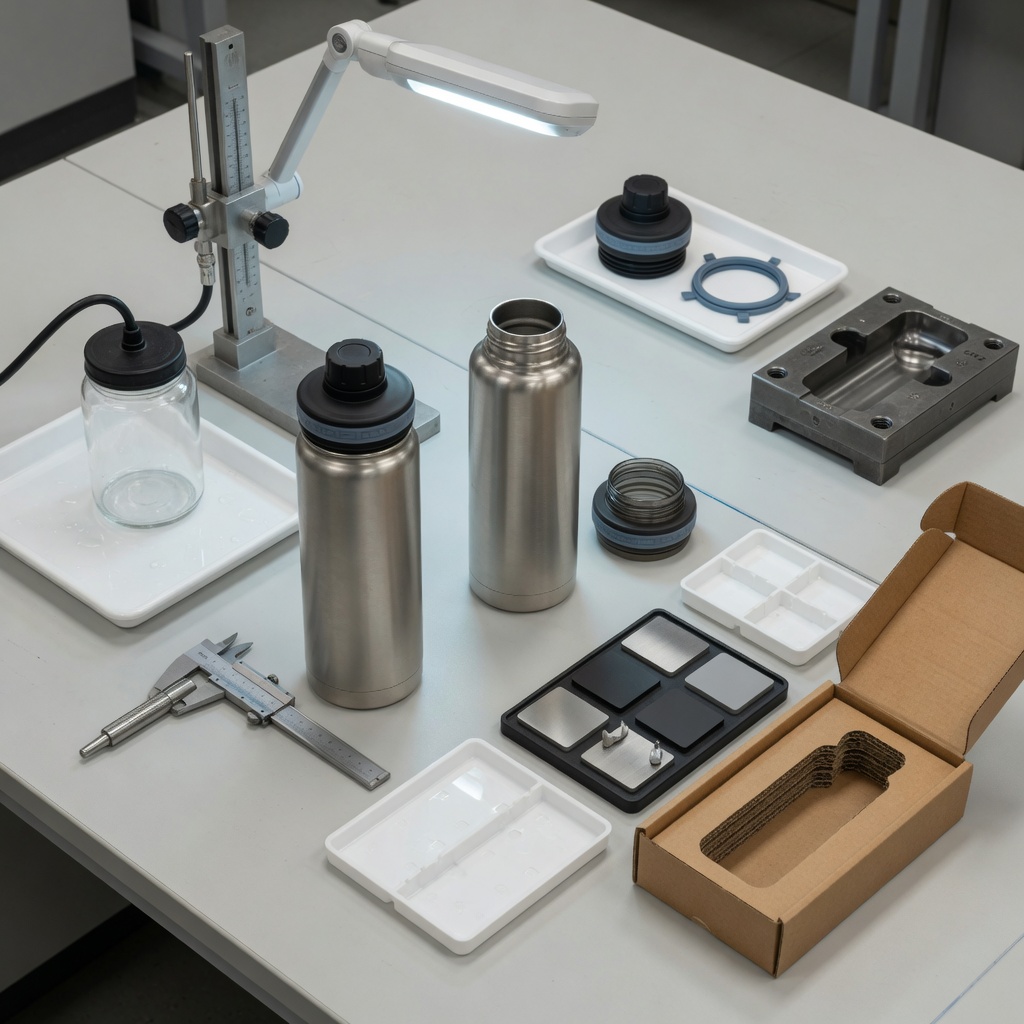
By Vincent Xi, Editorial Author
Decision answer: For Canadian business procurement teams issuing a Canada-bound request for quotation (RFQ), treat drinkware sourcing product development capability as approvable only when the bidder connects its proposed route to product-specific, revision-identified outputs. The decision file should establish:
- What is existing, modified, or new across the bottle body, lid, gasket, accessories, decoration, and packaging.
- What each prototype is intended to prove and where it differs from planned production.
- What tooling, drawings, files, charges, ownership terms, and change terms are included.
- How appearance, packaging, and product evidence will be approved.
- How approved development outputs will transfer into the quotation, inspection plan, and purchase order.
Under this buyer-side framework, a service label, equipment list, marketing claim, generic report, or unlinked sample does not by itself support approval.
The evidence base is intentionally narrow. Hydcup, Toptruebottle, and Golmate are commercial sources used to frame RFQ questions. They do not prove a bidder's capability for a quoted SKU or establish Canada-specific market suitability. Approval still depends on current quotation terms, controlled drawings, identified samples, product-linked evidence, and reviewed order documents.
Product development capability approval test for Canada-bound drinkware procurement
Apply the same test to every proposal for the Canadian program.
| Decision area | Approval evidence | Hold condition |
|---|---|---|
| Development route | The bidder declares its route and identifies each existing, modified, and new component. | OEM or ODM terminology appears without a component-level work scope. |
| Baseline product | The response identifies the current model, drawing revision, material specification, available options, and sample status. | The quotation references an existing model that cannot be identified or reviewed. |
| Feasibility | Exceptions, alternatives, manufacturing dependencies, buyer decisions, and unresolved points are recorded in writing. | Verbal assurance replaces a documented feasibility response. |
| Prototype control | Each sample has a defined class, purpose, method, material, schedule trigger, revision, acceptance criteria, and list of production differences. | The bidder does not explain what the sample represents or how it differs from planned production. |
| Tooling control | New and modified tools are itemized by component, with charges, ownership, storage, maintenance, modification, and release terms. | Tooling is presented only as an unexplained lump-sum charge or its associated rights are undefined. |
| Appearance and packaging | Color, decoration, assembly, artwork, and packaging references are physical or revision-identified and have defined approval methods. | Approval relies only on screen images, verbal descriptions, or an unapproved packaging concept. |
| Quality evidence | Records identify the issuer, date, sample, construction, method, result, and relationship to the quoted SKU. | Reports or marketing statements cannot be linked to the proposed materials and construction. |
| Production transfer | Approved samples, drawings, specifications, artwork, inspection criteria, and packaging references are frozen and cited by the order. | Development approvals and production documents contain conflicting or unidentified revisions. |
A buyer can place a proposal on hold when missing evidence can be resolved. Under a documented procurement policy, rejection is appropriate when a bidder refuses to define scope, ownership, material or process changes, subcontracted work, or the connection between submitted evidence and the quoted product.
Classify the development route by component change
Hydcup presents OEM as customization of an existing model through elements such as colors, logos, lids, and packaging. It presents ODM as involving new structures, molds, or exclusive designs. Use that commercial framing as question context, then classify the actual work by component rather than relying on the service label.
| Required change | Buyer-side route | Evidence to request |
|---|---|---|
| Retain the existing body and lid architecture while selecting available colors, decoration, lid options, or packaging | Existing-model route | Baseline model identifier, current drawing, option list, physical sample status, and confirmation of unchanged components |
| Retain the main platform but modify a component, interface, finish, or accessory | Modified-platform route | Component change map, interface dimensions, feasibility exceptions, prototype plan, and modified-tooling scope |
| Create a new body structure, lid mechanism, accessory interface, mold, or exclusive design | New-structure route | Design deliverables, feasibility record, new-component map, prototype stages, tooling register, and production-transfer plan |
The modified-platform route is a buyer-created control category, not a sourced industry definition. It prevents partial redesign work from being hidden inside an existing-model label.
Where exclusivity is requested, define the covered products, territory, duration, tooling rights, design-file rights, permitted production use, and release or transfer conditions in a reviewed agreement. Do not infer ownership or exclusivity from OEM or ODM terminology.
Practical drinkware RFQ checklist for product development capability in Canada
Copy this checklist into the RFQ. Require each bidder to mark every line Confirmed, Exception, Alternative, Buyer decision required, or Not applicable, then cite a quotation line, drawing revision, sample identifier, or evidence file. Treat blank responses as open items. This buyer-created checklist does not itself prove capability.
- [ ] Program and route: State Canada as the intended sales market and define the intended use; declare the existing-model, modified-platform, or new-structure route; map existing, modified, and new body, lid, gasket, accessory, decoration, and packaging elements.
- [ ] Baseline and specification: Provide the model identifier, drawing revision, material specification, sample status, capacity definition, dimensional datums and tolerances, finish, closure, accessory, and interface requirements.
- [ ] Feasibility response: Separate confirmations, assumptions, exceptions, alternatives, manufacturing dependencies, subcontracted work, unresolved points, and buyer decisions.
- [ ] Prototype plan: For each sample, state its class, purpose, method, material, schedule trigger, charge, revision, acceptance criteria, and all known differences from planned production.
- [ ] Tooling and files: Itemize molds, fixtures, and gauges by component; state charges, ownership proposal, file access, storage, maintenance, modification, replacement, and release terms.
- [ ] Appearance and packaging: Identify the physical color or finish reference, substrate, decoration process, artwork revision, viewing conditions, package structure, materials, insert, sample plan, fit check, and revision method.
- [ ] Product evidence: Identify the issuer, date, sample and construction, method, result, applicability to the quoted SKU, inspection plan, traceability, and written change-notification process.
- [ ] Commercial return: Separate the baseline product, design work, prototypes, tooling, decoration, packaging development, order configuration, schedule triggers, validity, assumptions, and exclusions.
- [ ] Production transfer: List the controlled drawings, specifications, artwork, approved references, evidence, inspection criteria, packaging revision, and purchase-order references to be frozen before release.
- [ ] Bidder sign-off: Identify the responsible commercial and technical contacts and confirm in writing that all deviations and open items are disclosed.
Close or explicitly accept each exception before comparing proposals. Do not release production until the quotation and purchase order cite the same approved product, evidence, and revisions.
Buyer-created assumptions for comparable drinkware quotations
The values below are illustrative assumptions for normalizing RFQ responses. They are not market data, typical specifications, minimum-order guidance, or supplier promises.
| RFQ field | Example assumption | Scope and measurement definition | Source, as-of context, and verification |
|---|---|---|---|
| Nominal capacity | 750 mL nominal capacity for the proposed stainless-steel bottle SKU | The bidder must state whether the value means usable-fill or brimful capacity and identify the proposed capacity method. | Source: buyer-created example assumption for quotation comparison, applicable only as of the RFQ issue date shown on the buyer's request. Verify in the supplier quotation, agreed capacity method, approved sample, controlled specification, and final purchase order. |
| Outside body diameter | 78 mm maximum outside body diameter for the proposed bottle SKU | Measure across the widest permanent finished-body feature using agreed datums; removable packaging is outside the measurement scope. | Source: buyer-created example assumption for quotation comparison, applicable only as of the RFQ issue date shown on the buyer's request. Verify in the supplier quotation, controlled dimensional drawing, approved sample, and final purchase specification. |
| Closed assembly height | 260 mm maximum closed height for the proposed bottle assembly with the selected lid fully seated | Measure from the flat base datum to the highest permanent point of the closed assembly. | Source: buyer-created example assumption for quotation comparison, applicable only as of the RFQ issue date shown on the buyer's request. Verify in the supplier quotation, controlled assembly drawing, approved sample, and final purchase specification. |
| Initial order quantity | 5,000 finished units for the initial production release of the proposed SKU | The quotation must identify configuration assumptions affecting the quantity, including color, decoration, lid, and packaging. | Source: buyer-created example assumption for quotation comparison, applicable only as of the RFQ issue date shown on the buyer's request. Verify in the supplier quotation and final purchase order. |
| Shipping-carton configuration | 24 finished units per shipping carton for the proposed finished packaging revision | The bidder must identify the product revision, insert, carton structure, and packing orientation covered by the configuration. | Source: buyer-created example assumption for quotation comparison, applicable only as of the RFQ issue date shown on the buyer's request. Verify in the supplier quotation, packaging specification, approved packaging sample, and final purchase order. |
Each bidder should accept an assumption for quotation purposes or return a specific exception. Replace every example with the approved project value before order release.
Evaluate product development capability by workstream
Design support and prototype definition
Toptruebottle identifies design support, prototype speed, imprint methods, Pantone matching, and new-product-development support as comparison factors. Convert those broad factors into defined RFQ deliverables by requesting:
- The function responsible for design and the files it will deliver.
- The buyer inputs required before schedule timing begins.
- Calendar-day duration between named start and completion events.
- Sample classification as an appearance reference, functional prototype, tooling trial, or pre-production reference.
- The sample method, material, intended purpose, and known limitations.
- Differences between the sample and planned production construction.
- Revision identifiers and a record of buyer and bidder changes.
- Measurable acceptance criteria for every in-scope attribute.
- Sample charges, revision allowances, and the commercial effect of requested changes.
Do not compare prototype speed until bidders are quoting samples with equivalent purposes, fidelity, material assumptions, and completion triggers.
| Attribute | Definition required before prototype approval |
|---|---|
| Capacity | Capacity type, fill condition, measurement method, instrument, result format, and acceptance boundary |
| Dimensions | Datums, measured features, finish state, instrument, tolerances, and result-recording method |
| Closure and leakage | Lid and gasket revisions, assembly condition, fill condition, orientation, duration, environment, and acceptance boundary |
| Color and decoration | Substrate, process, target physical reference, application area, viewing conditions, and acceptable variation boundary |
| Packaging fit | Product, insert, and carton revisions; packing orientation; closure condition; and unacceptable movement or damage criteria |
Structure, lids, tooling, and subcontracted work
Golmate states on its first-party page that its offered scope can include existing-model customization, new structures, custom molds, lid matching, color planning, logos, packaging, and quality management. This is a self-description, not verification for a particular RFQ.
Require a component map covering the bottle body, lid, gasket, accessories, and packaging. For each new or modified component, request:
- Design responsibility and required buyer inputs.
- Controlled drawings, specifications, and interface dimensions.
- Prototype method and approval route.
- Any mold, fixture, gauge, or other project-specific tool.
- The component or manufacturing need associated with each tooling charge.
- Tool ownership, storage, maintenance, modification, replacement, access, and release terms.
- Access terms for design files, production drawings, specifications, artwork, and packaging files.
- The identity and scope of subcontracted development or production work.
- Controls for subcontractor changes and retention of approved references.
A lump-sum tooling line is incomplete under this framework unless the quotation connects the charge to defined components, deliverables, rights, and change terms.
Color, decoration, and packaging
Toptruebottle includes imprint methods and Pantone matching among its comparison factors. Hydcup includes packaging within its description of existing-model customization, while Golmate lists color, logos, and packaging among its stated services. These statements support RFQ questions, not an assumed result.
For color and decoration, request:
- The target physical reference and substrate.
- The decoration process and application area.
- Artwork format and revision identifier.
- Required substrate preparation.
- The physical sample type and any limits on production equivalence.
- Viewing conditions and the acceptance boundary.
- Change-control requirements after appearance approval.
For packaging, request the structure, material, insert, closure, dieline, unprinted structural sample, finished sample, product-fit approval, and revision process. Product and packaging approvals should identify the exact revisions evaluated together.
Quality evidence and standards
Golmate describes its own quality-management scope as extending from materials through inspection. That statement does not establish that a quoted bottle, lid, gasket, coating, package, or production lot meets the buyer's requirements.
Request evidence showing:
- The document issuer and report date.
- The tested sample identifier and revision.
- The tested material, component, coating, or assembly.
- The test method and reported result.
- The relationship between the tested sample and quoted construction.
- Any substitution, difference, exclusion, or limitation.
- Proposed incoming, in-process, finished-product, and packaging inspection controls for the SKU.
- Traceability and written change-notification procedures.
- The containment, correction, and reapproval process for nonconforming samples or production.
If a bidder names a standard, request the applicable edition, product scope, requirement, and supporting document. Keep the standard's requirement separate from the bidder's internal inspection practice. An internal procedure does not by itself prove conformity, and a generic report does not prove that current production follows the tested construction. Do not treat certification as established without a current document linked to the claimed scope and reviewed for applicability.
Normalize quotation and ownership terms before comparing price
Require bidders to return the same commercial structure before comparing headline unit prices.
| Quotation line | Required response |
|---|---|
| Baseline product | Model identifier, included construction, unit-price basis, assumptions, and exclusions |
| Design work | Deliverables, file formats, revision terms, charges, and ownership proposal |
| Prototypes | Sample class, method, purpose, quantity basis, charges, timing triggers, and revision allowances |
| Tooling | Itemized component or tool, charge, ownership, storage, maintenance, modification, and release terms |
| Color and decoration | Process, application area, setup charge, sample requirement, and production-price basis |
| Packaging development | Structural work, dieline, samples, setup charges, and finished-pack price basis |
| Order configuration | Finished units by SKU, color, decoration, lid, and packaging configuration |
| Schedule | Trigger and duration for feasibility, prototypes, tooling, approvals, and production |
| Quote controls | Validity, assumptions, exclusions, buyer dependencies, and effect of approved changes |
| Production change control | Notification, buyer approval, document revision, evidence update, and subcontractor-change treatment |
Compare unit prices only after confirming that each bidder has quoted the same construction, development deliverables, tooling scope, appearance controls, packaging, evidence, and order configuration.
Transfer approved development into production
Use documented release points rather than treating product development as an undifferentiated approval.
- Brief acceptance: Confirm the route, Canadian program scope, product architecture, materials, dimensional definitions, appearance, packaging, evidence needs, and quotation assumptions.
- Feasibility approval: Resolve written exceptions, alternatives, manufacturing dependencies, and open buyer decisions before prototype authorization.
- Prototype approval: Compare the identified sample with the controlled drawing and defined criteria for capacity, dimensions, assembly, lid fit, leakage, appearance, decoration, and packaging fit.
- Tooling release: Approve component drawings, itemized tool scope, charges, ownership, storage, maintenance, and change procedures before expenditure is authorized.
- Pre-production approval: Freeze the approved reference sample, component specifications, appearance masters, artwork, inspection plan, evidence set, and packaging sample.
- Production-order release: Confirm that the quotation and purchase order cite the same approved revisions and require notification before any material, component, process, tool, packaging, or subcontractor change.
Record each release as approved, conditionally approved, or returned for revision. Silence, sample dispatch, payment, or tooling completion alone should not be treated as technical approval.
Methodology, source context, and limitations
Methodology and data derivation. Statements from the supplied pages were retained only when they could be attributed to a named source. Those statements were mapped into buyer-verifiable workstreams covering route selection, feasibility, prototypes, tooling, appearance, packaging, product evidence, quotation control, and production transfer. The approval tests, checklist, and RFQ fields are buyer-side procurement controls, not representations that a cited company satisfies them. Every numerical value is labeled as a buyer-created example assumption that must be confirmed or replaced in the supplier quotation and controlled order documents.
| Source context | How the source was used | Evidence boundary |
|---|---|---|
| Hydcup commercial article | Its stated distinction between existing-model customization and development involving new structures, molds, or exclusive designs | Not used to establish bidder capability, timing, ownership, exclusivity, or product suitability |
| Toptruebottle commercial comparison article | Its stated design-support, prototype, imprint, color-matching, and product-development comparison factors | Not used as proof that a particular bidder can meet the RFQ |
| Golmate first-party page | Its self-described customization, tooling, lid, color, packaging, and quality-management scope | Not treated as an independent audit, product-specific report, certification document, or capability approval |
Limitations and what to verify. The cited pages are commercial sources, not factory audits, product-specific test reports, current certification documents, contracts, or evidence of Canada-specific market suitability. Publication and access dates were not supplied. No source-supported basis was supplied here for project lead times, order quantities, prices, tooling life, ownership rights, exclusivity rights, or Canadian market requirements. Verify the final construction, dimensions, capacity method, materials, component interfaces, sample status, tooling terms, evidence applicability, packaging revision, commercial terms, and change controls in the supplier quotation, approved drawings, identified physical samples, reviewed agreement, and final purchase order. Confirm market applicability through the buyer's qualified review process for Canada.
Author note. The Vincent Xi author profile identifies Vincent Xi as Editorial Author. It does not document first-hand factory, product-testing, certification-review, client, or customer-outcome experience; no such claim is made here.
Procurement release rule: Authorize production only when the quotation, approved sample, drawings, tooling terms, product evidence, packaging specification, and purchase order describe the same controlled product and revisions.
Discuss Your Requirements
Review our manufacturing capabilities, then share your specifications for a supplier-fit review.