Drinkware OEM Production Scalability Planning for Europe
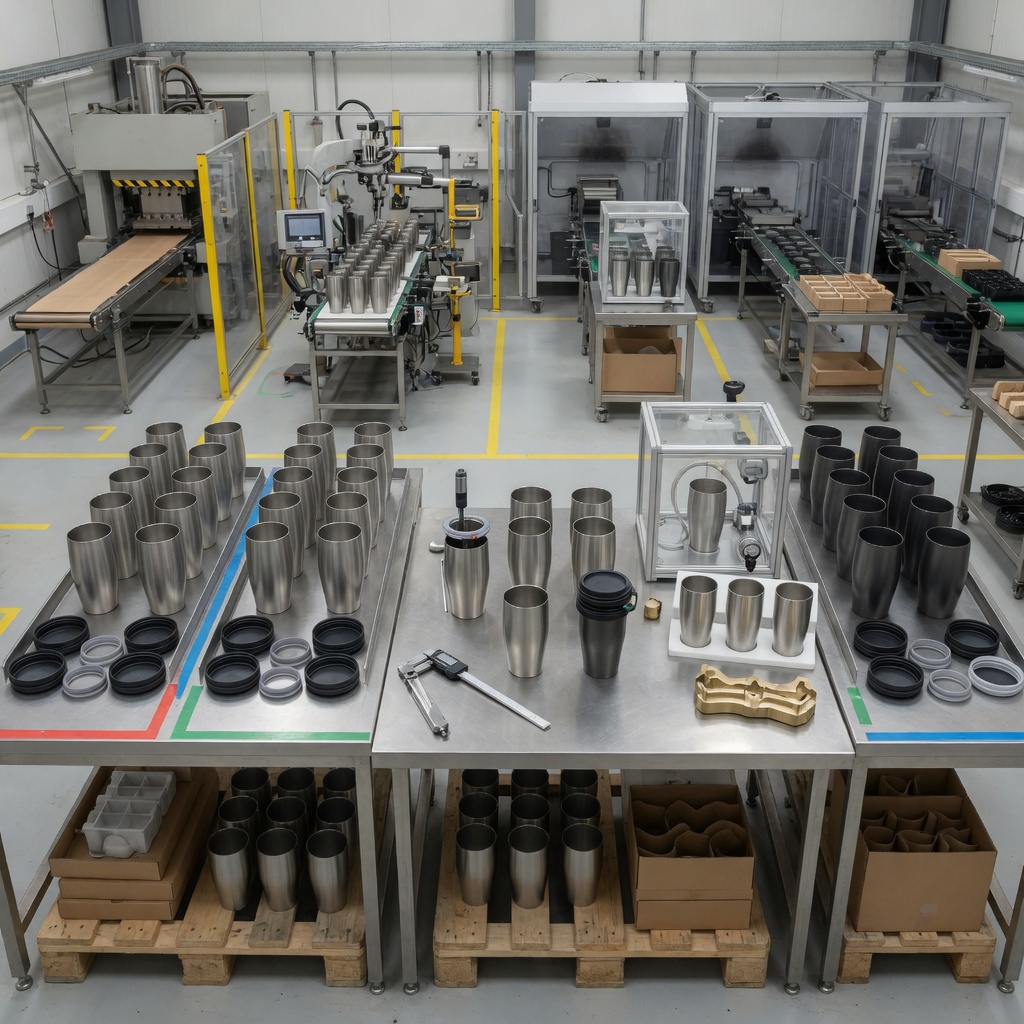
By Vincent Xi, Editorial Author
For procurement teams buying drinkware for Europe, production scalability planning is an RFQ evidence exercise. A large annual capacity claim does not establish that the supplier can make the required SKU, through the approved manufacturing route, during the required production window.
A decision-ready quotation should identify the manufacturing site, product revision, process constraint, demonstrated output, accepted load, planned downtime, changeovers, yield basis, tooling status, material coverage, quality-release gates, destination variants, and output reserved for the buyer. Each capacity figure needs a defined unit, product scope, production period, evidence date, and calculation basis.
European allocation also needs destination control. EU destinations, non-EU EEA destinations, UK routes, and country-specific variants should remain separate wherever the buyer's approved requirements create different production, inspection, pack-out, traceability, document, or release work. This is a manufacturing-planning distinction, not a claim that one legal framework applies across Europe.
Production scalability planning for drinkware RFQs in Europe
Use a common evidence schedule for every bidder. The following gates are buyer-defined controls, not claims about the performance of any supplier cited in this article.
| Decision gate | Evidence required from the bidder | Award treatment |
|---|---|---|
| Demand baseline | Version-controlled forecast by SKU, construction, finish, decoration, pack-out, destination, and production window | Hold if demand, yield, destination, or period definitions are missing |
| Constraint capacity | Process map, limiting-process output, operating calendar, accepted load, downtime, changeovers, and dated production evidence | Count only output demonstrated on the quoted route or a disclosed comparable route |
| Capacity allocation | Signed reservation naming the site, route, SKU scope, production window, commercial conditions, and expiry | Treat unreserved availability as context rather than committed output |
| Tooling and materials | Tool register, approval status, maintenance plan, material lead times, confirmed coverage, and substitution controls | Keep output conditional while an essential dependency is unapproved or undated |
| Ramp quality | Approved specification, pilot records, control plan, yield definitions, defect records, and open corrective actions | Reject capacity calculations based on a different revision, route, method, or release limit |
| European release | Buyer-approved destination matrix with variant, pack-out, traceability, document, and release responsibilities | Allocate capacity by approved release lane rather than accepting a generic European claim |
| Recovery capacity | Activation trigger, additional output, lead time, material dependency, technical approval, and price | Exclude surge or alternate-route output until it is approved and shown not to overlap baseline capacity |
Two supplied industry sources support the questions behind these gates. Yeway's supplier-authored OEM and ODM overview discusses custom tooling, dedicated production planning, and MOQ tradeoffs in an OEM context. It supports requesting tooling and planning evidence, but it does not verify a bidder's tooling status, MOQ, lead time, yield, or available capacity.
Waterbottle.tech's supplier-authored outsourcing article recommends asking whether production can move from an initial order to larger volumes while controlling quality and lead time. It also raises order quantity, peak periods, and unexpected surges as buyer questions. Those points can be converted into quotation fields; they are not proof that a particular bidder can scale.
Normalize demand and constraint capacity by SKU
Capacity comparisons fail when suppliers use different products, process stages, units, or periods. Define the terms in the RFQ and require every calculation to follow the same SKU scope and manufacturing window:
- Installed output: theoretical gross output under disclosed equipment, calendar, product-mix, utilization, and maintenance assumptions.
- Demonstrated output: dated production output for the quoted construction or a technically comparable route, with differences disclosed.
- Available output: demonstrated scheduled output remaining after accepted load, planned downtime, and changeovers in the requested window.
- Committed output: output contractually reserved for the quoted SKU scope and production window.
- Constraint output: output at the process that limits the quoted forming, finishing, decoration, assembly, inspection, or pack-out route.
A compact screening model is:
Required gross starts = saleable requirement / quoted planning saleable yield, rounded upward to a whole unit
Net unallocated constraint output = demonstrated scheduled constraint output - accepted load - planned downtime loss - changeover loss
Committed coverage = committed constraint output / required constraint output
Planning saleable yield should be defined separately from first-pass yield. The quotation should state whether recovered rework is credited, where rework re-enters the route, how much constraint time it consumes, and whether inspection rejects and scrap are included.
Illustrative RFQ calculation
The values below are buyer-created example assumptions for a hypothetical double-wall vacuum tumbler SKU. They are not supplier performance data and must be confirmed or replaced in a dated quotation.
| Data point | Unit, scope, and date context | Source status |
|---|---|---|
| 40,000 saleable drinkware units | Required saleable quantity for the hypothetical SKU during the January 2026 production window | Example buyer assumption to verify in the supplier quotation |
| 95.0 percent of gross starts | Assumed planning saleable yield for the same hypothetical SKU and January 2026 production window, with no recovered rework credited | Example buyer assumption to verify in the supplier quotation |
| 42,106 gross drinkware units | Calculated gross-start requirement for the same hypothetical SKU and January 2026 production window, rounded upward to a whole unit | Example calculation derived from the stated demand and yield assumptions; verify in the supplier quotation |
If a bidder proposes a different yield or rework treatment, it should recalculate gross starts and constraint consumption without changing the buyer's saleable demand.
Require the supporting capacity file to state:
- Quotation issue date, evidence date, and validity period.
- Manufacturing site and applicable line, cell, tool, or subcontracted process.
- SKU revision, construction, finish, decoration, and pack-out covered by each figure.
- Operating calendar, shift basis, utilization assumption, downtime, and changeovers.
- Accepted production load during the requested window.
- Gross starts, first-pass yield, final saleable yield, rework, scrap, and saleable output definitions.
- Constraint output, net unallocated output, and committed output in consistent units and periods.
- Forecast-change threshold requiring capacity and lead-time reconfirmation.
Test annual capacity against the requested production window
A corporate announcement republished by The Globe and Mail reported an Everich target of 27.6 million drinkware units per year across its announced China, Thailand, and Cambodia manufacturing scope by 2025. The unit is drinkware units per year, the scope is the announced manufacturing network, the date context is the target by 2025, and the source is the linked republished corporate announcement.
That reported target does not establish audited current output, compatibility with the buyer's SKU, available allocation, or committed capacity for a European production window. China, Thailand, and Cambodia are manufacturing-origin references in the announcement, not sales markets addressed by this article.
Do not prorate an annual headline into a monthly or seasonal requirement without bidder evidence. Request a dated load-versus-capacity file for the actual production window, constraint output for the quoted construction and finish, accepted load, planned downtime, changeovers, and comparable production records. Confidential customer details can be removed, but the product comparison basis and operating period must remain clear.
A signed allocation statement should define the reserved output, covered SKUs, site and route, reservation period, commercial conditions, and events that reduce or cancel the reservation. Output dependent on future investment, new tooling, material confirmation, overtime, outsourcing, or alternate-site approval should remain conditional in the award model.
Tie tooling, materials, and ramp evidence to output
The tooling register should identify the part produced, tool owner, physical location, approved revision, cavity or station configuration, approval status, maintenance basis, spare strategy, modification authority, and transfer conditions. The supplier should disclose whether its capacity assumes existing tooling, duplicate tooling, shared tooling, overtime, or transfer to another route.
Request a stage schedule covering only the work applicable to the quoted SKU. This may include specification release, tooling manufacture or modification, tool acceptance, pre-production samples, material procurement, controlled pilot production, quality review, ramp authorization, production, inspection, destination pack-out, document release, and shipment readiness. Each applicable stage needs an owner, dependency, evidence requirement, and missed-approval rule.
Material coverage should be tied to the approved body material, lid, seal, coating, decoration input, and packaging components. The response should identify approved sources, procurement lead times, confirmed quantity coverage, substitution controls, and the production period supported by that coverage. An unchecked supplier promise of material availability should not be added to committed output.
For an illustrative double-wall stainless-steel vacuum tumbler with a molded polymer lid and silicone seal, buyer-controlled characteristics may include body height, rim diameter, lid-interface geometry, seal fit, surface finish, decoration placement, leak performance, thermal-test conditions, assembly, contamination controls, and final pack-out. This is a hypothetical RFQ scope, not a BottleForge product claim or evidence of a bidder's current production.
Actual material grades, dimensions, tolerances, temperatures, durations, sample sizes, and acceptance limits must come from the buyer-approved drawing, specification, test plan, and destination matrix. Pilot and ramp records should use consistent definitions for output, yield, rework, scrap, defects, downtime, traceability, deviations, corrective actions, and release status.
If a bidder references a standard, record its exact title, edition, applicable clauses, and intended use. Keep the standard's published requirements separate from the supplier's own inspection, sampling, and release practices. Do not infer product conformity, management-system certification, or laboratory competence from a logo or general statement. Verify any relied-on document for issuer, holder, site, scope, and current validity.
Allocate production by European release lane
The buyer's qualified legal or regulatory owner should approve the destination matrix before the supplier commits variant capacity. The supplied sources do not establish which legal requirements apply to a particular drinkware SKU, destination, business model, or placing-on-the-market route.
| Release lane | Buyer-controlled RFQ scope | Supplier scalability response |
|---|---|---|
| EU destinations | Name each destination country, SKU variant, pack-out, approved requirement set, evidence set, and release owner | Schedule production, inspection, packing, document preparation, and release work by approved variant |
| Non-EU EEA destinations | Identify these destinations separately where the buyer-approved route differs from the EU scope | Confirm route-specific variant readiness, records, traceability, responsible parties, and release dependencies |
| UK destinations | State the destination and approved placing-on-the-market route; distinguish Great Britain and Northern Ireland where the buyer's review requires it | Provide route-specific production, pack-out, traceability, document, and release schedules |
| Country-specific variants | Define applicable language, packaging, importer or responsible-business details, documents, and customer release criteria | Reserve changeover time and output for each approved variant, with evidence due dates and owners |
These lanes are capacity-allocation controls, not a legal determination or a claim that common requirements apply throughout Europe. A destination change should trigger review of the affected materials, pack-out, documentation, allocation, and lead time before the supplier accepts the revised scope.
Practical RFQ checklist for production scalability planning
Before comparing bids, give every supplier the same checklist and require each item to be marked confirmed, conditional, or not offered. Each confirmed or conditional response should identify the supporting quotation field or attachment, responsible owner, evidence date, validity period, and unresolved dependency.
- [ ] Freeze the demand baseline by SKU, approved revision, construction, finish, decoration, pack-out, destination variant, and requested production window.
- [ ] State saleable demand, planning yield, gross starts, rework treatment, scrap treatment, and constraint consumption using consistent units and periods.
- [ ] Identify the manufacturing site, quoted route, limiting process, applicable line or cell, tooling, and any subcontracted stage.
- [ ] Separate installed, demonstrated, available, constraint, and committed output instead of presenting one undifferentiated capacity figure.
- [ ] Attach dated comparable-production evidence and disclose every difference between the evidence SKU and the quoted SKU.
- [ ] Reconcile demonstrated output against accepted load, planned downtime, maintenance, changeovers, and other disclosed production losses in the requested window.
- [ ] Obtain a signed allocation statement naming the reserved output, SKU scope, site, route, production window, commercial conditions, validity period, and cancellation events.
- [ ] Confirm tooling ownership, location, revision, approval status, maintenance basis, spare strategy, transfer conditions, and any duplicate-tool dependency.
- [ ] Confirm material and packaging coverage by approved specification, source, procurement lead time, covered quantity, supported production period, and substitution control.
- [ ] Define pilot, ramp, inspection, release, deviation, corrective-action, and change-control gates with evidence requirements and approval owners.
- [ ] Split EU, non-EU EEA, UK, and country-specific variants according to the buyer-approved destination matrix, including any separate pack-out, traceability, document, and release work.
- [ ] Identify surge, overtime, outsourcing, alternate-site, or alternate-route assumptions and show that proposed recovery output does not overlap committed baseline output.
- [ ] Record every cited standard by exact title, edition, applicable clause, and intended use, while keeping its requirements separate from the supplier's own control practices.
- [ ] Price the same demand scenarios across bidders, including MOQ drivers, tooling, duplicate capacity, reservation fees, surge costs, and cancellation exposure.
- [ ] Set quotation expiry, allocation expiry, forecast-change thresholds, missed-approval consequences, and events requiring capacity or lead-time reconfirmation.
A procurement reviewer should treat an unchecked item, missing evidence reference, expired record, or unresolved dependency as an open award condition. Narrative assurances should not be converted into committed output unless the quotation and allocation terms define the applicable SKU, route, period, and quantity.
The final comparison schedule should make each bidder's capacity basis and dependencies commercially visible.
| RFQ area | Mandatory response | Evidence or contractual control |
|---|---|---|
| Product scope | SKU, drawing revision, construction, material specification, nominal capacity, lid and seal design, finish, decoration, and pack-out | Signed revision acknowledgement and exception list |
| Demand profile | Launch, peak, and replenishment demand by production window and destination variant | Forecast version, issue date, freeze point, and change threshold |
| Capacity basis | Installed, demonstrated, available, constraint, and committed output reported separately | Dated calculations, assumptions, and supporting records |
| Allocation | Output reserved for the buyer's SKU scope and production window | Reservation, expiry, reduction, cancellation, and pricing terms |
| Tooling and materials | Approval status, ownership, location, maintenance, lead times, confirmed coverage, and substitution controls | Dated registers and confirmations tied to the demand window |
| Ramp control | Pilot evidence, control plan, defects, rework, downtime, deviations, and corrective actions | Defined release criteria and approval authority |
| Recovery route | Activation trigger, added saleable output, lead time, dependencies, route, and cost | Scenario-specific commitment with no overlap against baseline output |
| European release | EU, non-EU EEA, UK, and country variants from the approved destination matrix | Variant schedule, traceability plan, document register, and release owner |
| Change control | Changes requiring approval and resulting sample, test, document, pilot, or capacity review | Contractual notice and written approval process |
| Commercial scale | MOQ driver, price tiers, tooling cost, duplicate-capacity cost, reservation fee, surge cost, and cancellation exposure | Comparable scenarios based on the same demand and capacity assumptions |
The award record should identify accepted assumptions, unresolved dependencies, concessions, evidence dates, and reservation-expiry conditions. Capacity dependent on unapproved tooling, unconfirmed materials, destination review, or alternate-route qualification should remain conditional.
Evidence method and limitations
The editorial method classified each supplied page by source type, extracted only the claims relevant to scalability planning, and separated source-reported facts from buyer-created RFQ controls.
| Source context | Supported use | Boundary |
|---|---|---|
| Vincent Xi author profile | Author name, Editorial Author role, and profile URL | Does not support claims of factory work, testing, client outcomes, certifications, or operational experience |
| Yeway OEM and ODM overview | Supplier-authored context for questions about custom tooling, production planning, and MOQ tradeoffs | Does not verify a bidder's current tooling readiness, MOQ, lead time, yield, or capacity |
| Waterbottle.tech outsourcing article | Supplier-authored context for questions about scaling, order quantity, peak periods, quality, and lead time | Does not establish performance or scalability for a specific bidder |
| The Globe and Mail republished announcement | The reported capacity target, manufacturing scope, and target date stated above | Does not establish audited current output, SKU compatibility, available allocation, or reserved European production capacity |
The illustrative gross-start result was derived by dividing the stated example saleable demand by the stated example planning yield and rounding upward to a whole unit. It is an example RFQ calculation, not source-reported factory data. The capacity definitions, decision gates, release-lane controls, checklist, and quotation schedule are editorial procurement recommendations.
The supplied sources do not establish any bidder's current load, yield, tooling condition, material coverage, lead time, audit status, certification, alternate-route equivalence, or performance under the buyer's forecast. They also do not determine legal applicability for an EU, non-EU EEA, UK, or country-specific release route. Before award, verify those matters through dated quotations, load-versus-capacity records, approved specifications and samples, pilot and ramp evidence, current scope-relevant documents, contractual allocation, and qualified destination-specific review.
Discuss Your Requirements
Review our manufacturing capabilities, then share your specifications for a supplier-fit review.